The Championships at Wimbledon have always thrived on narrative disruption, but rarely does the tournament begin with quite this much structural uncertainty. Jannik Sinner, the world number one and reigning Australian Open champion, has withdrawn from the grass-court major, leaving a bracket that now tilts heavily toward Carlos Alcaraz—and leaving everyone else scrambling to recalibrate expectations.
Sinner's absence removes the most consistent baseline player in men's tennis from a surface that has historically rewarded variety over grinding. His departure also eliminates what would have been the marquee potential semifinal, a rematch of last year's Wimbledon final that Alcaraz won in four sets. Instead, the Spaniard enters as something close to a prohibitive favorite, a status that tends to make tennis observers nervous.
The Alcaraz question
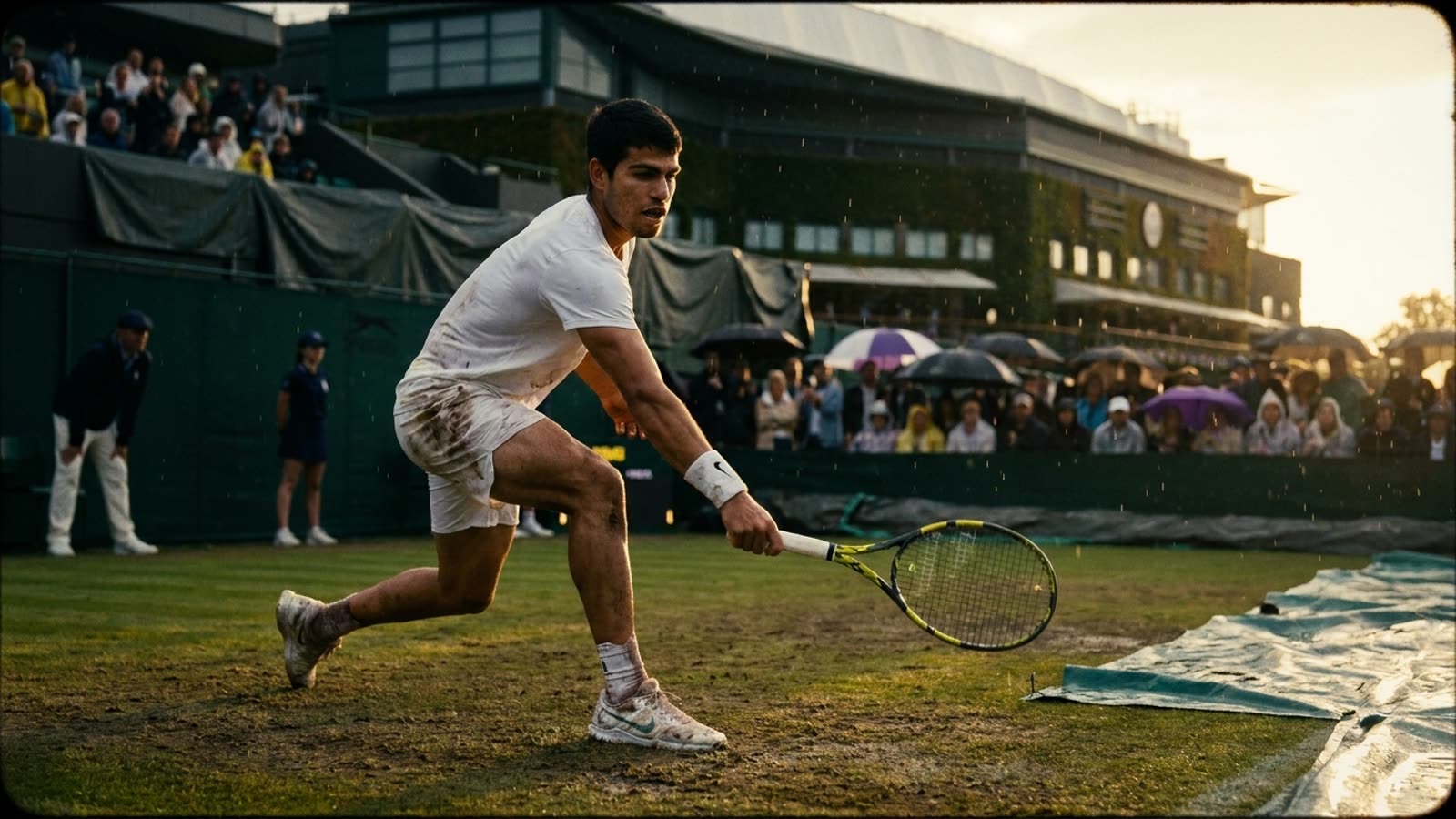
At 23, Alcaraz has won five major titles and established himself as the most complete player of his generation. His grass-court game—serve-and-volley instincts grafted onto modern baseline power—seems purpose-built for the All England Club. He has won the last two Wimbledon titles and enters having just claimed Queen's Club for the second time. The question is not whether he can win; it is whether anyone can generate enough pressure to test him.
The answer may depend on which version of Novak Djokovic shows up. At 39, Djokovic remains capable of transcendent tennis, but his body has become increasingly unreliable. A knee injury forced him out of last year's French Open, and his results since have been inconsistent. He could reach another final; he could also lose in the fourth round to a big server having the week of his life. The variance is the point.
The dark-horse tier
Behind the top names, the field offers intriguing possibilities without obvious breakthrough candidates. Alexander Zverev, still chasing his first major title, has improved his grass-court movement but remains prone to service-game wobbles at inopportune moments. Daniil Medvedev, whose game is almost comically unsuited to grass, has nonetheless reached Wimbledon semifinals before through sheer competitive stubbornness.
The more interesting names may be further down the draw. Jack Draper, the British number one, has the serve and the forehand to trouble anyone but has yet to prove he can sustain that level across seven matches. Holger Rune, the Danish talent who has flattered to deceive at majors, could finally convert potential into results. Neither would shock; neither inspires confidence.
Our take
Sinner's withdrawal is a genuine loss for the tournament—not because he was certain to win, but because his presence would have created stakes throughout the draw. Without him, Wimbledon 2026 risks becoming a coronation rather than a competition. Alcaraz is that good, and the field behind him is that thin. The Championships will still produce drama—grass courts guarantee chaos—but the drama may come from who finishes second rather than who lifts the trophy.