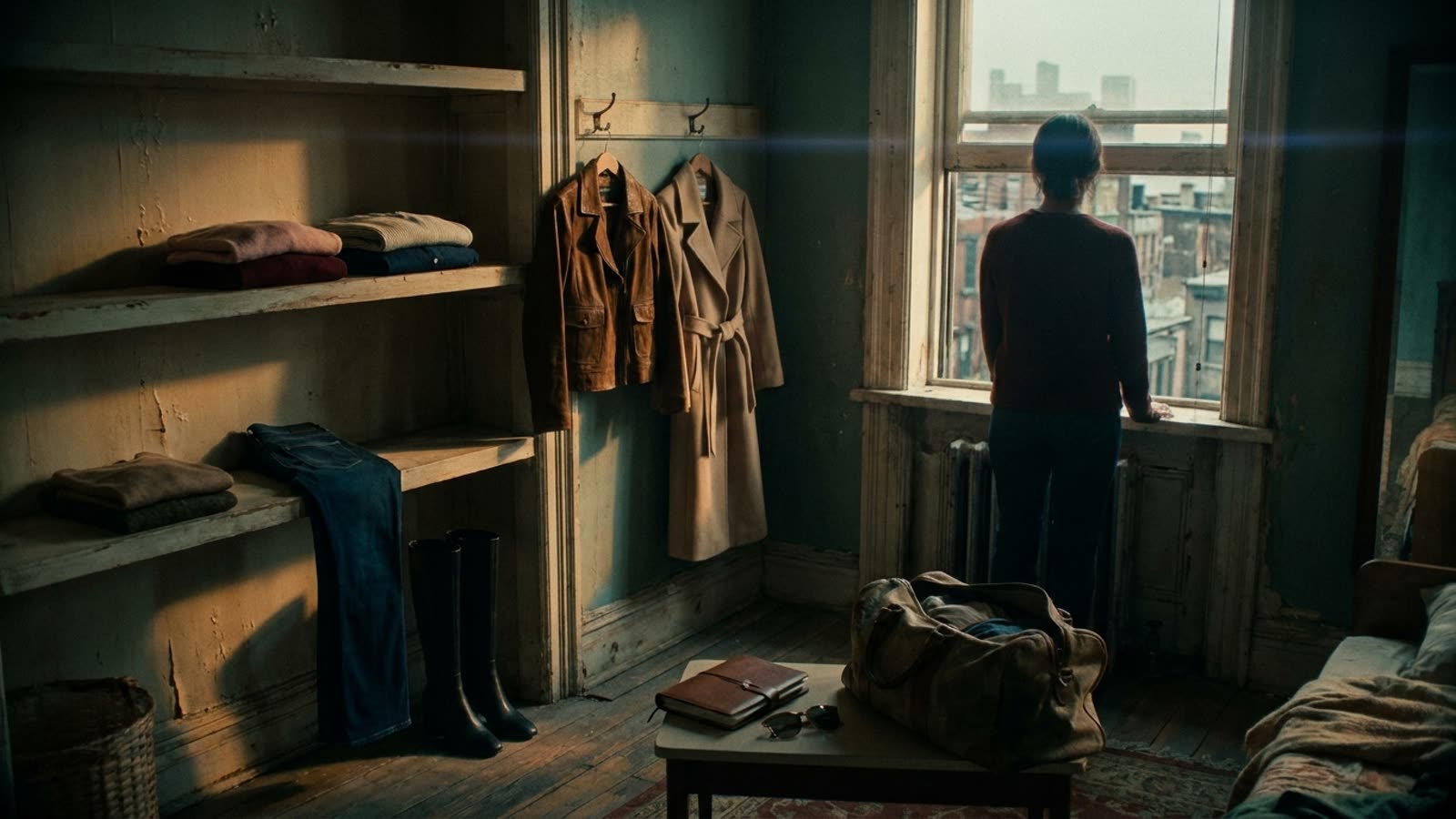
The idea is almost comically simple: own fewer clothes, but make them count. A neutral palette, interchangeable pieces, nothing that screams for attention. The capsule wardrobe has been declared dead and revived so many times that its persistence has become the more interesting story than its origins. It endures not because it solves the problem of what to wear, but because it promises to solve the problem of who to be.
The term traces to Susie Faux, who opened a London boutique called Wardrobe in 1973 and counseled clients to build small collections of essential pieces. Donna Karan amplified the concept in 1985 with her "Seven Easy Pieces" collection, which dressed the emerging class of professional women who needed to look authoritative without thinking too hard about it. But the capsule wardrobe's true cultural moment arrived decades later, when minimalism became the aesthetic of the anxious.
The appeal of constraint
The modern capsule wardrobe movement, which gained momentum in the early 2010s, coincided with the rise of decision fatigue as a mainstream concern. Executives bragged about wearing the same outfit daily. Marie Kondo became a household name. The logic was seductive: reduce choices, reduce stress, reduce the psychic weight of stuff. A wardrobe of thirty-three items—a number popularized by the Project 333 challenge—promised not just a tidier closet but a tidier mind.
What the evangelists rarely acknowledged was that the capsule wardrobe is expensive to do well. Cheap basics pill and fade; quality neutrals cost real money. The aesthetic also demands a certain body, a certain climate, a certain life free of dress codes that require sequins or steel-toed boots. It is, at heart, a fantasy of the professional class: the belief that one can opt out of fashion's churn while still looking put-together.
Sustainability, or the appearance of it
The capsule wardrobe found a second wind in the sustainability discourse. Buying less, the argument goes, means producing less, which means less waste. This is true as far as it goes, but it often obscures more than it reveals. A capsule wardrobe assembled from fast fashion is not inherently more sustainable than a larger collection bought secondhand. And the minimalist aesthetic itself has become a product category, complete with storage solutions, organizational apps, and influencer partnerships.
The more honest case for the capsule wardrobe is psychological rather than environmental. It offers a framework for resisting the relentless novelty of the fashion cycle, a permission structure for saying no. In an era when algorithms serve endless images of things to want, the capsule wardrobe is a small act of defiance—or at least a coping mechanism.
Our take
The capsule wardrobe persists because it addresses a real anxiety: the exhausting infinity of consumer choice. It will never fully work, because clothing is not merely functional and humans are not algorithms optimizing for efficiency. But as a North Star—a reminder that more is not always better and that personal style need not require constant reinvention—it remains quietly useful. The trend that refuses to die is less a trend than a truce.