Football's governing bodies have spent decades refining the Laws of the Game to eliminate randomness. VAR reviews millimeter offsides. Goal-line technology settles debates that once lasted generations. Pitch dimensions are standardized to the centimeter. And yet, when the most consequential matches reach their climax, we hand the outcome to a format that might as well involve coin flips and blindfolds.
The penalty shootout, introduced to major tournaments in the 1970s after a series of exhausting replays threatened to break players and schedules alike, was always a compromise. It solved the logistical problem of needing a winner while creating an epistemological one: how can eleven players' collective effort over two hours be fairly adjudicated by five isolated moments of individual nerve?
The answer, of course, is that it cannot. And that is the point.
The mathematics of manufactured drama
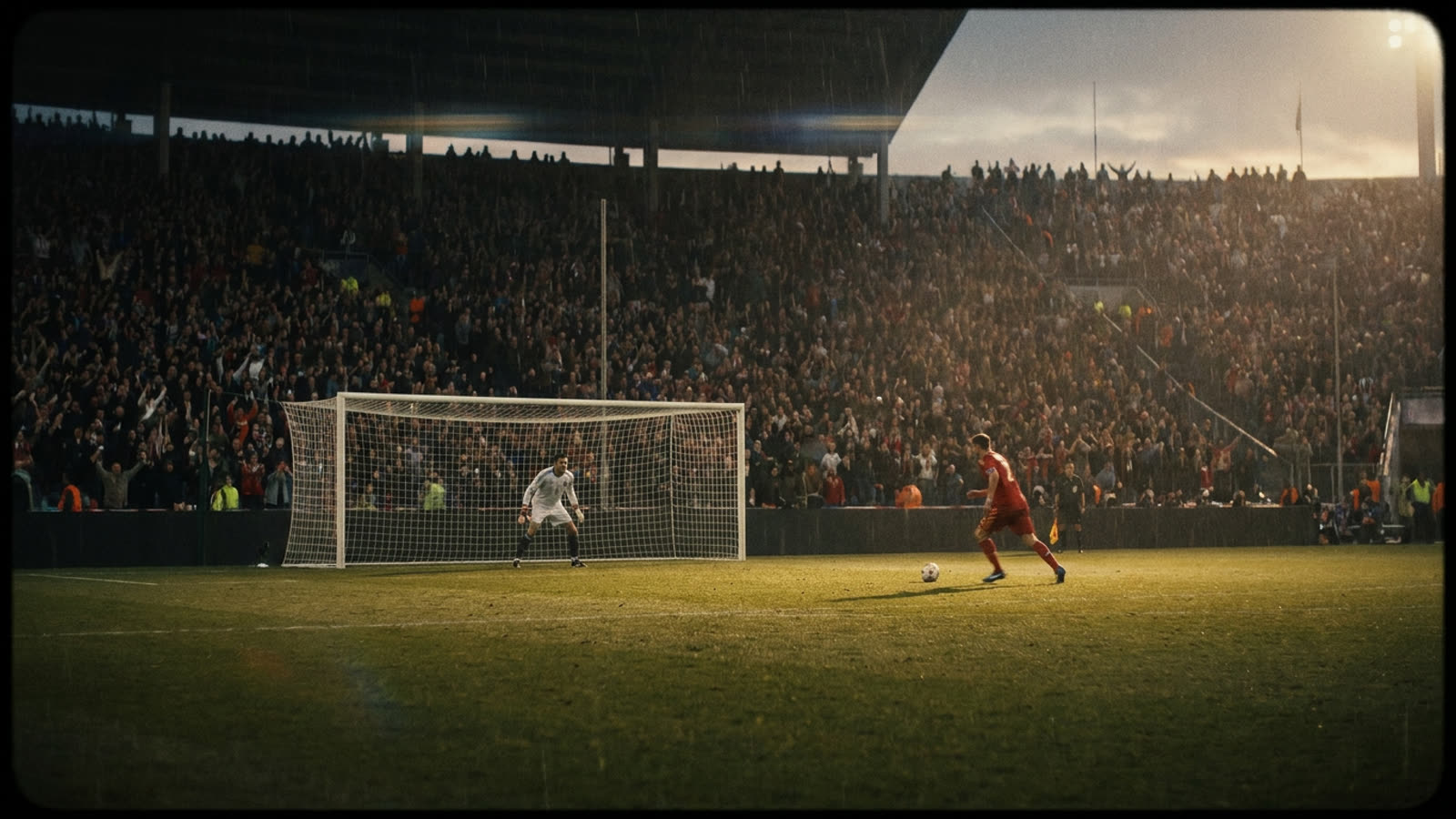
Researchers have repeatedly demonstrated what any observer intuits: penalty shootouts are substantially random. Conversion rates hover around 75 percent for the average taker, meaning even excellent sides will see roughly one in four efforts saved or missed. The team shooting first wins approximately 60 percent of the time, an advantage significant enough that it should probably prompt rule changes but never has. Goalkeepers guess direction before the ball is struck, transforming their role from athletic to probabilistic.
None of this is secret knowledge. Coaches employ psychologists, data analysts, and video specialists to optimize their shootout preparations. Some nations have invested millions in penalty research. The margins have barely moved. The format resists optimization because its core mechanic—a human being under extraordinary pressure attempting to place a ball past another human being who is guessing—contains irreducible chaos.
Why we watch anyway
The shootout's persistence reveals something important about sport's actual function. We claim to want the best team to win, but what we truly crave is narrative resolution under conditions of maximum emotional intensity. The shootout delivers this with brutal efficiency. It isolates individuals from collective responsibility, creating heroes and villains in seconds. It generates the specific cruelty of watching someone fail publicly at something they have practiced thousands of times.
Great shootout moments—Roberto Baggio's sky-bound miss, the Gerrard-Lampard-Terry-Hargreaves sequence against Portugal, Asamoah Gyan's crossbar—become cultural shorthand precisely because they feel unfair. The format manufactures tragedy with industrial reliability, and tragedy, not justice, is what makes sporting events persist in memory.
The alternatives nobody wants
Proposals to replace or reform the shootout surface periodically. Golden goal was tried and abandoned after producing defensive paralysis. ABBA sequencing (to address first-kick advantage) was tested and rejected as too confusing. Some have suggested expanding the goal or reducing the goalkeeper's allowed movement. None have gained traction, because the shootout's flaws are also its features.
A perfectly fair tiebreaker would be boring. It would distribute outcomes according to underlying team quality, which is what the preceding match already attempted and failed to do. The shootout succeeds because it introduces a different kind of test entirely—one that measures something other than footballing ability, something closer to character under duress, or perhaps just luck dressed in psychological clothing.
Our take
The penalty shootout is sport's most honest lie. It pretends to identify the better team while actually identifying who held their nerve in an artificial crisis. That this format has survived half a century of criticism suggests we understand, at some level, that sport is not really about fairness. It is about the production of meaning through structured uncertainty. The shootout, for all its absurdity, does this better than any alternative yet devised. Long may it remain gloriously unjust.