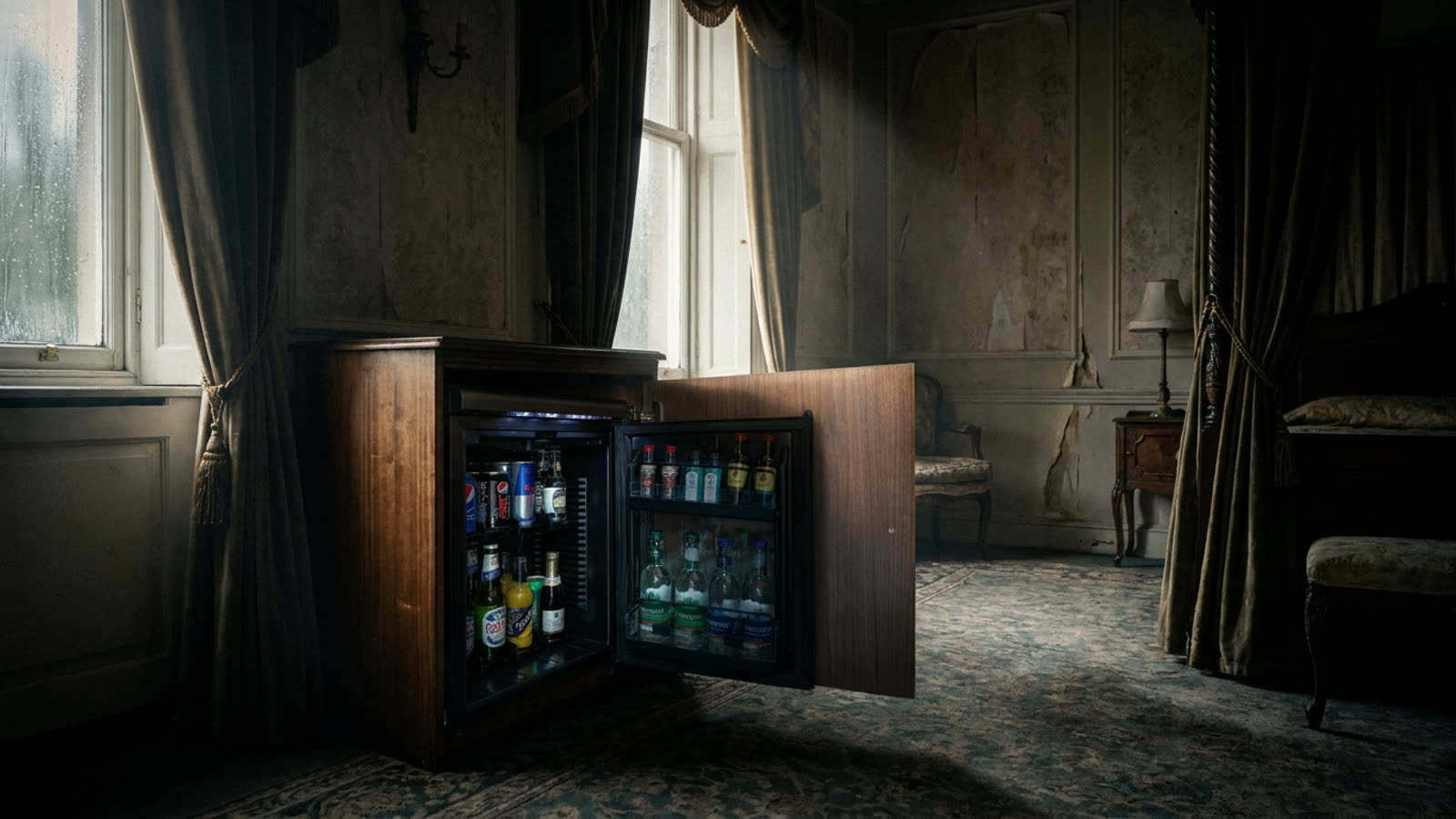
The hotel minibar is, by any rational measure, a failure. Guests rarely open it. When they do, they recoil at prices that seem designed to provoke rather than tempt. The logistics are punishing: staff must inventory tiny bottles, restock erratically depleted shelves, and adjudicate disputes over whether that Toblerone was actually consumed or merely moved. Revenue per available room from minibars has declined steadily for decades. And yet the minibar endures, a small refrigerated altar to an idea of travel that no longer exists.
Understanding why requires understanding what the minibar was built to do—and what it accidentally became.
The golden age of captive guests
The minibar emerged in the late 1970s, when Hong Kong's Peninsula Hotel is widely credited with pioneering the concept. The economics made sense in an era before ubiquitous room service, 24-hour convenience stores, and delivery apps. A business traveler arriving late, exhausted, and hungry had limited options. The minibar offered immediate gratification at a premium that felt justified by circumstance.
For two decades, it worked. Hotels reported minibar margins that would make a pharmaceutical company envious. The captive guest, marooned in a room with only a telephone and a television, would pay handsomely for a can of Pringles.
Then the world changed. Mobile phones eliminated isolation. Urban hotels found themselves surrounded by competitors offering the same snacks at a fraction of the price. Business travelers, increasingly cost-conscious and expense-reported, learned to walk past the minibar without a glance.
The persistence of theatrical luxury
So why not remove them? Some hotels have. Budget chains and many mid-market properties now offer empty refrigerators or nothing at all. But at the upper end of the market, the minibar has proven remarkably resilient—not because it generates profit, but because it generates atmosphere.
Luxury, it turns out, is partly about the presence of options you don't intend to use. The minibar signals abundance, possibility, a world where your whims can be indulged at any hour. That the prices are absurd is almost beside the point; the absurdity is part of the theater. A forty-dollar jar of macadamia nuts is not really for eating. It is for contemplating, for photographing, for telling stories about later.
This is the secret logic of much high-end hospitality: the amenity exists to be noticed, not necessarily consumed. The robe you don't wear, the pillow menu you don't consult, the minibar you don't open—all contribute to a cumulative impression of being cared for.
Our take
The minibar's survival is a small lesson in how humans actually experience value. We are not purely rational actors optimizing for utility. We respond to signals, to the feeling that someone anticipated our needs even if we never articulate them. Hotels that have stripped out minibars in the name of efficiency often find guests vaguely dissatisfied without knowing why. The room feels less complete, less considered. The minibar may be economically indefensible, but it remains psychologically essential—a tiny, overpriced shrine to the idea that you deserve to be somewhere special.