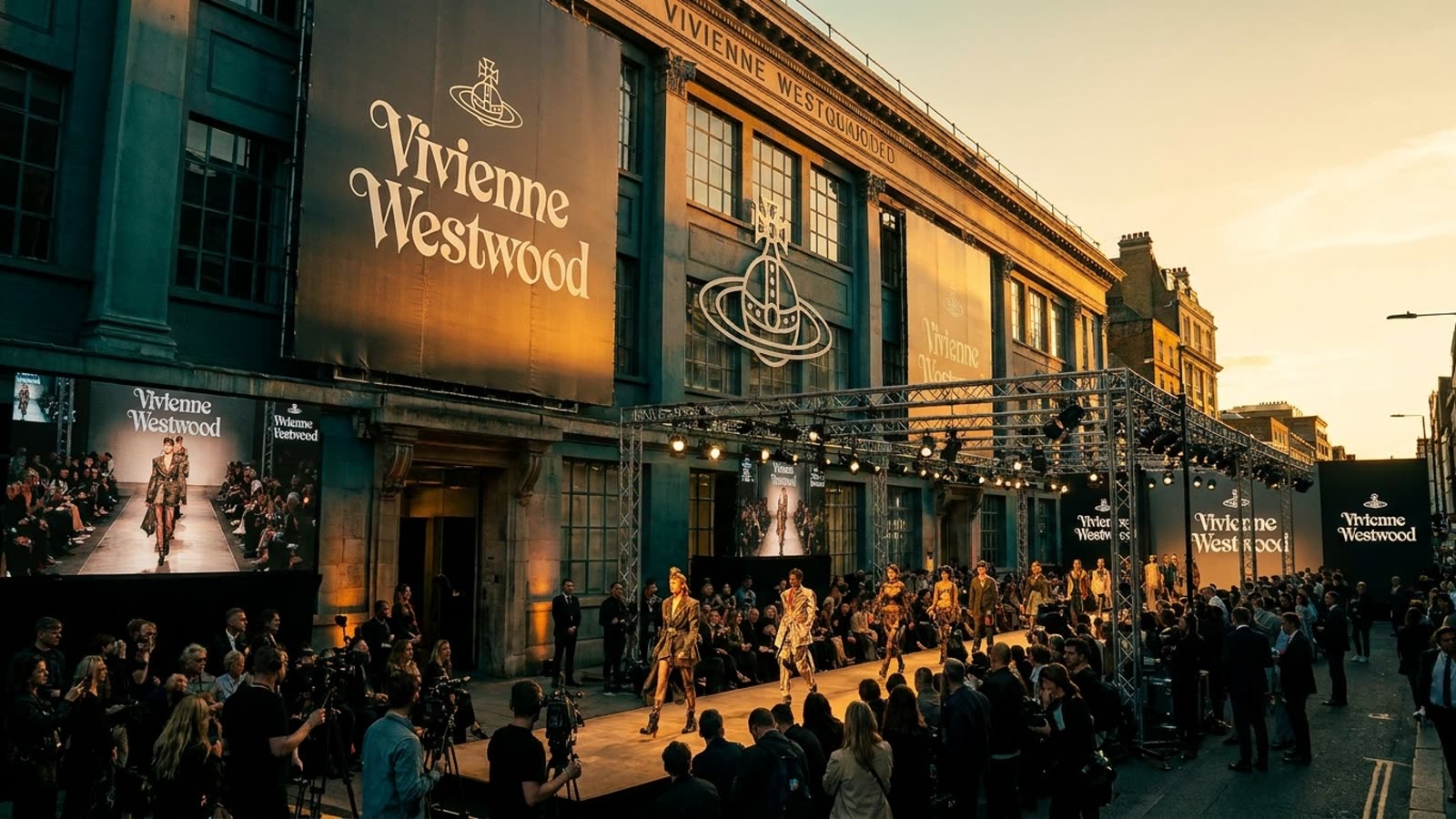
The question hovering over every posthumous fashion house is when homage curdles into taxidermy. Vivienne Westwood's Spring 2027 ready-to-wear, shown in Paris this week, answered with a collection so argumentative, so gleefully antagonistic toward the current vibe-shift toward quiet luxury, that it felt less like a séance and more like a slammed door.
Westwood died in December 2022, leaving her husband and creative partner Andreas Kronthaler at the helm. Three years on, the anxiety that the house might soften into archival nostalgia has proven unfounded. If anything, Kronthaler has leaned harder into the confrontational DNA that made Westwood fashion's most reliable contrarian.
The clothes themselves
Spring 2027 opened with exaggerated silhouettes—crinolines that looked ready to knock over café tables, corsetry worn outside tailored jackets, and tartans slashed and reassembled with visible seams. The palette ran from acid greens to bruised purples, punctuated by the house's signature orb motif rendered in oversized hardware. Nothing whispered. Everything insisted.
The standout pieces were deconstructed suiting—jackets with one lapel twice the size of the other, trousers cut asymmetrically so wearers appeared perpetually mid-stride. It was clothing that refused to let the body rest, a fitting metaphor for a brand that has never been interested in comfort.
The market context
Westwood's timing, intentional or not, is shrewd. After two years of "stealth wealth" dominance—Loro Piana, The Row, the beige industrial complex—there are signs the pendulum is swinging back toward maximalism. Prada's recent collections have grown louder. Bottega Veneta under Matthieu Blazy keeps pushing proportion. Westwood's Spring 2027 arrives not as outlier but as leading indicator.
The commercial question remains whether the house can convert runway heat into retail reality. Westwood has always been more influential than profitable, a brand other designers cite while consumers buy elsewhere. Kronthaler's challenge is translating punk credibility into sustainable business without diluting the very abrasiveness that makes the label matter.
Our take
Fashion loves to canonize dead designers while quietly burying their vision under "elevated" reinterpretation. What Kronthaler is doing at Westwood is rarer and riskier: keeping the argument alive. Spring 2027 isn't a memorial collection; it's a provocation. Whether the market rewards that remains to be seen, but at minimum, it confirms that Westwood's legacy isn't being managed—it's being weaponized.