The vinyl record, that supposedly obsolete artifact of the analog age, has staged one of consumer culture's most improbable comebacks. Sales have grown for nearly two decades straight, with revenues now exceeding those of CDs in most major markets. Yet the industry supplying this demand rests on a foundation so fragile it borders on absurd: a global network of perhaps forty significant pressing plants, many operating machinery built before disco died, staffed by technicians whose expertise cannot be taught in any school because no school teaches it.
This is not a story about nostalgia. It is a story about what happens when demand resurrects a technology whose supply chain was deliberately dismantled.
The stamper problem
A vinyl record begins as a lacquer master, cut by a lathe onto a disc coated with nitrocellulose. That master is electroplated to create a metal "father," which yields a "mother," which produces the stampers that actually press the records. Each step requires specialized chemistry, precise temperature control, and equipment that major manufacturers stopped producing decades ago. The dominant supplier of lacquer blanks, a single facility in California, suffered a catastrophic fire several years ago, briefly threatening the entire industry's ability to produce new titles.
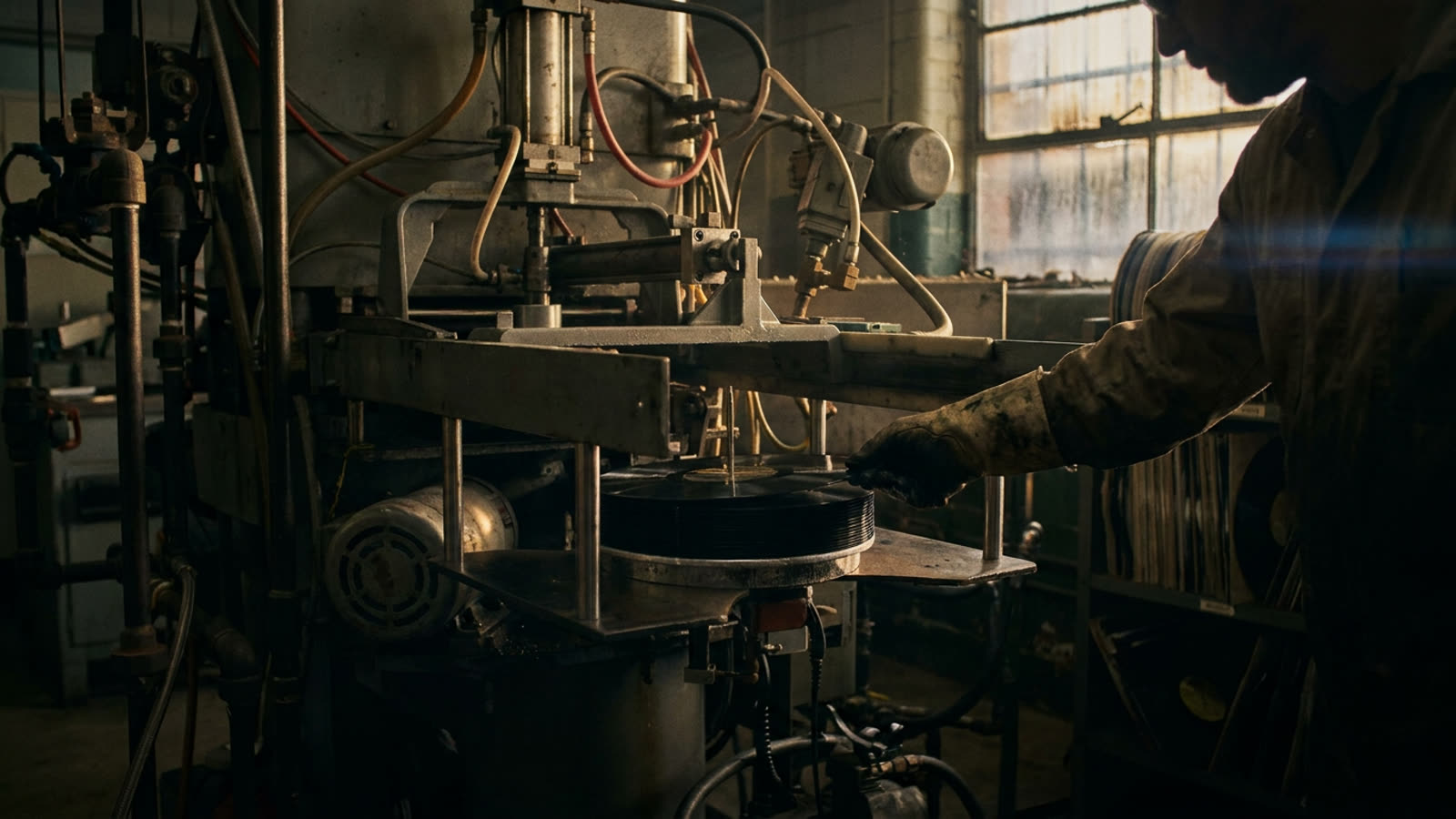
The pressing machines themselves are industrial antiques. The Toolex Alpha, a Swedish hydraulic press, remains the workhorse of the industry despite the company ceasing production in the early 1980s. Plants cannibalize broken units for parts. Technicians machine replacement components by hand. When a press dies, it often stays dead.
Why new machines don't solve it
Several companies have attempted to build modern pressing equipment, and a few have succeeded in limited deployments. But the economics are punishing. A new automated press costs several hundred thousand dollars and requires months of calibration. Meanwhile, a refurbished Toolex can be operational for a fraction of that—if you can find one. More critically, the new machines often struggle with the tolerances that audiophiles and labels demand. The old presses, designed for an era when vinyl was the primary medium, were over-engineered for quality. Their modern successors, designed for a niche market, optimize for throughput.
The result is a two-tier system. Major labels with guaranteed volume secure priority at the largest plants, locking in capacity months in advance. Independent artists and small labels face wait times stretching past a year, their releases held hostage to a queue they cannot see or influence.
The labor bottleneck nobody discusses
Even if unlimited presses materialized tomorrow, the industry would face a second constraint: the people who know how to run them. Vinyl pressing is not automated in any meaningful sense. It requires operators who can diagnose problems by sound, who understand the thermal behavior of PVC, who can adjust a stamper's alignment by feel. This knowledge was never codified because it never needed to be—the industry was supposed to be dead.
The technicians who kept plants running through the lean decades of the 1990s and 2000s are now retiring. Their replacements learn through apprenticeship, a process that takes years. No venture capital injection can accelerate the transmission of tacit knowledge.
Our take
The vinyl revival is real, culturally significant, and economically substantial. It is also structurally precarious in ways that most consumers never consider when they order a limited-edition pressing. The bottleneck is not a temporary supply-chain hiccup but a permanent feature of an industry rebuilt on salvaged infrastructure and aging expertise. Every colored variant, every Record Store Day exclusive, every deluxe reissue passes through this needle's eye. The format's charm lies partly in its physicality, its resistance to the frictionless abundance of streaming. That same physicality now imposes hard limits on how much vinyl the world can actually produce—a constraint that feels almost poetically appropriate for a medium that was never supposed to survive.