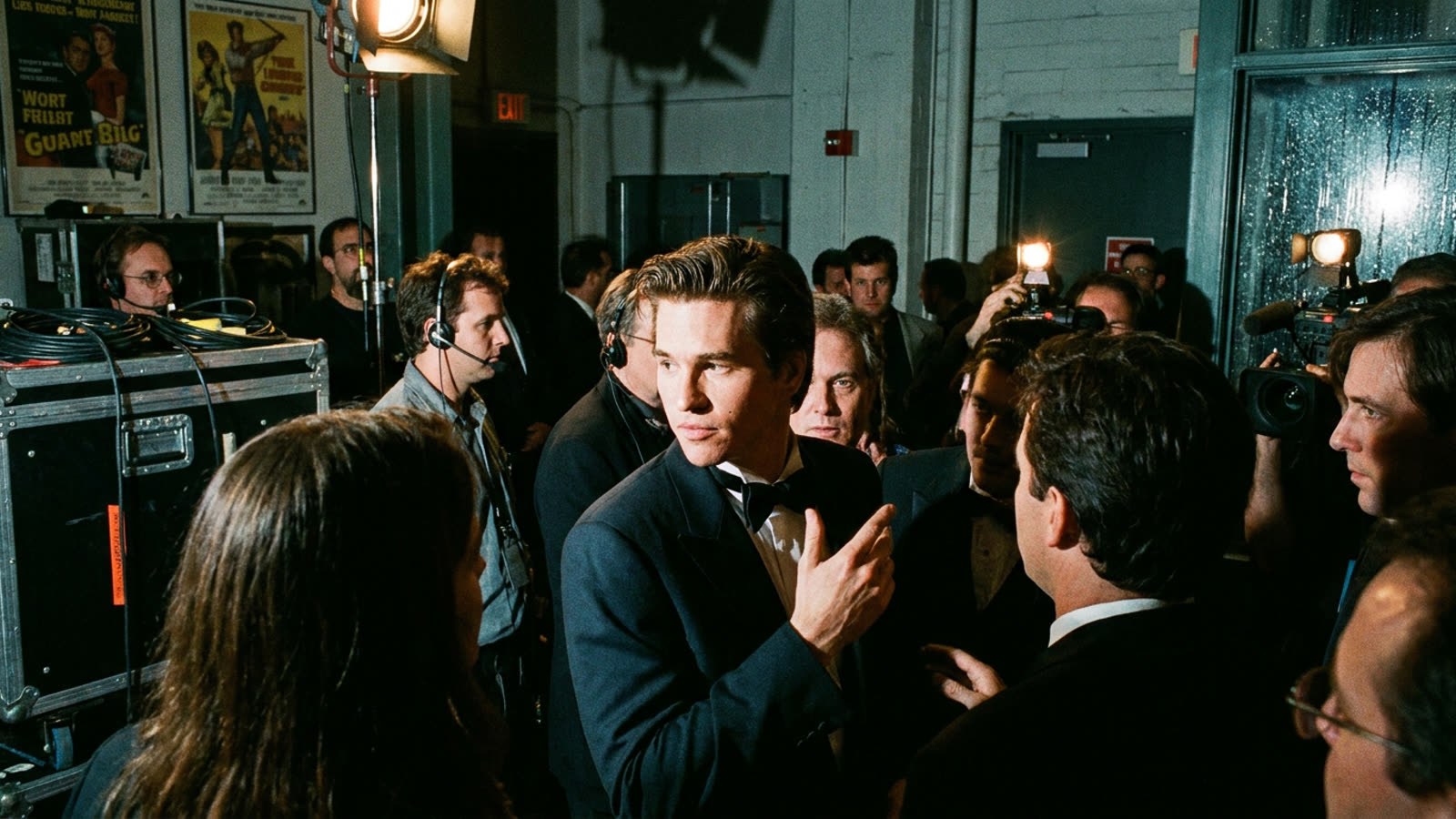
The obituary industrial complex usually waits a decent interval before the revisionism begins. Not this time. Adam Marcus, who directed Val Kilmer in the 1993 thriller Conspiracy, has given an interview calling the recently deceased actor "the worst human being I've ever known"—a claim so blunt it feels almost quaint in an era of carefully lawyered statements and publicist-approved grief.
Marcus's accusations are specific and damning: that Kilmer was cruel to crew members, deliberately sabotaged takes, and treated the production as a personal fiefdom. The director frames his decision to speak now as a corrective to the hagiographic coverage that followed Kilmer's death, arguing that silence amounts to complicity in myth-making.
The Difficult-Man Industrial Complex
Hollywood has always maintained a separate moral ledger for talent. The stories about Kilmer's on-set behavior were never secrets—his firing from The Island of Dr. Moreau and clashes with John Frankenheimer became industry lore. But the 2021 documentary Val, which the actor largely self-produced, recast him as a misunderstood artist, a man whose intensity was simply the cost of his commitment to craft. The film earned an Emmy nomination and genuine critical sympathy.
Marcus's interview is a direct assault on that rehabilitation. It also arrives at a moment when the industry claims to have reckoned with abusive behavior, post-#MeToo, post-Weinstein, post-countless HR trainings. Yet the response to his comments has been notably muted—no industry figures have publicly corroborated or disputed his account. The silence suggests that the rules for speaking ill of the dead remain stricter than the rules for protecting the living.
The Timing Problem
Critics of Marcus will note the obvious: Kilmer cannot defend himself. The actor spent his final years battling throat cancer, communicating through a voice box, and by most accounts making peace with former collaborators. Speaking now, some argue, is cowardice dressed as courage.
But there's a counterargument worth taking seriously. If we only permit criticism of the powerful while they hold power, we guarantee that the historical record will be written by survivors and sycophants. The question isn't whether Marcus's timing is tasteful—it isn't—but whether tastefulness should be the governing principle of truth-telling.
Our take
Marcus's interview is uncomfortable precisely because it refuses the conventions of celebrity death coverage. Whether his account is entirely accurate, partially exaggerated, or a grudge nursed for three decades is unknowable from the outside. What's clear is that Hollywood's relationship with difficult men remains fundamentally unchanged: we valorize their work, mythologize their eccentricities, and wait until they're safely dead to ask whether anyone should have intervened. The industry didn't learn from Kilmer's career. It's not clear it wants to.