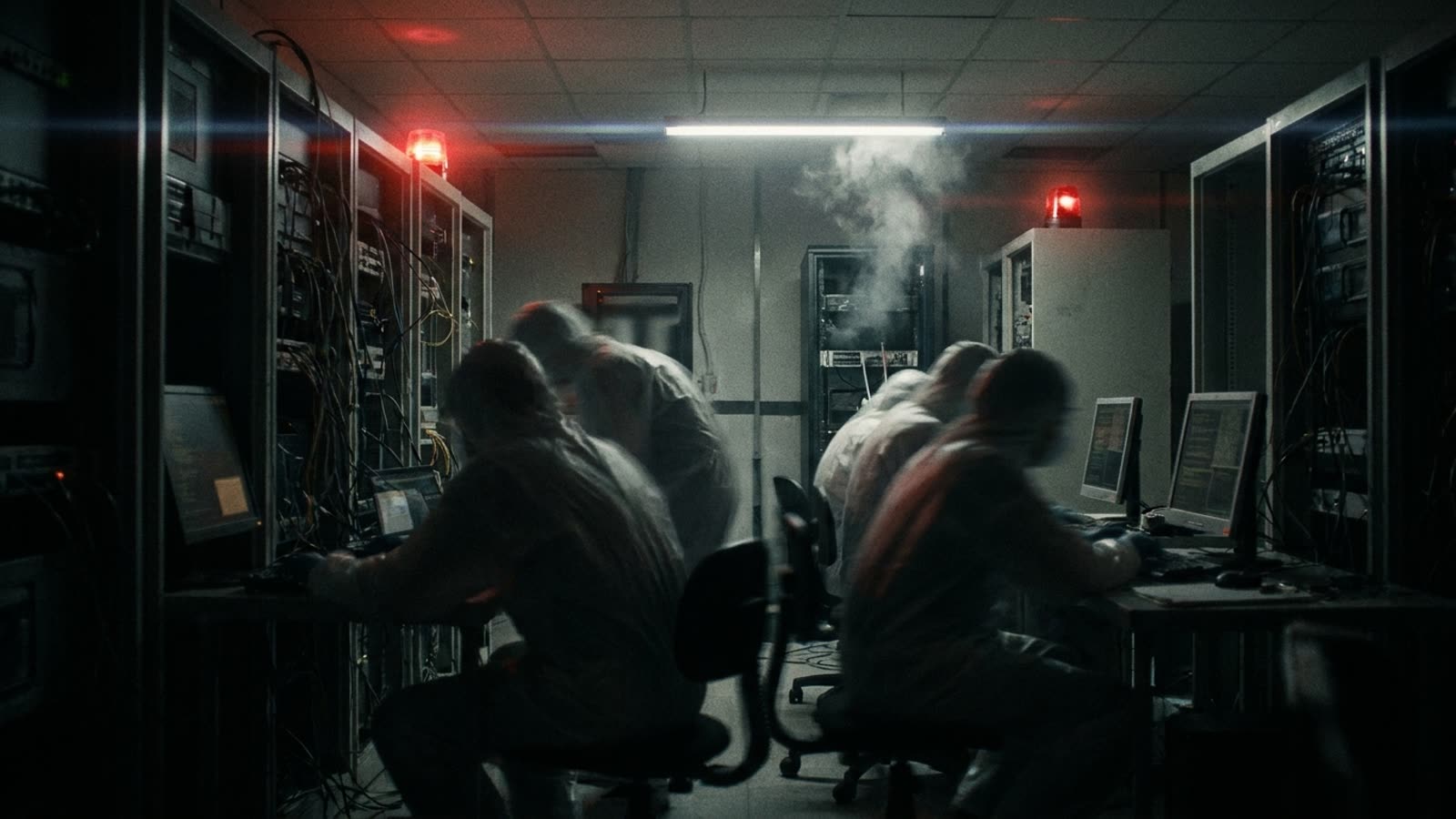
The British government's cybersecurity arm has concluded that AI-driven malware capable of autonomously compromising critical national infrastructure—power stations, airports, hospitals—is "highly likely" to emerge within two years. The assessment, from the National Cyber Security Centre, represents the clearest official acknowledgment yet that the same generative AI capabilities delighting consumers are being weaponized at pace by hostile state actors and criminal syndicates.
The warning lands at an awkward moment. Western governments have spent the past eighteen months oscillating between AI boosterism and AI doomerism, rarely settling on the unglamorous middle ground of operational security. The NCSC's forecast is not speculative fiction; it is a planning assumption now embedded in UK defense posture.
The autonomous threat model
Traditional cyberattacks require human operators to probe networks, identify vulnerabilities, and craft exploits. AI-powered malware changes the calculus by automating reconnaissance and adaptation. A sufficiently capable model can scan thousands of systems, generate novel attack vectors, and pivot in real time when defenders patch one hole. The labor economics of hacking flip: attackers scale effortlessly while defenders remain bottlenecked by human analysts.
The NCSC's concern is not hypothetical. Security researchers have already demonstrated proof-of-concept tools that use large language models to write polymorphic code—malware that rewrites itself to evade signature-based detection. Pair that with agentic frameworks that can chain actions across networks, and the result is an adversary that never sleeps and learns faster than any SOC team.
Why critical infrastructure is uniquely exposed
Power grids, water treatment plants, and transport hubs run on operational technology designed decades ago, often air-gapped in theory but increasingly connected in practice. The convergence of IT and OT networks has created attack surfaces that legacy security tools struggle to monitor. AI malware does not need a zero-day; it needs a misconfigured firewall and time.
The UK is not alone in this exposure. The US Cybersecurity and Infrastructure Security Agency has issued parallel warnings, and European utilities have quietly accelerated tabletop exercises simulating AI-assisted intrusions. But exercises are not defenses, and the gap between red-team scenarios and production-grade resilience remains vast.
Our take
Two years is not a prediction; it is a deadline. The NCSC is telling ministers and utility executives that the threat model has shifted and budgets must follow. Whether that message penetrates the inertia of procurement cycles and board-level complacency is another matter. The uncomfortable truth is that AI defense tools are maturing alongside AI attack tools, but defenders must protect everything while attackers need only succeed once. Britain's spies are right to sound the alarm. The question is whether anyone with signing authority is listening.