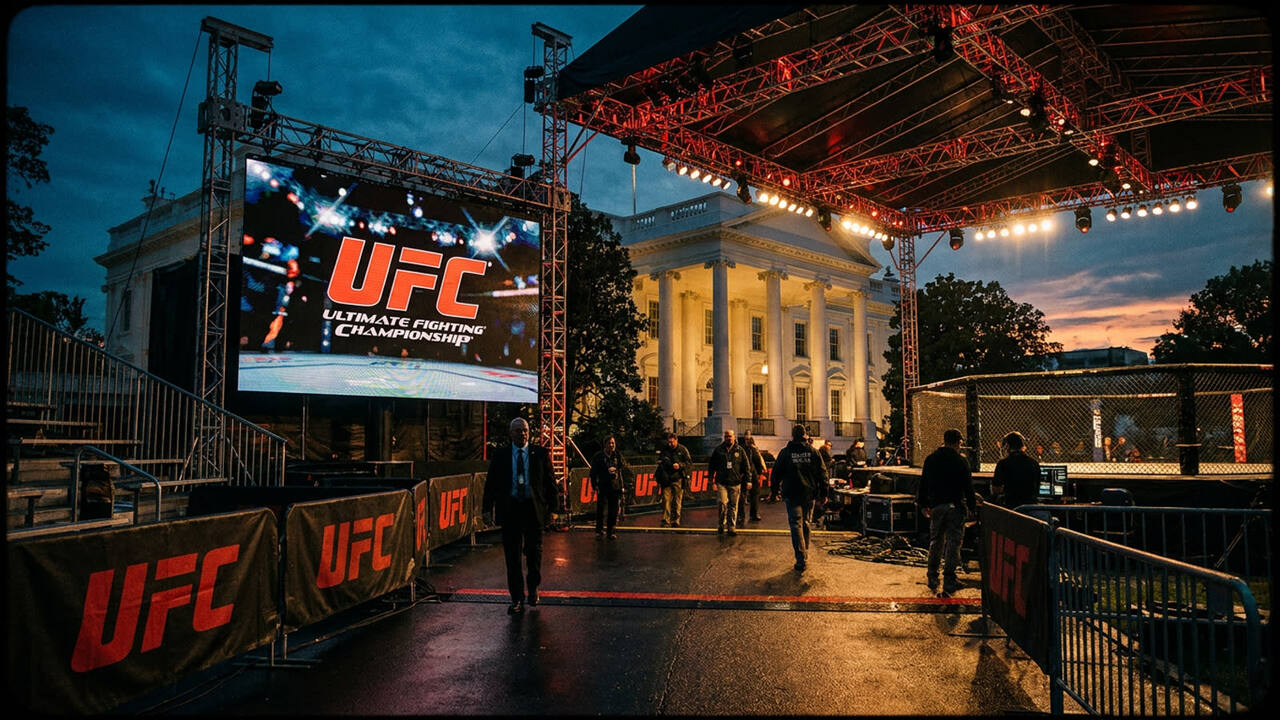
The question is no longer whether American politics has become entertainment — that debate ended years ago. The question now is whether the White House should function as a literal arena, complete with cage fights, pay-per-view revenue, and blood on the canvas.
The Trump administration's reported interest in hosting Ultimate Fighting Championship events at 1600 Pennsylvania Avenue represents the logical endpoint of a trajectory that began with celebrity apprentice boardrooms and continued through WWE Hall of Fame inductions. But logical endpoints, once reached, tend to generate new trajectories.
The venue problem
The White House has hosted musical performances, state dinners, and the occasional Easter egg roll. It has never hosted professional combat sports. The practical objections are obvious: security concerns, infrastructure limitations, the question of whether the Rose Garden can accommodate an octagon. But practical objections have rarely constrained this administration's event planning.
More interesting is the question of what hosting UFC would actually accomplish. The administration's supporters argue it would demonstrate cultural relevance and connect with working-class voters who follow mixed martial arts. Critics suggest it would further degrade the dignity of the presidency. Both arguments assume the presidency still operates according to pre-2016 norms about institutional dignity — an assumption that requires increasingly creative interpretation of available evidence.
The audience question
Polling on whether Americans want UFC at the White House reveals predictable partisan splits, but the more revealing data concerns intensity. Those who strongly oppose the idea cite institutional desecration; those who strongly support it cite institutional irrelevance. The presidency, in this framing, is either a sacred trust or an overrated building — and the choice of framing determines everything that follows.
UFC's audience skews younger and more male than traditional political engagement metrics capture well. The administration's interest in the partnership reflects a broader theory that cultural institutions matter more than political ones, that Dana White's endorsement reaches voters CNN cannot, and that spectacle is not the opposite of governance but its most effective form.
The precedent cascade
If UFC fights at the White House become reality, the next question is what else becomes possible. Professional wrestling? Boxing? The Super Bowl halftime show? Each step normalizes the next, until the distinction between campaign rally and state function becomes purely semantic.
This is not entirely new. Kennedy brought Camelot glamour; Reagan brought Hollywood production values; Clinton played saxophone on late-night television. But those were gestures toward popular culture from within a framework that still distinguished governance from entertainment. The UFC proposal suggests that framework may have outlived its usefulness.
Our take
The honest answer to whether Americans want UFC at the White House is that Americans want incompatible things: they want their institutions dignified and their leaders relatable, their presidency both sacred and accessible. The UFC proposal forces a choice most voters would prefer to avoid. That it is being seriously discussed tells us less about mixed martial arts than about how completely the membrane between politics and entertainment has dissolved. The White House has always been a stage; the only question now is what kind of show it will host.