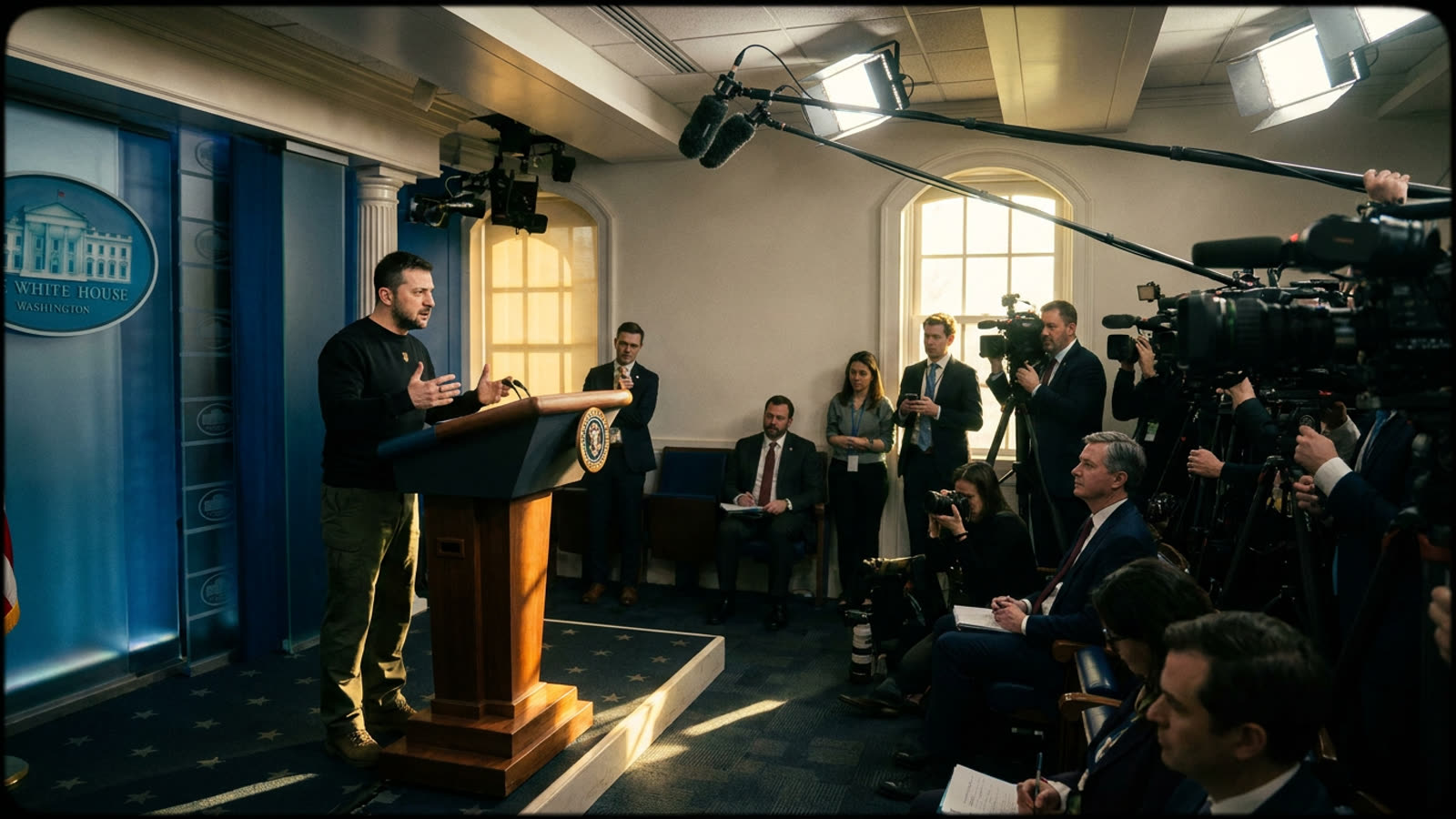
The American presidency has always involved a certain amount of salesmanship, but Donald Trump's performance at yesterday's White House meeting suggests the sales pitch has become entirely detached from the product. In remarks that veered from the Iran conflict to economic data to, inexplicably, the reflecting pool on the National Mall, the president offered a series of claims that do not survive contact with the public record.
The meeting, ostensibly convened to discuss economic policy with business leaders, became instead a showcase for presidential revisionism. Trump asserted that the Iran conflict—now in its fragile ceasefire phase—had been "inherited" from his predecessor, despite the fact that the current hostilities began after his administration withdrew from diplomatic channels. He claimed job creation figures that exceed Bureau of Labor Statistics data by several hundred thousand. And in a moment that would be comic if it weren't symptomatic, he insisted the reflecting pool had been "made longer" during his term, a claim the National Park Service has no record of.
The Iran problem
The most consequential falsehoods concern the ongoing military engagement with Iran. Trump characterized American strikes around the Strait of Hormuz as purely defensive, responding to unprovoked Iranian aggression. The timeline suggests otherwise: the current escalation followed Washington's decision to designate additional Iranian financial institutions for sanctions, which Tehran interpreted as economic warfare. The Revolutionary Guards' targeting of a U.S. airbase came after, not before, American military action.
This matters because the ceasefire now being tested depends on both sides accurately characterizing their own actions. A president who cannot acknowledge the sequence of events that led to conflict is poorly positioned to negotiate its end. Iran, meanwhile, is reportedly seeking the release of billions in frozen funds as a precondition for any lasting agreement—a demand that becomes harder to assess when the basic facts of the conflict remain contested.
The economic mirage
The economic claims are easier to fact-check and no less troubling. Trump's assertion of record job growth contradicts the administration's own Labor Department, which shows solid but unremarkable employment gains. His insistence that inflation has been "completely defeated" ignores the Federal Reserve's most recent statement, which noted persistent price pressures in housing and services. The stock market, he claimed, had reached "the highest point in history"—true in nominal terms, less impressive when adjusted for inflation or compared to GDP growth.
Business leaders in attendance reportedly exchanged glances during these passages. Several declined to comment on the record, though one described the atmosphere as "surreal."
Our take
Presidential mendacity is not new, but its brazenness has consequences. When a commander-in-chief cannot accurately describe a military conflict he is managing, allies question intelligence-sharing arrangements and adversaries probe for weakness. When economic claims diverge from official data, markets begin to price in uncertainty. The reflecting pool comment is trivial; the pattern it represents is not. A president who will fabricate the dimensions of a pond will fabricate anything.