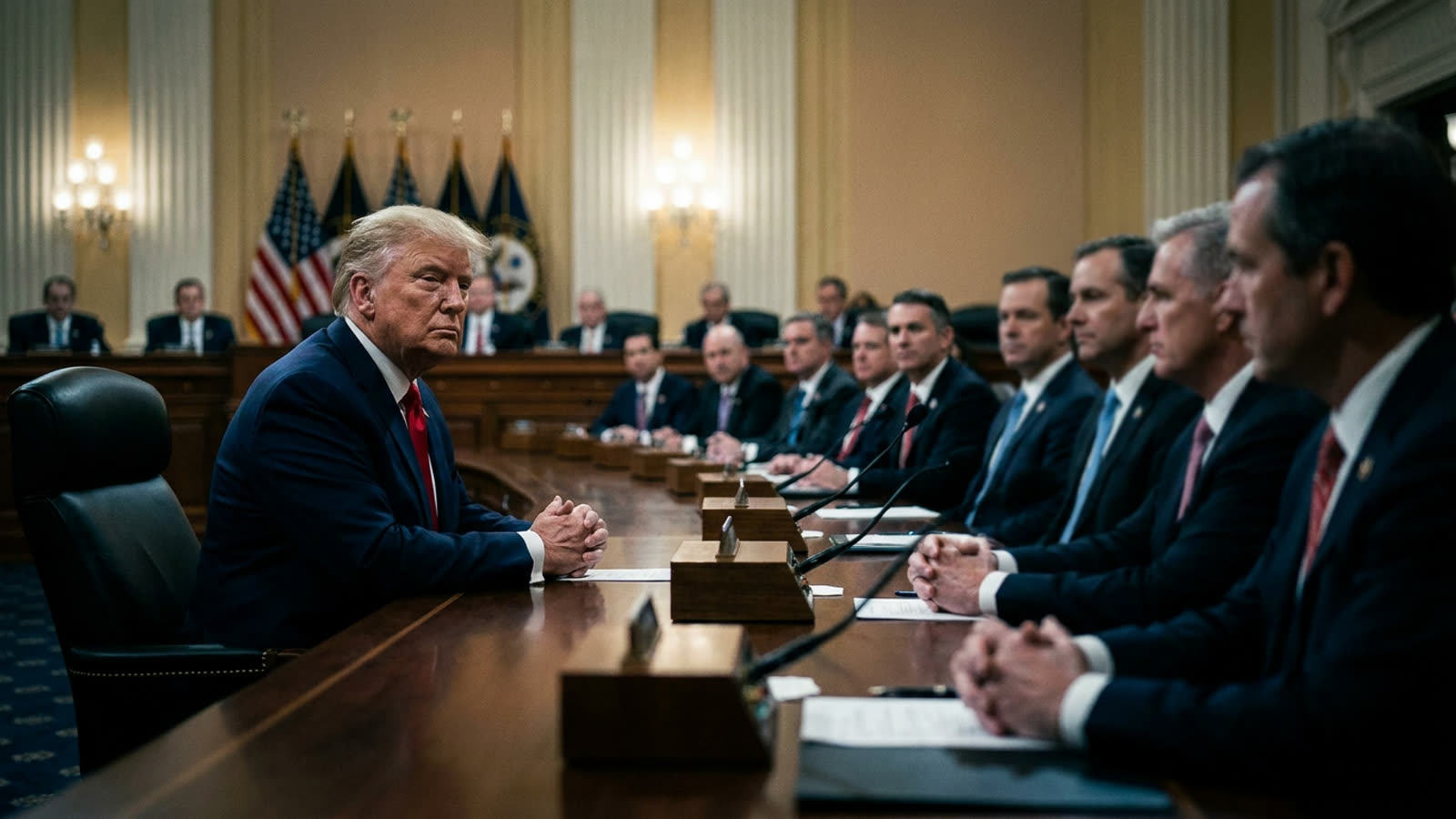
For eighteen months, congressional Republicans have swallowed policy reversals, constitutional stretches, and rhetorical excesses that would have triggered mass defections in any previous administration. They accepted tariffs that contradicted decades of free-trade orthodoxy. They acquiesced to executive orders that tested the boundaries of presidential authority. They defended statements that made their own reelection campaigns measurably harder. And then Donald Trump asked for $1.8 billion in discretionary funds to compensate allies he believes were unfairly prosecuted, and suddenly the caucus remembered it had principles.
The revolt that erupted this week across both chambers represents something genuinely novel in the Trump era: Republicans defecting not over ideology or electoral self-preservation, but over the raw mechanics of patronage. The proposed fund, tucked into the broader budget reconciliation package, would have given the executive branch extraordinary latitude to distribute taxpayer money to individuals the president personally deems victims of "weaponized" federal prosecution. No judicial review. No congressional oversight beyond initial appropriation. Just presidential discretion backed by a nine-figure checkbook.
The Senate Fractures First
The upper chamber's rebellion began quietly, with Susan Collins and Lisa Murkowski raising procedural objections that their colleagues initially dismissed as the usual moderate handwringing. But by Tuesday, at least seven Republican senators had signaled they would not support the reconciliation package with the fund intact. The defectors span the ideological spectrum—from Collins to Mike Lee, who objected on constitutional grounds that the fund represented an impermissible delegation of congressional spending authority.
What made the Senate revolt remarkable was its velocity. Republican leadership had assumed the fund would pass with minimal scrutiny, buried as it was among hundreds of pages of budget provisions. Instead, it became the single most discussed line item in the entire package within forty-eight hours of its discovery by congressional staff.
The House Follows Suit
The lower chamber's response proved even more dramatic. House leadership had scheduled a vote on a separate measure that would have effectively ended congressional oversight of ongoing military operations—a provision that aligned with the administration's broader Iran posture. When it became clear that the anti-weaponization fund controversy had contaminated the entire Republican agenda, leadership pulled the war powers vote entirely rather than risk a humiliating defeat.
The cancellation represented a tactical retreat with strategic implications. It signaled that Republican unity, which had held through far more substantive policy fights, could shatter when members perceived they were being asked to fund what critics have called a "loyalty rewards program" with public money.
The Patronage Problem
The fund's design made it nearly impossible to defend on procedural grounds. Unlike disaster relief or even controversial defense appropriations, the anti-weaponization money came with no objective criteria for distribution. Recipients would be selected based on the administration's determination that they had been targeted for political reasons—a standard that exists nowhere in federal law and that would make the president simultaneously prosecutor, judge, and banker.
Several Republican members privately acknowledged that they could support compensation for individuals who had been demonstrably mistreated by federal authorities, but only through normal legislative channels with proper oversight. The fund's structure, they argued, was designed to circumvent exactly the kind of scrutiny that legitimate claims would survive.
Our take
The anti-weaponization fund revolt matters less for what it prevents than for what it reveals. Congressional Republicans have spent the second Trump term convincing themselves that accommodation was strategy, that swallowing small indignities would preserve their influence over large policy questions. This week demonstrated the opposite: the party's tolerance had become so absolute that only the most nakedly transactional demand could trigger resistance. Trump didn't lose this round because Republicans rediscovered constitutional principles. He lost because he finally asked for something so obviously self-serving that even allies couldn't pretend otherwise. The question now is whether this revolt represents a genuine inflection point or merely a speed bump on the road to complete executive dominance of the legislative branch.