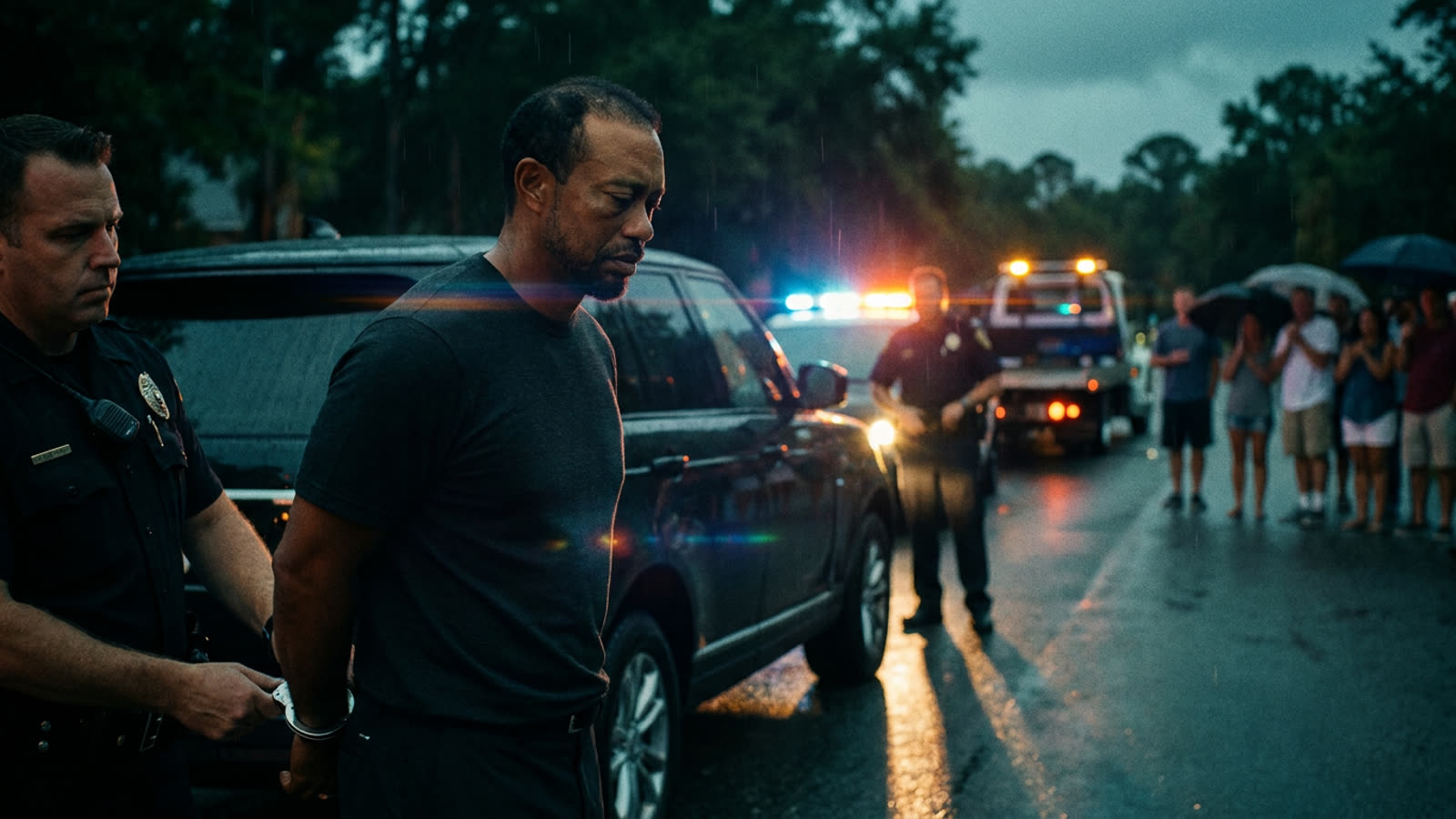
The vehicle that carried Tiger Woods through one of the lowest moments of his public life has been sitting in a Southern California salvage yard, its crumpled frame now documented in photographs that circulated this week. The 2015 Mercedes-AMG-badged Range Rover—found by Florida police in May 2017 with Woods asleep at the wheel, engine running, blinker on, nowhere near a golf course—has become an accidental artifact of celebrity wreckage, literal and otherwise.
The timing is peculiar. Woods, now 50, remains a fixture at major championships, his body held together by fusion hardware and sheer competitive spite. He is simultaneously a living legend and a cautionary tale, a man who won the 2019 Masters after spinal surgery and then nearly lost his leg in a 2021 single-car crash in Los Angeles. The junkyard photos don't tell us anything we didn't already know. They simply make the knowledge harder to aestheticize.
The 2017 incident, revisited
Woods was found unconscious on a Jupiter, Florida roadway with a cocktail of prescription medications in his system: Vicodin, Dilaudid, Xanax, Ambien, and THC. He pleaded guilty to reckless driving, entered a diversion program, and issued the requisite statement about seeking professional help. The arrest came two years after his fourth back surgery and during a period when his playing career appeared finished. The SUV was impounded, processed, and eventually made its way west through the anonymous machinery of automotive afterlife.
Why the photos matter now
Celebrity vehicles have a strange second life in American culture. James Dean's Porsche 550 Spyder became a traveling exhibit. Paul Walker's Carrera GT wreckage was scrutinized for evidence. Princess Diana's Mercedes S280 was reportedly crushed to prevent it from becoming a morbid souvenir. Woods's Range Rover falls into a less dramatic category—no fatalities, no high-speed chase—but it carries symbolic weight nonetheless. It is the physical evidence of a narrative we have largely agreed to forget in favor of the redemption story that followed.
The photographs show a vehicle that has been stripped of parts, its luxury origins barely recognizable beneath rust and neglect. There is something almost too on-the-nose about the imagery: the greatest golfer of his generation, reduced to tabloid fodder, his transportation reduced to scrap metal.
Our take
We are not in the business of relitigating Tiger Woods's personal struggles. The man paid his legal dues, sought treatment, and returned to competition at the highest level. But the junkyard photographs serve a useful function: they puncture the seamless narrative of comeback that professional sports and its media apparatus prefer to sell. Woods's story is remarkable precisely because it includes the Range Rover, the DUI, the mugshot with the glassy eyes. Pretending otherwise isn't redemption—it's revisionism.