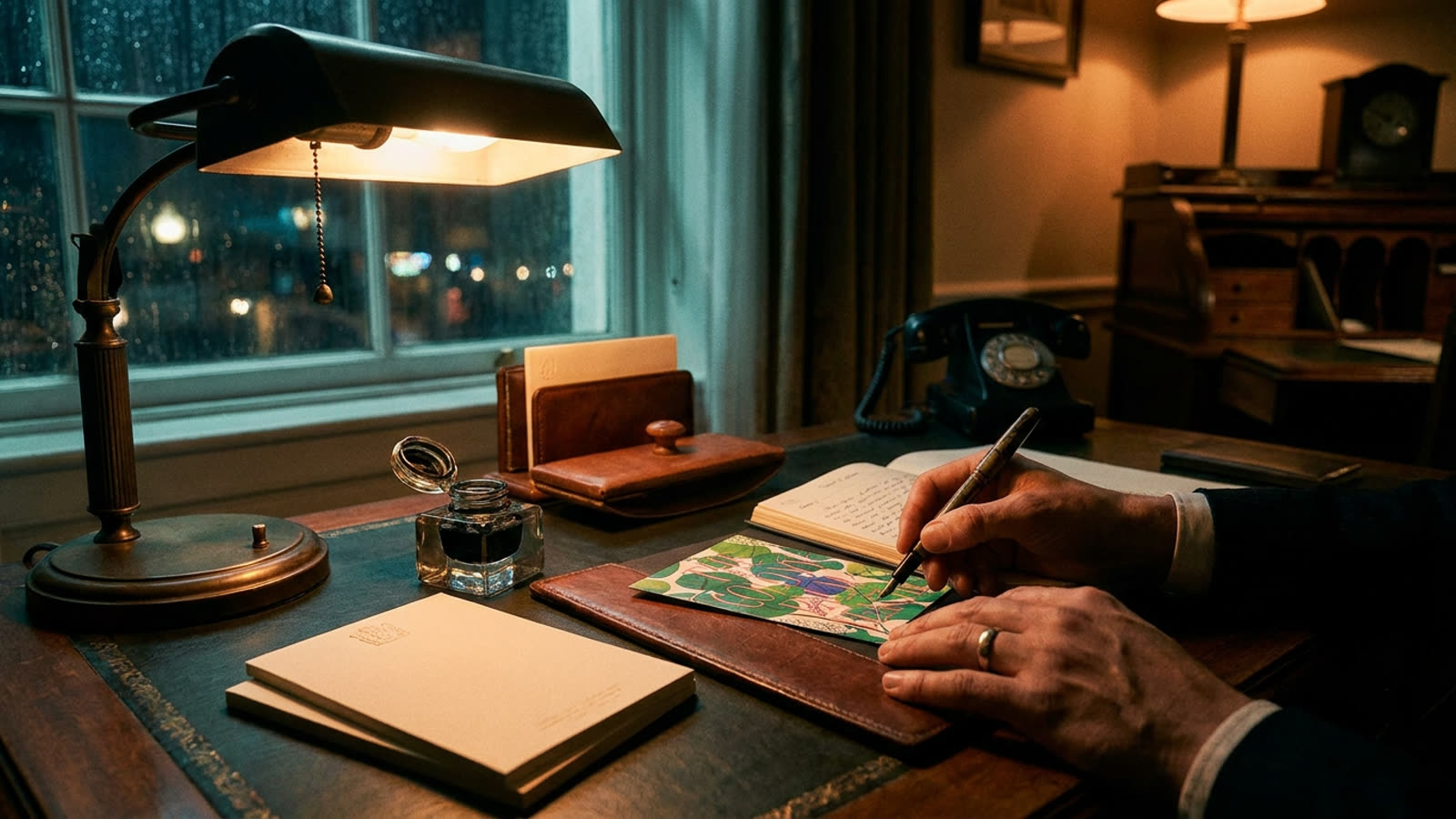
There was a time when checking into a fine hotel meant inheriting a small office. The writing desk by the window held cream-colored paper, matching envelopes, a pen that wrote smoothly, and sometimes a leather-bound blotter. The paper bore the hotel's crest, embossed or letterpress-printed, and using it felt like borrowing someone else's authority. A postcard dashed off on Claridge's stationery carried more weight than the same sentiment scrawled on a napkin. The medium was, quite literally, the message.
This ritual has not vanished entirely, but it has become vestigial. Most travelers never open the desk drawer. The stationery, if it exists at all, sits untouched, a relic of analog hospitality competing with the magnetic pull of the charging cable.
The semiotics of letterhead
Hotel stationery was never just paper. It was a status marker, a souvenir, and a creative prompt rolled into one. Writers from Graham Greene to Joan Didion composed on hotel sheets, the borrowed grandeur loosening something in the prose. Business travelers used it strategically: a proposal typed on Ritz letterhead suggested you were the kind of person who stayed at the Ritz. The paper did half the persuading.
The design itself was a minor art form. The Savoy's intertwined S, the Plaza's serif elegance, the Chateau Marmont's gothic whimsy — each communicated a philosophy of hospitality before a single word was written. Collectors still trade vintage examples, and auction houses occasionally surface stationery used by famous guests, the paper itself becoming artifact.
Why it faded
The decline tracks predictably with the smartphone's rise. Email obviated the letter; Instagram replaced the postcard. Hotels, facing cost pressures and sustainability concerns, quietly reduced their paper offerings. Some replaced full stationery suites with a single notepad; others eliminated desks altogether, reasoning that guests prefer to work from bed.
But something was lost in the efficiency. The act of writing by hand on good paper imposes a discipline that typing does not. You cannot unsend a letter. You must think before you write, and the thinking changes when the medium demands permanence. Hotel stationery offered travelers a rare permission: to slow down, to compose rather than react, to become briefly the kind of person who writes letters.
The quiet revival
A handful of hotels have begun restoring serious stationery programs, treating them as amenities rather than overhead. The approach is less about nostalgia than about differentiation in an era when every room has the same streaming services and USB ports. A beautiful sheet of paper, the thinking goes, is harder to replicate than a rain shower.
Some properties commission artists for limited-edition designs. Others stock fountain pens alongside the ballpoints. The gesture is small but legible: we believe you might have something worth writing down.
Our take
The hotel writing desk was always a fiction — a stage set suggesting you might become a more thoughtful version of yourself while traveling. But useful fictions have value. In an attention economy that monetizes every spare second, the empty page and the waiting envelope represented a counteroffer: here is time, here is silence, here is permission to be slow. That the paper often went unused does not diminish the offer. Some doors are worth leaving open even if no one walks through.