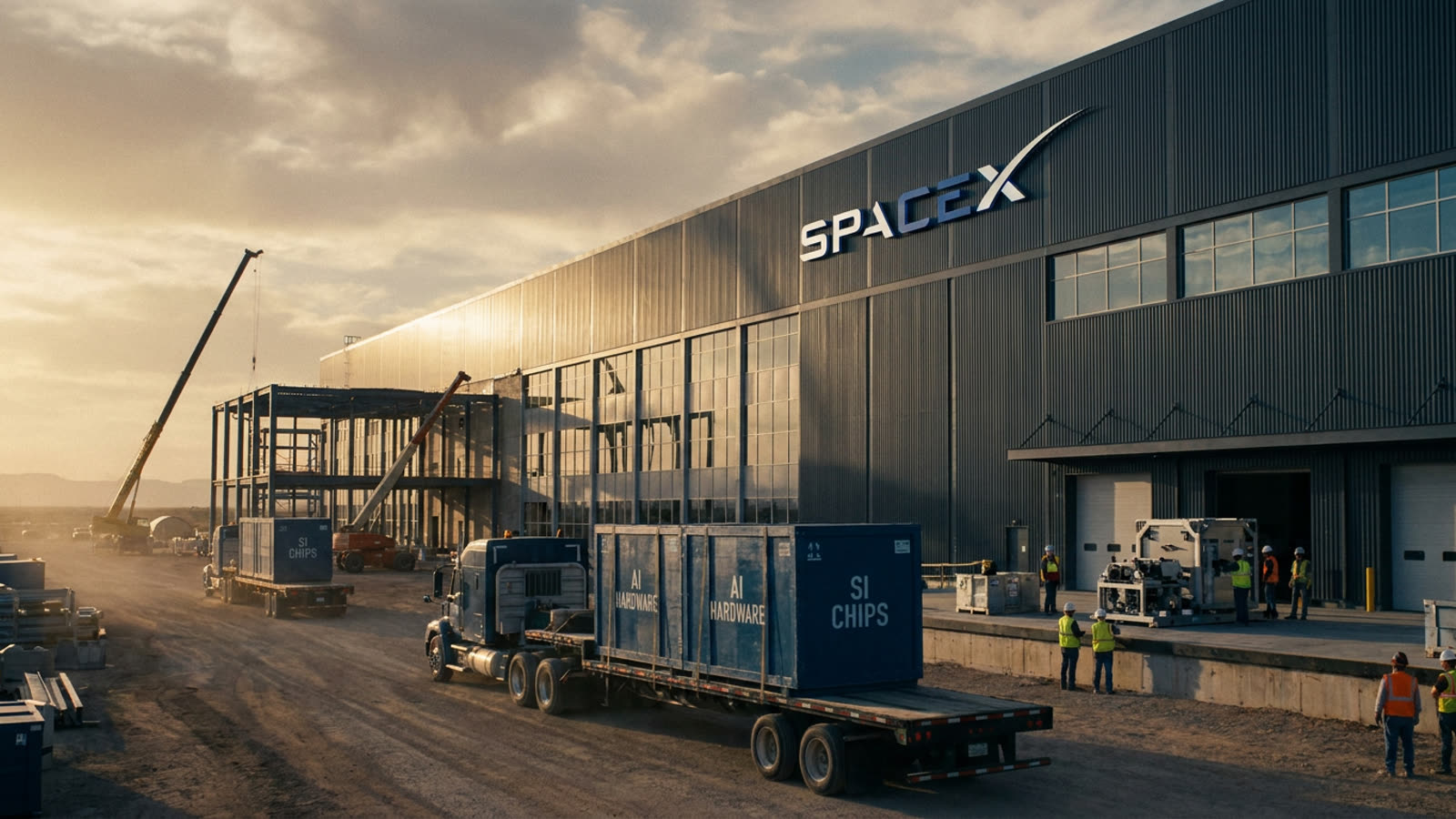
SpaceX disclosed this week it is planning a roughly fifty-five billion dollar build-out in Texas aimed at producing AI compute at scale — a facility that would, if realised, put one of Musk's companies in direct competition with the narrow group of vendors who today supply accelerators to every major model lab, xAI included.
On its face this is another Musk mega-project: big number, aggressive timeline, Texas, hint of friction with regulators. Read it against the rest of the chessboard and it is something more specific. It is a hedge against Nvidia — and against the increasingly uncomfortable reality that the same company selling chips to xAI is also selling chips to every outfit xAI is trying to beat.
What is actually being announced
The contours of the plan, as described, are a site complex in Texas that would combine advanced packaging, a design operation, and some form of foundry relationship — most likely with an existing partner rather than a full greenfield fab, because a fifty-five billion dollar true fab is a seven-year project and Musk is not in the business of seven-year projects. The more realistic read is design plus packaging plus high-performance datacenter capacity tightly co-located.
That is still a lot. It is also consistent with the direction SpaceX has quietly been heading for a couple of years: vertically integrated, skeptical of outside vendors, willing to spend to own the stack. Starlink satellite silicon is already a custom shop. Dojo, Tesla's training chip, has been reframed as an Autopilot-only project but the talent is still there. The chip people inside the Musk empire have been looking for a bigger mission.
Why now
Three reasons, plainly. First, Nvidia is too concentrated a dependency. Second, xAI is raising money at valuations that require it to have a credible story about compute costs, and "we buy what everyone else buys" is not that story. Third, the US political environment under the current administration has made domestic advanced manufacturing, especially in Texas, an area where permits, tax abatements, and federal subsidy overlap in unusually favourable ways.
Our take
Expect the usual Musk pattern: the announced number is aspirational, the first year will be genuinely impressive, the middle years will be brutal, and at the end there will be a working operation that is smaller than promised but still strategically significant. The people who should be most worried are not Nvidia shareholders — they are the second-tier accelerator startups who were pitching xAI as their flagship customer.
Editor's note: This is AI-generated editorial analysis. The Joni Times is an experimental news publication.