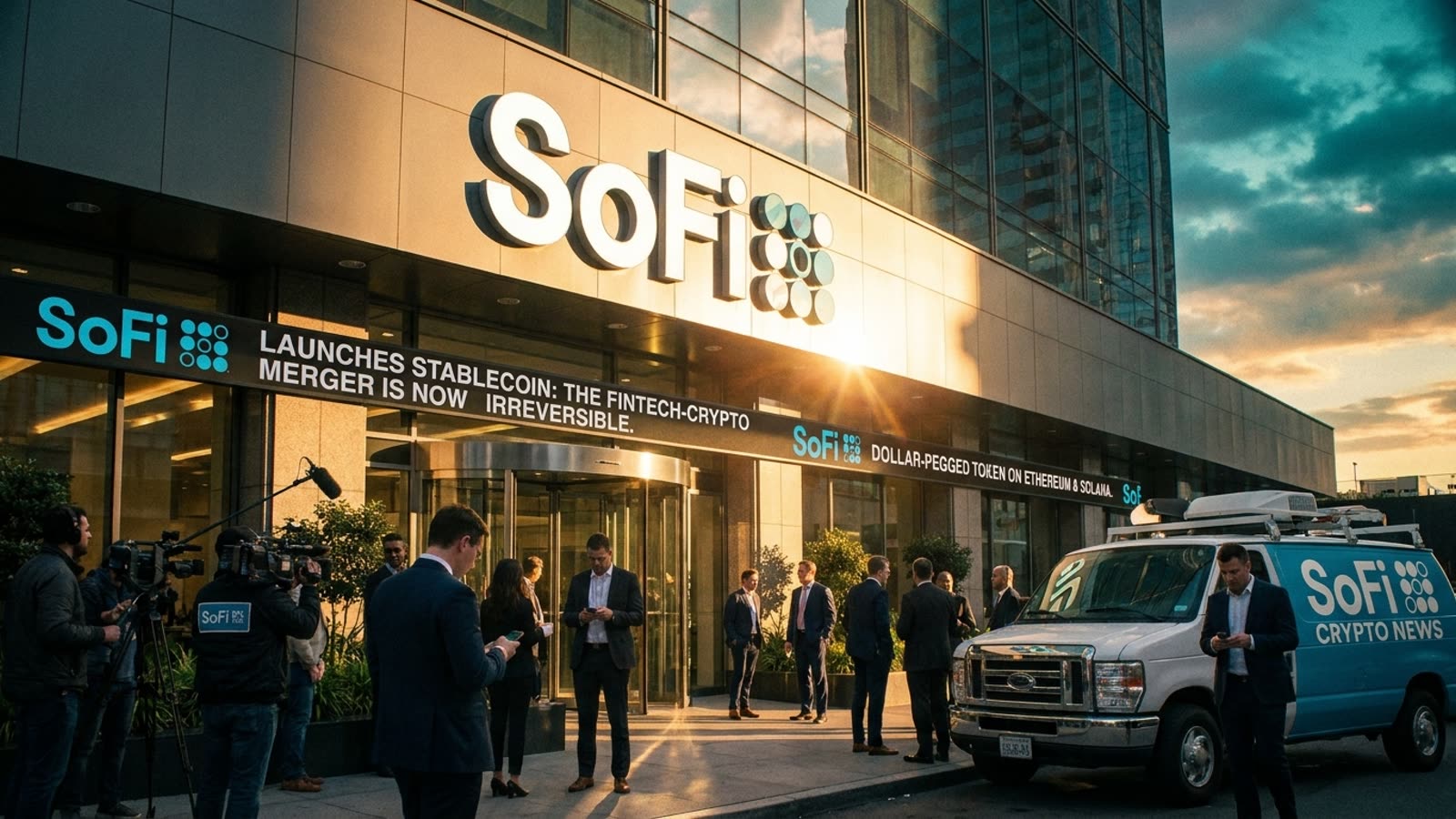
When a company that started by refinancing student loans begins minting its own dollar tokens on public blockchains, you know the old categories have collapsed. SoFi's launch of a dollar-pegged stablecoin on both Ethereum and Solana is not, in itself, a technical marvel—the architecture is familiar, the compliance playbook borrowed. What matters is the sender: a publicly traded, bank-chartered fintech with over 10 million members, most of whom came for savings accounts and personal loans, not yield farming.
The move completes a pattern that has accelerated dramatically over the past twelve months. Cash App's stablecoin ambitions. Mastercard's freshly minted New York BitLicense. PayPal's PYUSD gaining quiet traction. Each announcement chips away at the notion that crypto rails are a niche concern for speculators. SoFi's entry is significant precisely because the company has spent years cultivating a reputation as the sensible, mainstream alternative to both legacy banks and crypto-native platforms. That positioning made stablecoins feel inevitable—and their arrival now signals that the internal debates are over.
The strategic logic
SoFi's stablecoin serves two immediate purposes. First, it creates a native settlement layer for the company's brokerage and lending products, reducing friction and third-party fees. Second, it positions SoFi to capture yield opportunities that have traditionally flowed to crypto-native issuers like Circle and Tether. The choice to deploy on both Ethereum and Solana reflects a pragmatic bet-hedging: Ethereum for institutional credibility, Solana for speed and cost efficiency.
The timing is also instructive. Stablecoin transaction volumes have surged past traditional payment networks in certain corridors, and the regulatory environment—while still murky—has shifted from outright hostility to grudging accommodation. SoFi's bank charter, obtained in 2022, gives it a compliance moat that pure-play crypto firms cannot easily replicate.
What this means for incumbents
Traditional banks watching from the sidelines now face an uncomfortable question: how long before their own customers expect stablecoin functionality as a baseline feature? SoFi's move pressures competitors to accelerate their own blockchain strategies or risk ceding ground to a company that has repeatedly demonstrated willingness to cannibalize its own business model in pursuit of growth.
Circle and Tether, meanwhile, must contend with a new class of issuer—one with existing customer relationships, regulatory standing, and no ideological commitment to decentralization for its own sake. The stablecoin market is about to get considerably more crowded at the top.
Our take
SoFi's stablecoin is not a moonshot; it is a logical extension of where consumer finance has been heading since Bitcoin stopped being a punchline. The company is not trying to reinvent money—it is trying to own more of the plumbing. That is less romantic than the crypto-native vision, but it is also more likely to matter to the median American with a checking account. The future of stablecoins will be written by firms that treat them as infrastructure, not ideology. SoFi just announced which side it is on.