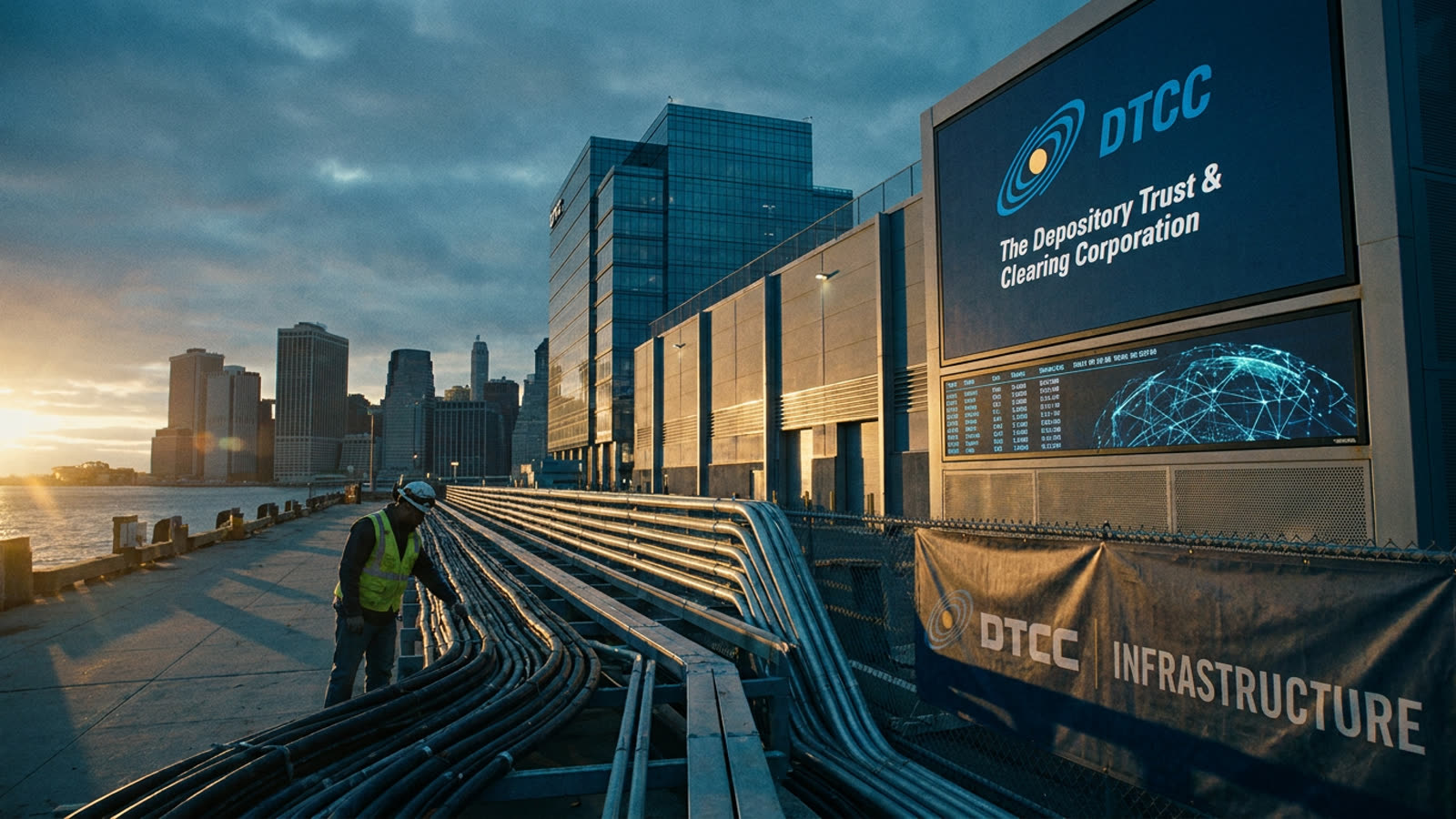
When the organization that clears roughly $2.5 quadrillion in securities annually decides to build on a public blockchain, the crypto industry's long-promised "institutional adoption" narrative finally has a credible protagonist. The Depository Trust & Clearing Corporation's announcement that it will bring tokenized assets to the Stellar network by 2027 is not a press-release experiment or a sandbox pilot. It is a declaration that the back office of American capitalism is ready to treat distributed ledgers as production-grade rails.
The move deserves attention precisely because it is boring. DTCC does not chase hype cycles; it processes trades. Its interest in Stellar—a network designed for payments and asset issuance rather than DeFi speculation—suggests that tokenization's killer app may not be fractional Picassos or on-chain real estate, but the mundane business of settling equities, bonds, and money-market instruments faster and with fewer intermediaries.
Why Stellar, and why now
Stellar has spent years cultivating relationships with regulated financial institutions, positioning itself as the sensible alternative to Ethereum's gas-fee volatility and Solana's periodic outages. Circle, the issuer of USDC, recently unveiled Arc, its own stablecoin-focused blockchain, but Stellar already hosts a meaningful share of USDC volume and has a track record with cross-border payment corridors. For DTCC, choosing Stellar signals a preference for predictability over programmability—a blockchain that does fewer things but does them reliably.
The timing aligns with a broader regulatory thaw. The SEC's evolving posture on tokenized securities, combined with state-level licensing momentum—Mastercard just secured a New York BitLicense—has created a window for incumbents to move without fear of enforcement whiplash. DTCC is walking through that window with the confidence of an institution that knows regulators will not kneecap the entity responsible for preventing systemic settlement failures.
What this means for crypto's identity crisis
Tokenization has always been crypto's most plausible bridge to mainstream finance, yet it has languished in the shadow of more speculative narratives. The DTCC announcement reframes the conversation: blockchain is not just an asset class to trade but a technology to adopt. For Stellar, the partnership is vindication of a strategy that prioritized institutional credibility over retail mindshare. For Ethereum and Solana, it is a reminder that the tokenization race may be won by networks they have largely ignored.
The broader implication is that the next wave of on-chain activity may not come from crypto-native protocols at all, but from legacy institutions migrating existing workflows onto blockchain infrastructure. That is less romantic than the decentralization thesis, but it is also more durable.
Our take
DTCC is not betting on Stellar because it believes in crypto ideology; it is betting because tokenization solves real problems in settlement latency and counterparty risk. That is exactly the kind of adoption that matters. The industry has spent years begging for institutional validation while dismissing the institutions themselves as dinosaurs. Now the dinosaurs are building, and they are choosing networks that prioritize compliance over composability. Crypto purists may grumble, but the plumbing company's endorsement is worth more than a thousand ETF inflows.