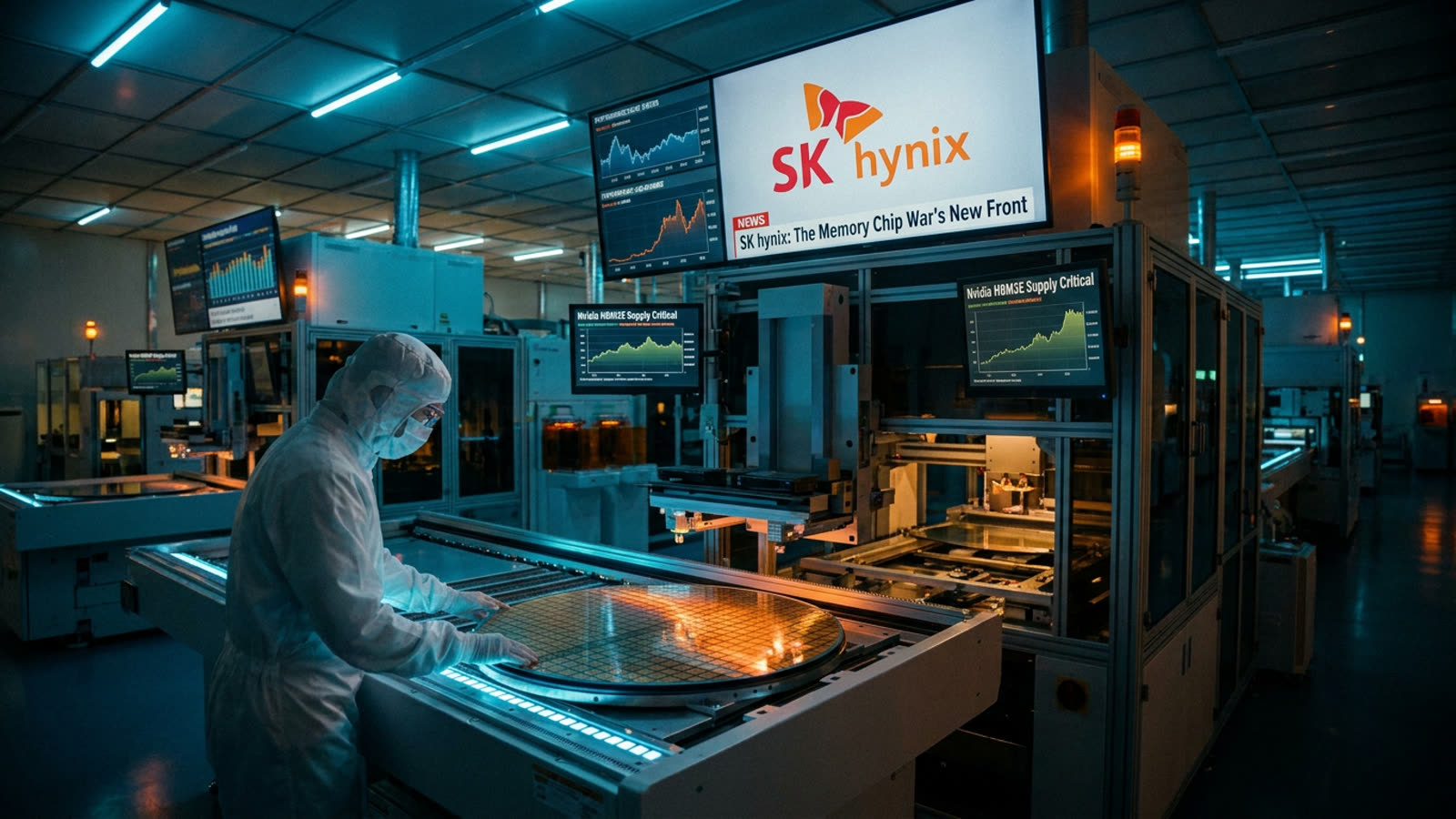
The AI boom has a bottleneck, and it is not compute — it is memory. SK Hynix, the South Korean semiconductor giant that manufactures the high-bandwidth memory chips essential to every cutting-edge AI accelerator, is preparing to list on American exchanges, a move that will reshape how US investors participate in the infrastructure buildout powering generative AI.
The company's HBM3E chips are the beating heart of Nvidia's H100 and Blackwell GPUs, the hardware that OpenAI, Anthropic, Google, and every serious AI laboratory on Earth is scrambling to acquire. SK Hynix commands roughly half the global HBM market, with Samsung trailing and Micron — the only American competitor — holding a distant third. Until now, US investors wanting direct exposure to SK Hynix had to navigate Korean exchanges or settle for ADR workarounds. A full US listing changes the calculus entirely.
Why memory became the chokepoint
For years, the semiconductor conversation centered on logic chips — the processors that execute calculations. Memory was commodity hardware, undifferentiated and margin-thin. AI changed everything. Large language models require not just fast computation but vast, rapid-access memory to hold the billions of parameters that define their capabilities. High-bandwidth memory, which stacks DRAM dies vertically and connects them with through-silicon vias, delivers the throughput these models demand. SK Hynix bet early on HBM technology, and that bet is now paying extraordinary dividends.
The company's memory revenue has surged as hyperscalers place orders years in advance, desperate to secure supply. Nvidia's Jensen Huang has publicly credited SK Hynix as a critical partner. The relationship is symbiotic: Nvidia cannot ship GPUs without HBM, and SK Hynix cannot sell HBM without Nvidia's designs driving demand.
The geopolitical dimension
A US listing is not merely a capital markets event. It arrives amid escalating tension over semiconductor supply chains, with Washington pushing to reduce dependence on Asian manufacturing while simultaneously relying on Korean and Taiwanese firms for the most advanced components. SK Hynix operates major fabrication facilities in South Korea and China — the latter a persistent source of regulatory anxiety as US export controls tighten.
Listing in America signals confidence that SK Hynix can navigate this fraught landscape, but it also invites scrutiny. American investors will demand transparency about Chinese operations, supply agreements with sanctioned entities, and contingency plans should cross-strait tensions disrupt the broader semiconductor ecosystem. The company is betting that the appetite for AI exposure will outweigh these concerns.
Our take
SK Hynix's American debut is less about raising capital than about claiming legitimacy in the market that matters most. The company already prints money; what it wants is mindshare among the institutional investors who will shape semiconductor policy for the next decade. For American portfolios heavy on Nvidia but light on its supply chain, this listing offers something genuinely new: a direct stake in the memory layer that makes AI possible. Whether that stake comes with geopolitical strings attached is a question investors will have to answer for themselves.