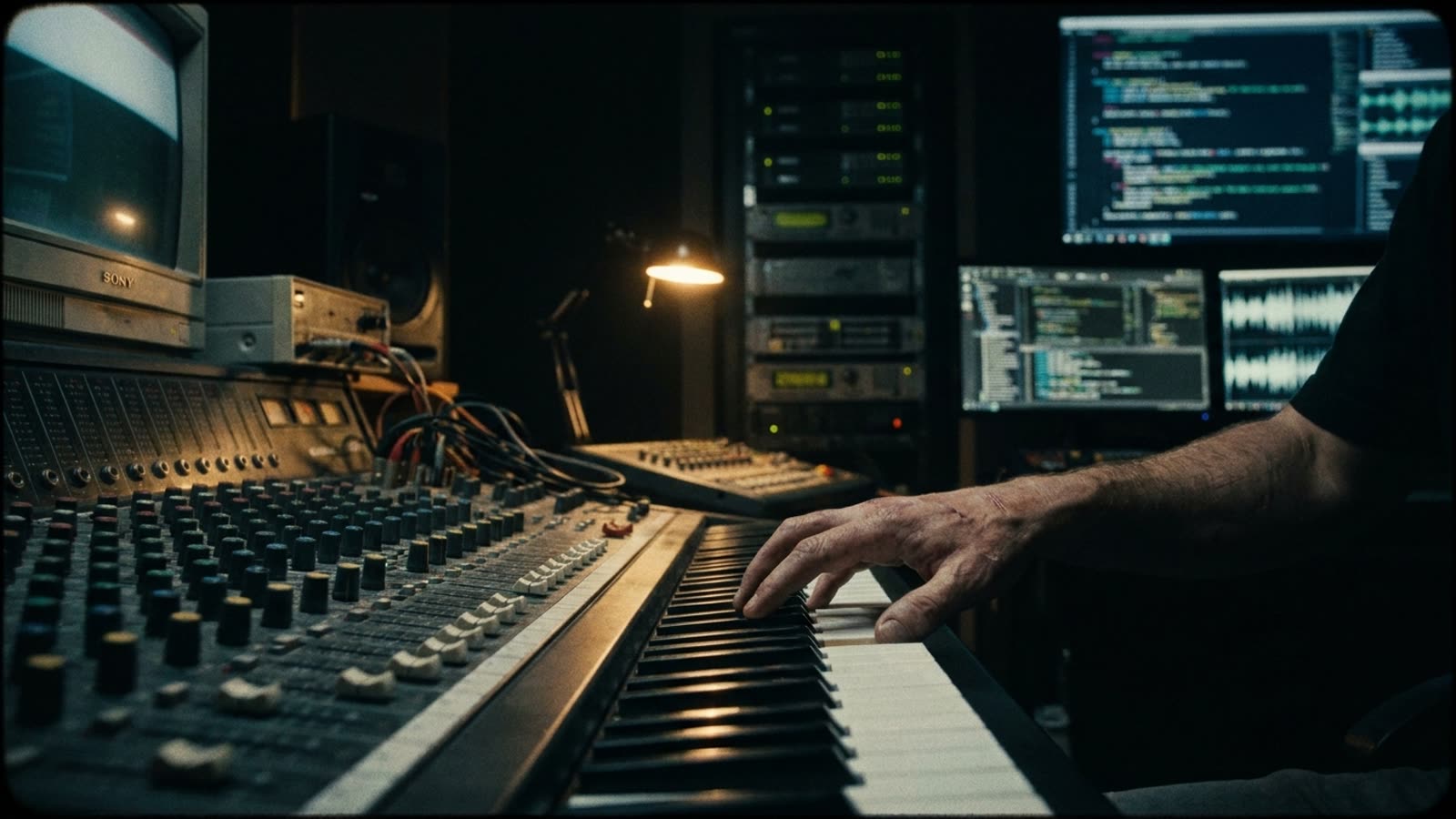
The recording studio has always been a place where technology and intuition collide. From Les Paul's multitrack experiments to Auto-Tune's pitch-perfect interventions, every generation of producers has absorbed new tools that their predecessors viewed with suspicion. But the current wave of AI-assisted music production presents something categorically different: software that doesn't just process sound but generates it, that doesn't just follow instructions but offers suggestions.
The shift is less dramatic than headlines suggest and more profound than most producers admit. AI isn't replacing musicians so much as it's becoming a peculiar kind of collaborator—one that works tirelessly, never gets defensive about feedback, and has absorbed the patterns of virtually every recorded song in history.
The quiet revolution in the control room
Modern AI music tools fall into roughly three categories: those that generate raw material (melodies, chord progressions, drum patterns), those that handle technical grunt work (mixing, mastering, stem separation), and those that assist with arrangement and structure. The first category attracts the most anxiety and the least actual use. The second has become nearly ubiquitous. The third is where the interesting creative questions live.
A producer working on a pop track can now feed an AI a rough vocal take and receive back a dozen harmonic options, each stylistically coherent, each technically sound. The AI doesn't know what the song is about, doesn't understand that the bridge needs to feel like a release after tension, doesn't grasp why one chord substitution feels clever and another feels cheap. But it can generate options faster than any human collaborator, and sometimes—often enough to matter—one of those options sparks something the producer wouldn't have found alone.
The authenticity question nobody can answer
Music has always been a magpie art, built on borrowed phrases and absorbed influences. The difference now is scale and transparency. When a guitarist unconsciously quotes a lick they heard decades ago, we call it style. When an AI explicitly draws on a training corpus of millions of songs, we call it theft—or at least we're not sure what to call it.
The legal questions remain genuinely unsettled. But the creative questions are more interesting: if a producer uses AI to generate a bassline, then modifies it substantially, then builds a song around it, who made the music? The answer probably matters less than we think. Listeners have never cared much about process; they care about how the final product makes them feel. The producer's job has always been to serve the song, not to prove their own indispensability.
What the machines can't hear
For all their pattern-matching prowess, current AI systems remain deaf in ways that matter. They can identify that a minor seventh chord typically resolves in certain ways, but they can't feel the ache in a suspended resolution. They can generate a technically proficient guitar solo, but they can't understand why B.B. King's single bent note carries more emotional weight than a thousand fast runs.
This limitation isn't a temporary bug awaiting a fix. It reflects something fundamental about what music is for. The best producers have always been translators between technical possibility and human feeling. AI expands the technical possibilities enormously while remaining mute on the question of feeling.
Our take
The panic about AI in music production misses the point, as does the hype. These tools will make certain kinds of competence cheaper and more accessible, which is mostly good. They will generate enormous amounts of forgettable background music, which is mostly neutral. They will not replace the human capacity to make sounds that move other humans, because that capacity was never really about the sounds themselves. The ghost in the machine is useful precisely because it has no soul to bare. The producer's job is to have one.