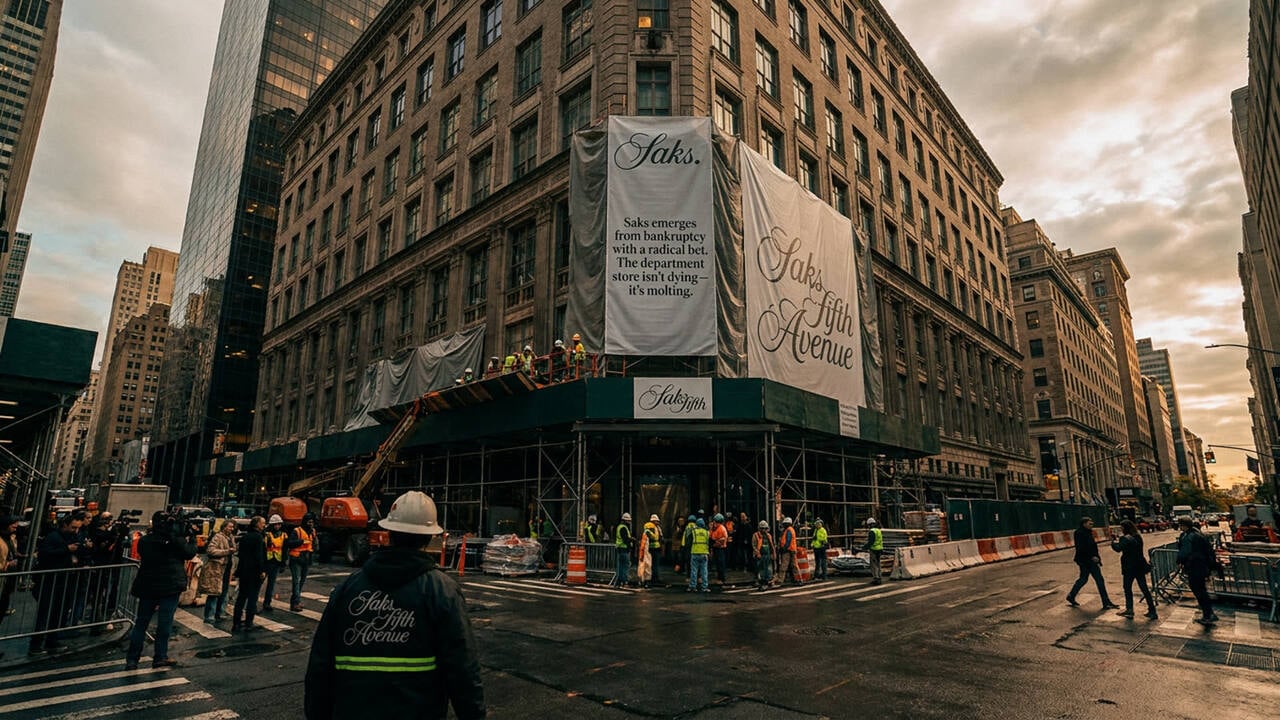
The obituaries for American department stores have been written so many times they've become a genre unto themselves. Macy's, Neiman Marcus, JCPenney, Lord & Taylor—the litany of closures, bankruptcies, and liquidations has conditioned us to view any retail restructuring as the first movement in a funeral march. Saks Fifth Avenue's emergence from bankruptcy this week invites a different interpretation: not death, but metamorphosis.
The company's reorganization plan centers on a deceptively simple premise—that a luxury retailer should actually be luxurious. This sounds obvious until you consider how thoroughly American department stores abandoned the concept over the past two decades, chasing volume through endless discounting, cluttered floors, and the slow surrender of service to self-checkout kiosks.
The arithmetic of exclusivity
Saks' new strategy involves fewer stores, smaller footprints, and a deliberate retreat from the middle market that department stores have spent decades trying to serve. The company will focus on what retail analysts call "high-touch" service—personal shoppers, private appointments, alterations that actually fit—the very things that e-commerce cannot replicate and that mass retail abandoned as too expensive to scale.
The economics here are instructive. A single customer who spends $50,000 annually on curated purchases requires roughly the same overhead as ten customers spending $5,000 each on discounted merchandise they found themselves. But the former customer is loyal, predictable, and immune to Amazon's price-matching algorithms. The latter is one browser tab away from defection.
What bankruptcy buys
Chapter 11 gave Saks what organic restructuring never could: permission to break leases, shed underperforming locations, and renegotiate supplier relationships without the gradual bleeding that killed Barneys and wounded Neiman Marcus. The company reportedly eliminated more than $2 billion in debt and closed dozens of locations that were diluting its brand positioning.
This is the paradox of luxury retail bankruptcy. The process that destroys mass-market retailers can actually strengthen luxury ones by forcing the discipline that shareholders and management teams are too timid to impose during normal operations. Saks couldn't have announced the closure of thirty stores and a pivot to "elevated service" without the legal and financial cover that Chapter 11 provides.
The European precedent
Saks' playbook borrows heavily from European luxury houses that never made the American mistake of democratizing their brands into oblivion. Hermès doesn't discount. Brunello Cucinelli doesn't chase volume. These companies understood decades ago that scarcity and service are features, not bugs—that wealthy customers will pay premium prices precisely because others cannot.
American department stores, by contrast, spent the 2000s and 2010s racing to the bottom, adding outlet locations, launching perpetual sales, and training their best customers to never pay full price. Saks' bankruptcy represents an expensive admission that this strategy was a category error.
Our take
The retail analysts who pronounced department stores dead were half right. The stores that tried to be everything—luxury and mass, curated and comprehensive, exclusive and accessible—those are indeed dying. But Saks' emergence suggests a different future: smaller, more profitable luxury retailers that serve fewer customers better. It's not a model that will save American retail writ large. But it might save the stores worth saving.