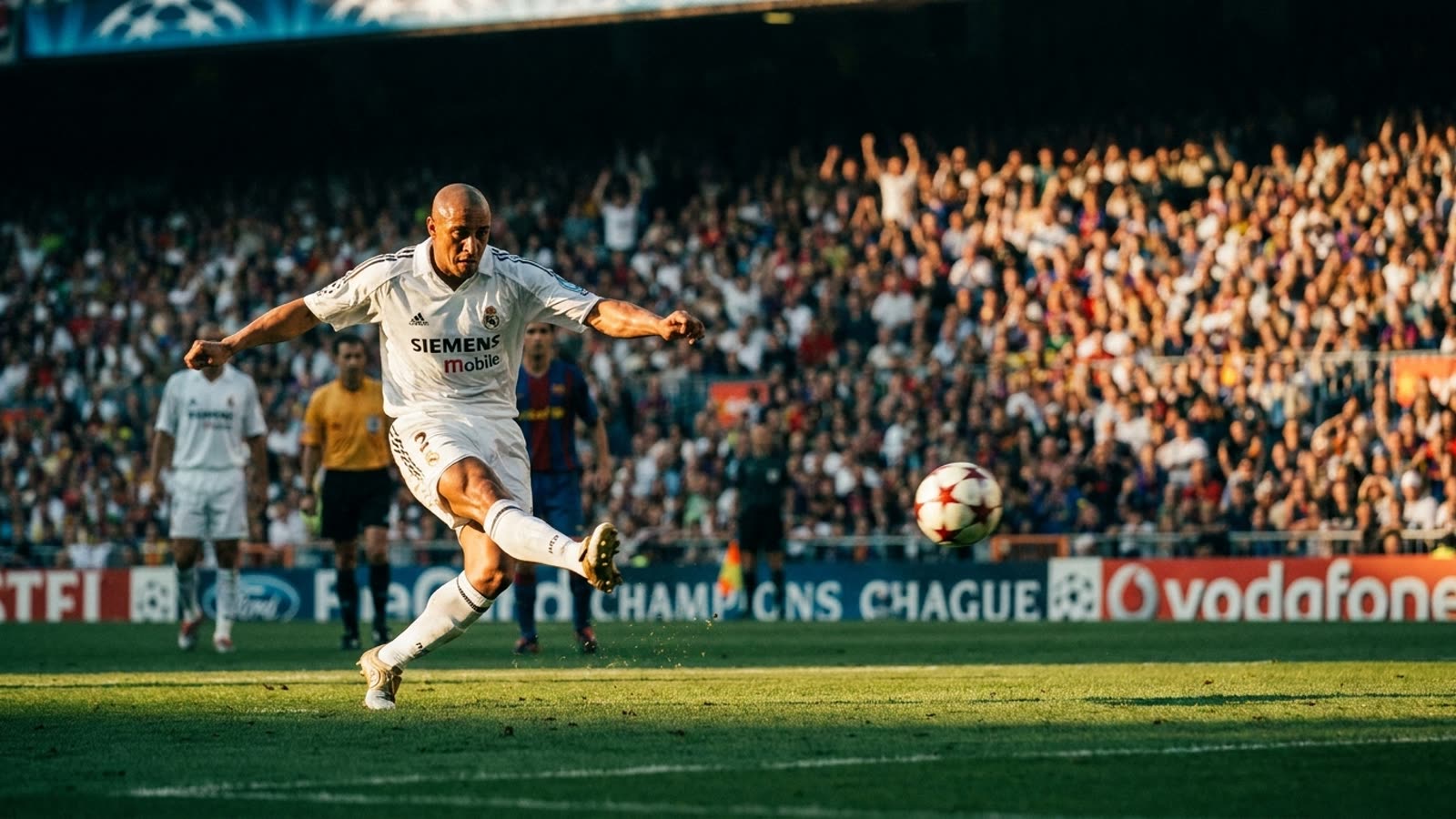
The ball was placed thirty-five meters from goal, too far right for a direct attempt, at an angle that demanded a cross into the box. The French wall, featuring some of the finest defenders of their generation, shuffled into position expecting exactly that. What Roberto Carlos did instead has been studied by physicists, replicated in wind tunnels, and attempted by millions of players who discovered that understanding something and reproducing it are entirely different things.
The Brazilian left-back struck the ball with the outside of his foot, sending it on a trajectory so improbable that a ball boy standing behind the goal ducked out of its apparent path. The ball curved, kept curving, and then curved some more, bending around the wall and inside the post while goalkeeper Fabien Barthez stood frozen, his positioning rendered meaningless by physics he could not have anticipated.
The science of the swerve
Researchers at universities across Europe have published papers explaining what happened that evening in Lyon. The Magnus effect — the same principle that makes curveballs curve and sliced golf shots slice — was at work, but at an extreme that required extraordinary precision. The ball was struck with such force and such specific spin that it generated differential air pressure on its surfaces, pushing it along an arc that seemed to defy Newtonian expectations.
But the scientific explanation, while accurate, somehow diminishes the achievement. Roberto Carlos did not calculate the required angular velocity or account for the coefficient of drag on the Tricolore match ball. He simply knew, in the way that certain athletes know things their bodies understand better than their minds, that if he struck the ball in precisely this manner, it would do precisely that. The gap between knowledge and execution, in this case, was approximately three centimeters — the margin by which the ball cleared the wall.
Why this goal endures
Football produces spectacular goals regularly. Overhead kicks, solo runs through entire defenses, volleys struck from impossible angles — the sport's highlight reels overflow with moments of technical brilliance. Yet this particular free kick, scored in a tournament few remember (the Tournoi de France, a pre-World Cup friendly competition), has achieved a permanence that more consequential goals have not.
Part of the answer lies in the goal's perfect legibility. Unlike a dribbling run that unfolds over seconds and involves multiple decisions, the free kick is a single, discrete action. Ball, foot, flight, net. The viewer can watch it repeatedly and isolate the exact moment when the ordinary became impossible. There is no complexity to parse, only wonder to experience.
The goal also benefits from what it revealed about Roberto Carlos himself — a defender, nominally, who possessed an attacking weapon more devastating than most forwards could claim. His left foot was not merely strong but intelligent, capable of calculations that seemed to operate outside conscious thought.
Our take
Sport occasionally produces moments that transcend competition entirely, becoming instead demonstrations of what human beings can do when talent, preparation, and circumstance align perfectly. Roberto Carlos's free kick belongs to this category. It was not the most important goal ever scored, nor did it win a trophy or decide a championship. But it showed millions of people something they had never seen before and have rarely seen since: a ball doing something that looked, for a fraction of a second, genuinely impossible. That is worth more than most trophies.