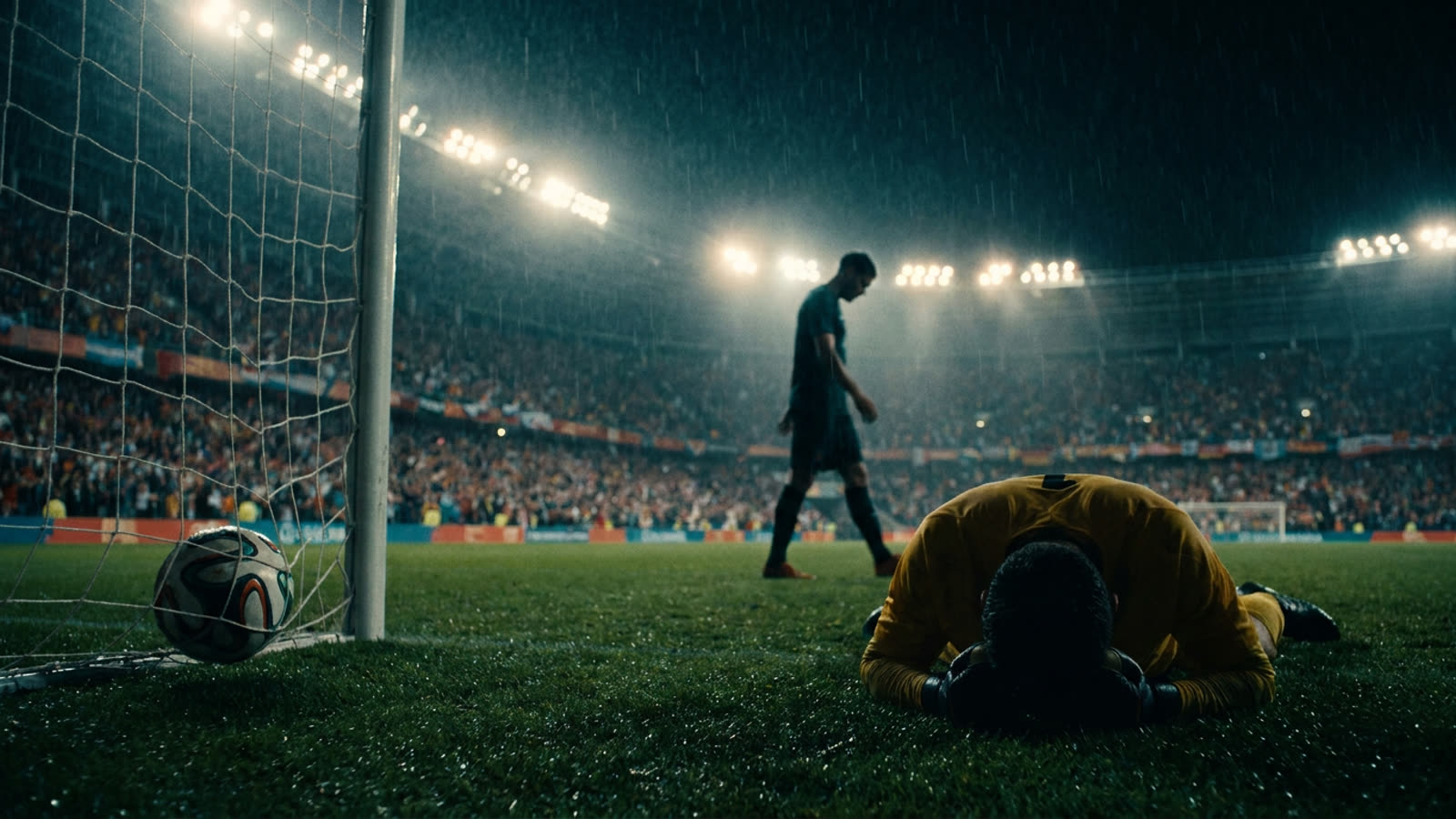
The walk from the centre circle to the penalty spot takes approximately fifteen seconds, but it contains a lifetime of doubt. In that brief traverse, a player must somehow reconcile the simplest task in football—kicking a stationary ball past a single opponent—with the knowledge that millions are watching, that teammates are praying, and that history will remember only whether the net rippled or the goalkeeper guessed correctly.
Penalty shootouts were introduced to World Cup knockout rounds in 1978, a bureaucratic solution to the problem of matches that refused to end. What the administrators could not have anticipated was that they had created something far more profound than a tiebreaker: a psychological laboratory that strips away everything except the individual and the moment.
The geometry of impossibility
The mathematics should favour the striker overwhelmingly. The goal is eight yards wide and eight feet tall. The goalkeeper, standing at the centre, can cover perhaps two-thirds of that space if he commits early and guesses correctly. A well-struck penalty placed in either corner is, by the laws of physics, unsaveable. Conversion rates in regular match play hover around seventy-five to eighty percent.
Yet World Cup shootouts tell a different story. The conversion rate drops measurably when the stakes are highest, and certain footballing nations have developed reputations—fair or not—for faltering at the spot. England's struggles became so notorious that they spawned academic studies, psychological interventions, and eventually, in recent tournaments, a deliberate effort to select penalty takers based on composure rather than seniority.
The explanation lies not in technique but in cognition. Under extreme pressure, the brain shifts from automatic processing to conscious control. The striker who has converted thousands of penalties in training suddenly finds himself thinking about the mechanics of striking a ball—a catastrophic interference with muscle memory that researchers call "paralysis by analysis."
The goalkeeper's gamble
Goalkeepers occupy a peculiar position in the shootout drama. They are expected to lose. A keeper who dives the wrong way on every penalty but his team still wins is a hero; one who saves two but watches his teammates miss three is blameless. This asymmetry of expectation creates a strange freedom.
The great shootout goalkeepers understand something counterintuitive: their job is not primarily to save penalties but to create doubt. The hesitation, the stutter-step, the early movement that draws a yellow card—these are tools of psychological warfare. A goalkeeper who can plant a seed of uncertainty in a striker's mind has done more than any athletic save could accomplish.
Some keepers study opponents obsessively, cataloguing tendencies and tells. Others rely on reading body language in the moment—the angle of the hips, the position of the standing foot, the direction of the final glance. The truth is that even the best-prepared goalkeeper is guessing roughly half the time, but the theatre of preparation may matter more than the preparation itself.
What shootouts reveal
There is something almost cruel about how shootouts expose character. The player who demands the ball in open play may suddenly find reasons to defer when the order of takers is being decided. The quiet professional who never seeks the spotlight may step forward with the expression of someone who has been waiting for exactly this moment.
World Cup history is littered with images that compress entire careers into single frames: Roberto Baggio staring at the sky in Pasadena, Fabio Grosso wheeling away in Berlin, Kylian Mbappé converting with the cold efficiency of a machine. These moments become inseparable from how we remember the players themselves, which is both their tragedy and their opportunity.
Our take
The periodic calls to abolish shootouts or replace them with something less arbitrary miss the point entirely. Football is not merely a test of skill; it is a test of nerve, of will, of the capacity to perform when everything conspires against performance. The shootout is not a flaw in the tournament format—it is the tournament format distilled to its psychological essence. Those twelve yards from the centre circle to the penalty spot are the loneliest walk in sport, and that loneliness is precisely what makes the World Cup unforgettable.