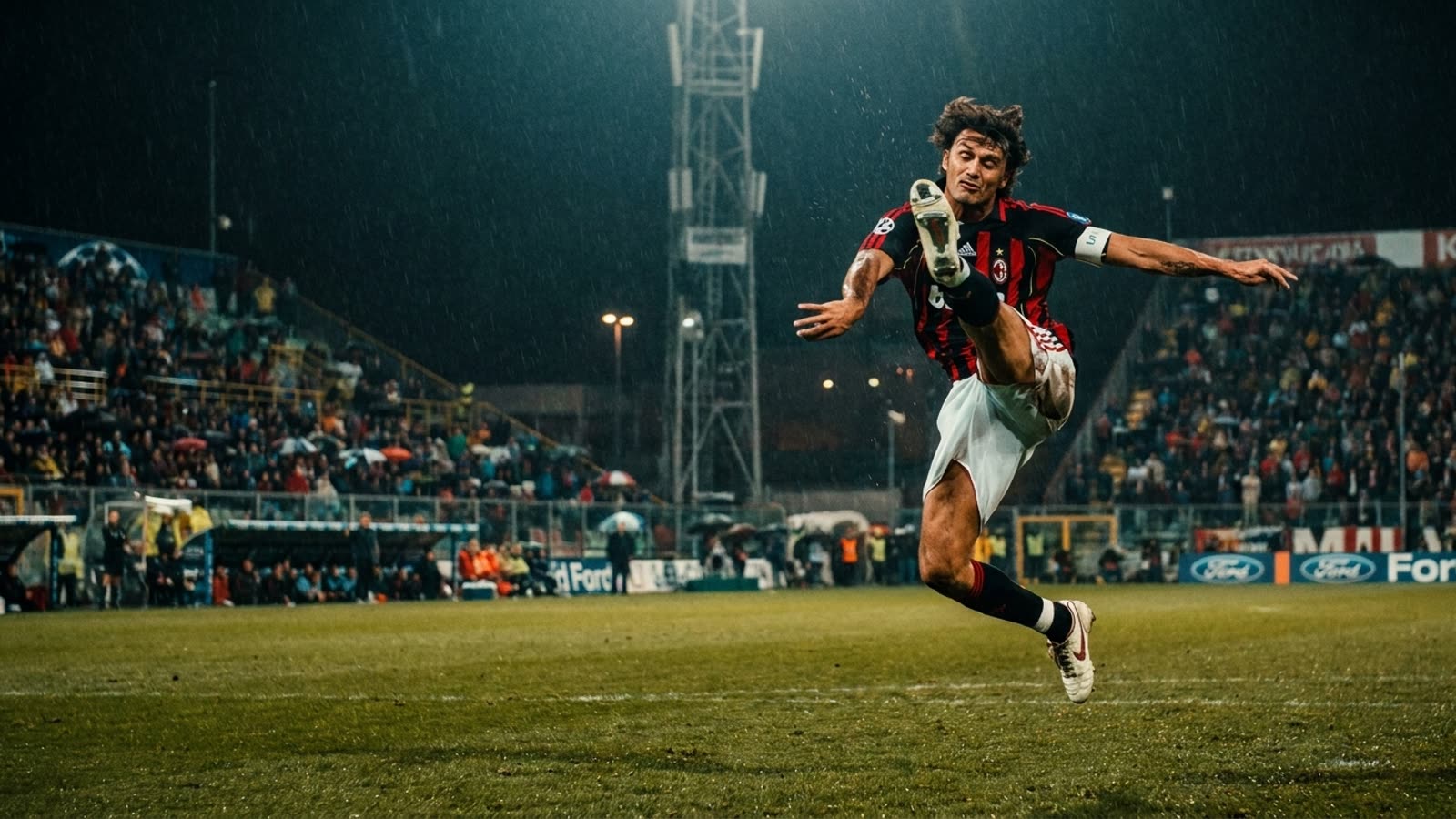
There is a famous Maldini quote that has become something of a cliché in football circles: "If I have to make a tackle, then I have already made a mistake." It is repeated so often that it has lost its subversive edge. But consider what it actually claims: that the highest form of defending is invisible, that perfection leaves no trace in the highlight reel, that the best work happens before anyone notices there was danger at all.
This is a profoundly unfashionable idea in an era that measures football in expected goals and progressive carries and touches in the final third. Paolo Maldini, who spent his entire quarter-century career at AC Milan, embodied a philosophy of the game that modern analytics can barely articulate, let alone quantify.
The geometry of anticipation
What made Maldini singular was not athleticism, though he possessed it, nor technique, though his was immaculate. It was spatial intelligence — an almost architectural understanding of where attackers wanted to go and how to make that destination unreachable without ever appearing to exert effort. He defended in angles and shadows, positioning his body to eliminate options before they materialised.
Watch footage of Maldini at his peak in the 1990s and early 2000s, and what strikes you is the economy. Other defenders lunge and recover, slide and scramble. Maldini glides into position as if he had read the play three passes earlier — which, of course, he had. The tackle he never made was the tackle he rendered unnecessary.
This required a kind of cognitive processing that remains poorly understood. Attackers are taught to be unpredictable, to disguise their intentions, to manufacture chaos. Maldini's gift was pattern recognition so refined that unpredictability became predictable to him. He saw the grammar beneath the improvisation.
The inheritance problem
Maldini retired in 2009, and Italian football has spent the years since searching for his successor without quite finding one. This is partly bad luck and partly a structural shift in how defenders are developed. Youth academies now prize ball-playing ability above all; the centre-back who can ping diagonal switches is more valued than the one who can read a through-ball before it is played.
The market reflects this. Transfer fees for defenders have exploded, but the premiums go to those who fit possession-based systems — players comfortable receiving under pressure, comfortable as auxiliary midfielders. Pure defending, the art of denial, has become almost a secondary consideration.
This is not necessarily wrong. Football evolves, and the modern game demands different skills. But something has been lost in the transition: the understanding that defending is not merely the absence of attacking, not merely the negative space around the goal, but a discipline with its own aesthetics and its own genius.
Our take
Maldini's career poses an uncomfortable question for football's data revolution: how do you measure what doesn't happen? Expected goals against captures some of it, but not the positioning that discouraged the pass in the first place, not the reputation that made attackers choose the other flank. The best defenders, like the best editors, do their finest work by removing things — and removal leaves no fingerprint. Football will continue to celebrate the spectacular, the goals and the assists and the dribbles past three men. But those of us who watched Maldini know that there was something equally spectacular in the quiet authority of a man who made defending look like prophecy.