Modern football has a curious blind spot. We can quantify expected goals to the third decimal, track pressing intensity in real time, and debate the merits of inverted full-backs with theological fervor. Yet when it comes to evaluating defenders, we mostly shrug and mention clean sheets. Paolo Maldini's quarter-century at AC Milan exposes this analytical poverty for what it is: a failure of imagination.
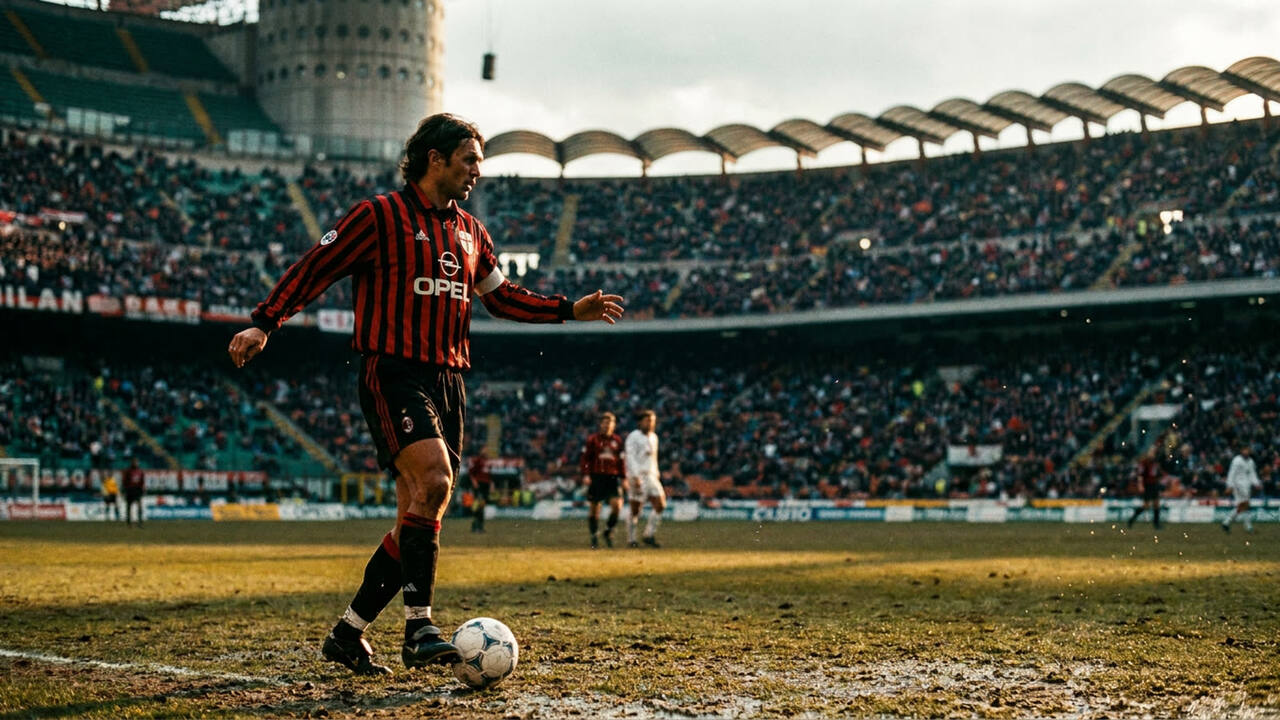
The Italian spent his entire club career at San Siro, retiring at forty after more than a thousand professional appearances. He won five European Cups, seven Serie A titles, and reached three more Champions League finals. But the statistics, impressive as they are, miss the point entirely. Maldini was not great because he accumulated trophies. He accumulated trophies because he understood something about defending that most players—and most analysts—never grasp.
The geometry of anticipation
Maldini's famous observation that he rarely needed to tackle because positioning made it unnecessary sounds like false modesty until you watch the footage. Where other defenders lunged and recovered, Maldini simply arrived. His body was already occupying the space the attacker wanted before the attacker knew they wanted it. This was not athleticism, though he possessed plenty. It was spatial intelligence operating at a level that made the game look slower than it was.
He began as a left-back in his father Cesare's image, then migrated to centre-back in his thirties as pace diminished but reading of the game deepened. Both positions showcased the same quality: an almost eerie calm that suggested he was playing a different match than everyone else, one with more time and fewer surprises.
Why the position has drifted
Contemporary football values defenders who can play. Ball progression, line-breaking passes, comfort under pressure—these are the currencies of the transfer market. The shift is not wrong, exactly. Building from the back has genuine tactical merit. But it has produced a generation of centre-backs who are praised for what they do with the ball and excused for what they cannot do without it.
Maldini could pass, certainly. He was technically excellent. But no one watched him and thought first about his distribution. They thought about the way he made attacking players look ordinary, how he seemed to drain confidence from opponents through sheer inevitability. That skill—the art of denial—has become harder to teach because it is harder to measure, and what cannot be measured struggles to survive in an age of data-driven recruitment.
Our take
There is something melancholy about a craft that cannot be adequately captured by the tools we use to evaluate it. Maldini's career is a reminder that football is not only about creating chances but about extinguishing them, not only about space exploited but about space refused. The game will keep producing excellent defenders. Whether it will produce another who makes the position look like philosophy is a different question, and the honest answer is probably not.