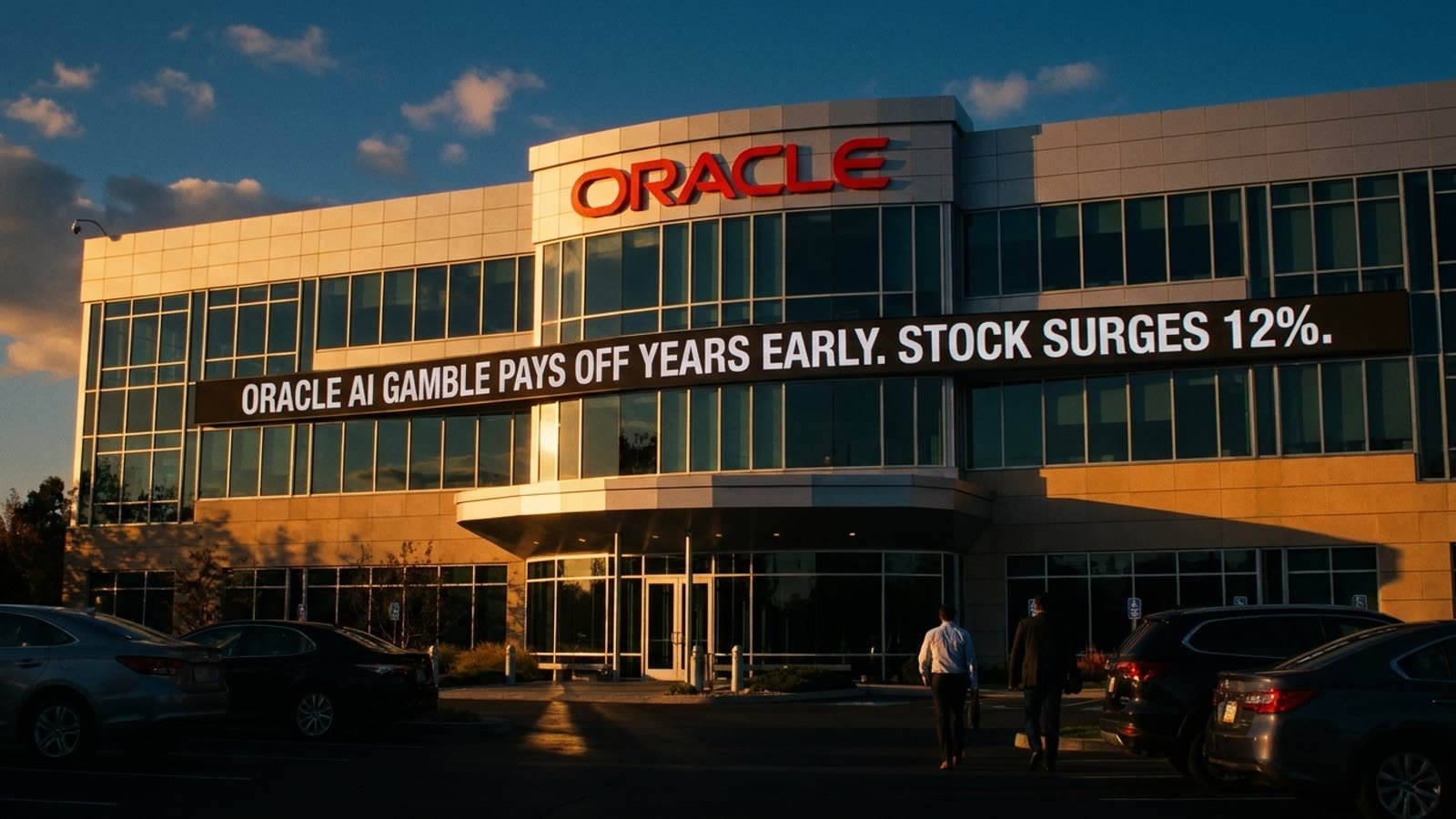
For a company that spent much of the 2010s being written off as a legacy dinosaur, Oracle's investor day on Wednesday felt like a victory lap taken at a sprint. The database group told analysts it now expects to hit $30 billion in annual free cash flow by fiscal 2029—a target that, just eighteen months ago, management had penciled in for the early 2030s. The stock jumped 12 percent in afternoon trading, adding roughly $50 billion to Oracle's market capitalization in a single session.
The acceleration rests on a simple, if risky, thesis: that enterprise demand for AI infrastructure is so voracious, and Oracle's cloud margins so favorable, that the company can fund most of its data center expansion from operating cash rather than debt. Management pledged to cap incremental borrowing for the buildout at $20 billion, a figure that would have sounded impossibly modest two years ago, when hyperscalers were gorging on cheap capital to erect GPU farms across three continents.
Why the market bought it
Oracle's credibility on AI has grown quietly but steadily. Its multi-cloud partnerships with Microsoft and Nvidia have positioned it as a neutral Switzerland for enterprises wary of locking themselves into a single hyperscaler. Revenue from cloud infrastructure services has been growing at north of 50 percent year-over-year for several quarters, and gross margins in that segment remain above 60 percent—a number that would make AWS accountants weep with envy. Investors, having watched Oracle's stock roughly triple since 2022, are now pricing in a scenario where the company becomes the preferred back-end for corporate AI workloads that don't fit neatly into the Microsoft-OpenAI or Google-Anthropic ecosystems.
The risks Oracle glossed over
The investor presentation was notably light on the competitive dynamics that could derail the thesis. Amazon, Google, and Microsoft are all racing to commoditize the very infrastructure Oracle is betting on. Custom silicon from each hyperscaler threatens to erode the Nvidia dependency that currently gives Oracle its multi-cloud leverage. And the $20 billion borrowing cap assumes that interest rates will cooperate—a fraught assumption given that the Federal Reserve, just hours before Oracle's presentation, held rates steady at 3.75 to 4 percent with no clear signal of cuts ahead. If rates stay elevated and AI demand cools even modestly, Oracle's self-funding model could require painful revisions.
What it means for the AI infrastructure race
Oracle's guidance is the clearest sign yet that the AI infrastructure boom is entering a phase of consolidation. The era of infinite capital for anyone with a shovel and a GPU purchase order is ending. Winners will be companies that can finance growth from cash flow, not just from investor faith. Oracle is betting it can be one of those winners. Wednesday's market reaction suggests that, for now, the bet is working.
Our take
Oracle's reinvention has been one of the quieter corporate comebacks of the decade, and Wednesday's guidance is its boldest claim yet. Whether the company can actually deliver $30 billion in free cash flow by 2029 depends on variables—AI adoption curves, interest rates, competitive dynamics—that no spreadsheet can reliably forecast. But the market's willingness to reward the promise tells you something important: in a sector littered with vaporware and inflated projections, Oracle's track record of underpromising and overdelivering has become a genuine competitive asset. The dinosaur, it turns out, learned to code.