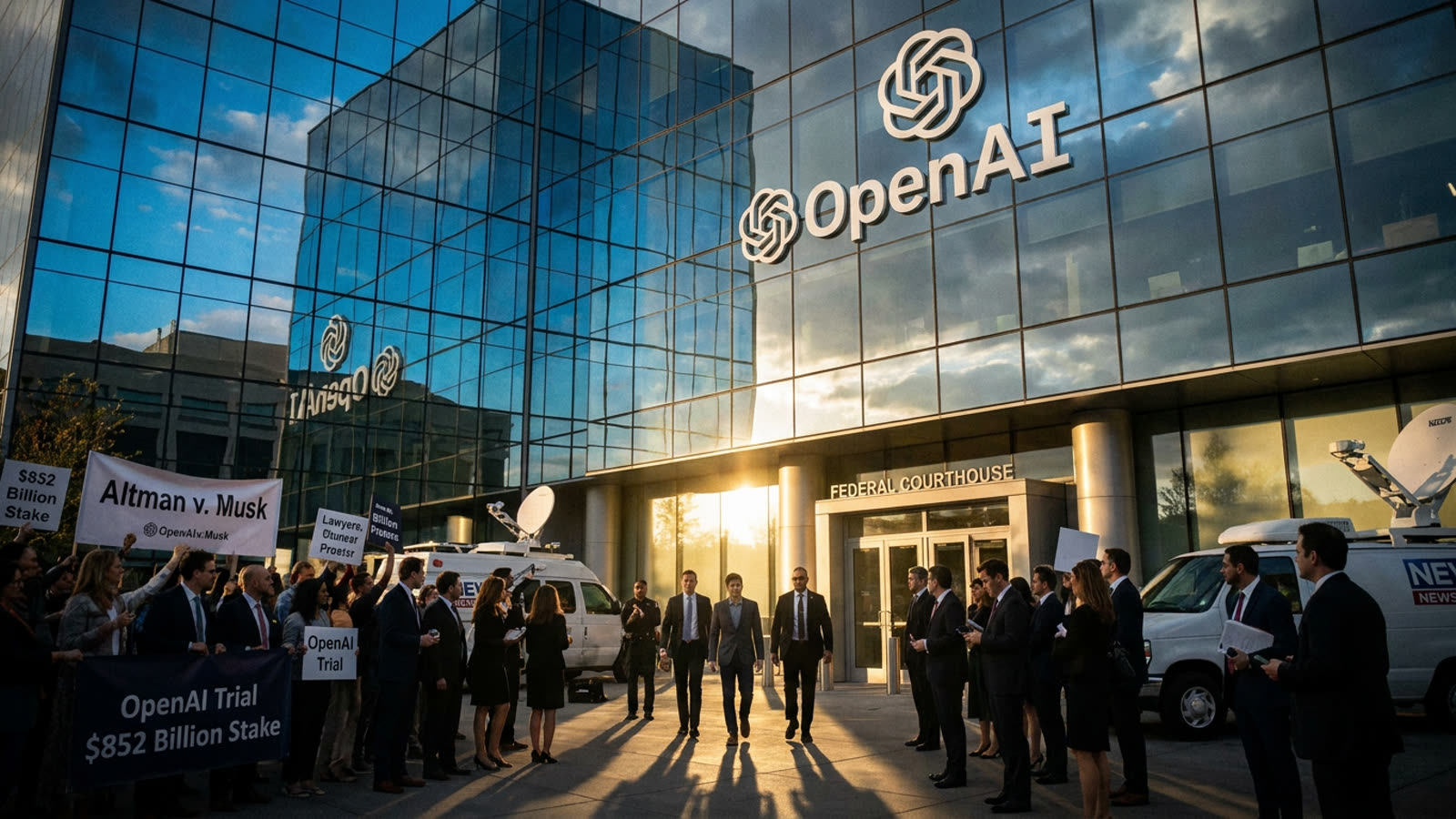
What began as a billionaire's grievance has become something rarer: a courtroom excavation of how the most valuable startup in history was actually built, and who got left behind.
The Musk v. OpenAI trial, now entering its final week in San Francisco federal court, has already delivered testimony from board members, early employees, and Microsoft executives. But the main event arrives Monday, when Sam Altman—the man Musk once backed and now seeks to destroy—takes the witness stand to defend the company's transformation from nonprofit research lab to $852 billion commercial juggernaut.
The architecture of a falling out
Musk's core claim is straightforward: he gave OpenAI roughly $50 million on the understanding it would remain a nonprofit dedicated to developing artificial general intelligence for humanity's benefit. Instead, Altman restructured the organization, created a capped-profit subsidiary, and signed a multi-billion-dollar partnership with Microsoft that Musk argues violated the founding agreement.
The defense counters that Musk himself proposed converting OpenAI into a for-profit entity in 2017 and 2018, and that his departure came only after the board rejected his bid to take control. Internal communications entered into evidence have shown a relationship that curdled from mutual admiration into something approaching contempt, with Musk at one point telling Altman the company had "no chance" of competing with Google without him.
What the trial has already revealed
Beyond the legal arguments, the proceedings have offered an unusually candid look at Silicon Valley's power dynamics. Testimony has touched on everything from the chaotic 2023 board crisis that briefly ousted Altman to the internal debates over whether GPT-4 represented a genuine step toward AGI. Former board member Helen Toner's appearance was particularly pointed, describing what she characterized as a pattern of Altman providing incomplete information to directors.
Microsoft's role has also come under scrutiny. The company's $13 billion investment gave it extensive access to OpenAI's technology while the nonprofit board retained nominal control—an arrangement that several witnesses acknowledged created inherent tensions. Satya Nadella is not expected to testify, but his deputies have defended the partnership as mutually beneficial.
The stakes beyond the verdict
Whatever the jury decides, the trial has already reshaped the narrative around OpenAI's ascent. The company has long presented itself as a mission-driven organization that reluctantly embraced commercial structures to fund its research. Musk's lawsuit, and the documents it has surfaced, suggest a messier reality: ambitious people making opportunistic decisions under conditions of genuine uncertainty about what they were building.
For Musk, a victory could mean unwinding OpenAI's corporate structure or extracting billions in damages. For Altman, even a legal win may come at reputational cost. The portrait emerging from testimony is of a leader who operated with considerable autonomy, sometimes to the frustration of those nominally overseeing him.
Our take
The Musk-Altman feud is often framed as a clash of egos, and it is certainly that. But it is also a dispute about something more fundamental: whether the development of transformative AI can be governed by traditional nonprofit structures, or whether the capital requirements are simply too vast. Musk's lawsuit implicitly argues for the former; OpenAI's existence argues for the latter. The jury will rule on contract law, but the larger question—who should control the most powerful technology ever built—remains unanswered. That this trial is happening at all suggests the answer will not come from courtrooms.