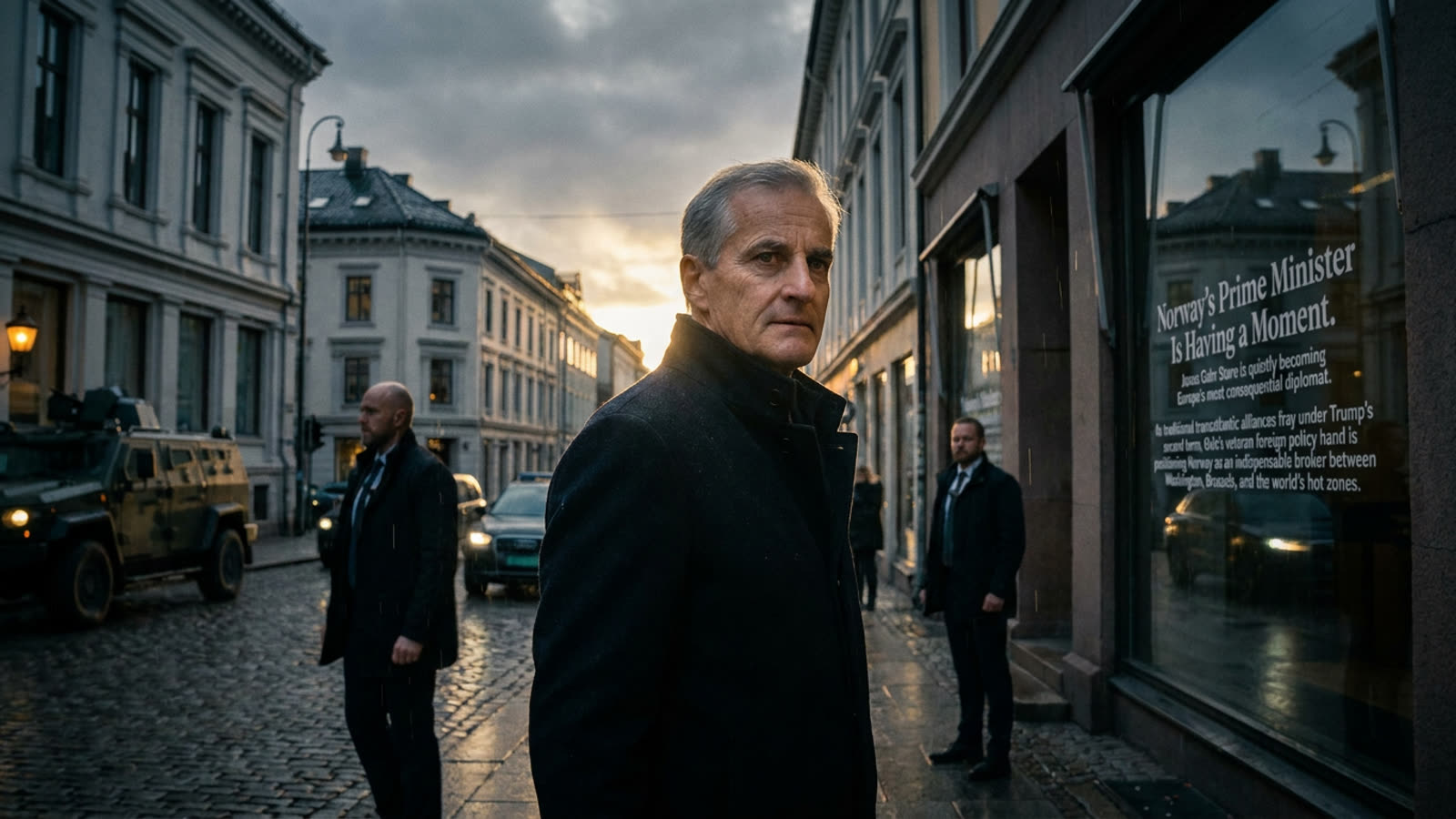
While European leaders scramble to interpret Donald Trump's mercurial foreign policy, Norway's Jonas Gahr Støre has been doing something unfashionable: listening, traveling, and saying very little in public.
The Labour prime minister's visit to France this week—his third European capital in ten days—underscores a diplomatic offensive that has largely escaped American attention. But in chancelleries from Berlin to Kyiv, Støre's role as a quiet interlocutor is increasingly valued. Norway sits outside the European Union but inside NATO, shares an Arctic border with Russia, manages one of the world's largest sovereign wealth funds, and has historically served as a back-channel venue for everyone from the PLO to the Tamil Tigers. In 2026, those credentials matter more than ever.
The Trump factor
Washington's unpredictability has created a vacuum that mid-sized powers are racing to fill. Støre, who served as foreign minister from 2005 to 2012 and helped negotiate the Oslo Accords' twentieth-anniversary follow-up talks, understands the game. His government has quietly offered to host preliminary discussions on Ukraine, kept communication lines open with both Tehran and Gulf capitals, and resisted the temptation to grandstand on social media.
The contrast with some EU leaders—who oscillate between public hand-wringing and performative defiance—is deliberate. "Norway's utility is that it can talk to Washington without being dismissed as a supplicant, and to Moscow without being accused of appeasement," a senior French diplomat told reporters in Paris this week. Støre's government has increased defense spending, honored NATO commitments, and avoided the rhetorical provocations that irritate the current White House.
Domestic constraints
None of this makes Støre popular at home. His coalition trails the opposition Conservatives in polls, inflation has eroded purchasing power, and the left flank of his own party grumbles about oil-fund investments and immigration policy. A snap election remains unlikely before the scheduled 2029 vote, but the prime minister's approval ratings hover in the low 30s.
Yet foreign policy has rarely decided Norwegian elections. Støre appears to be betting that competence abroad will eventually translate into credibility at home—or at least that a diplomatic success could shift the narrative. The risk is that he becomes indispensable to everyone except Norwegian voters.
Our take
Small-country diplomacy is easy to romanticize and hard to execute. Støre's Norway is not going to broker a grand bargain on Ukraine or Iran; the power asymmetries are too vast. But in an era when the major players seem intent on talking past each other, a trusted intermediary with no territorial ambitions and deep institutional memory is genuinely useful. Whether that usefulness survives another Trump term—or a change in Oslo—remains to be seen. For now, Støre is proof that in diplomacy, the boring option is sometimes the smart one.