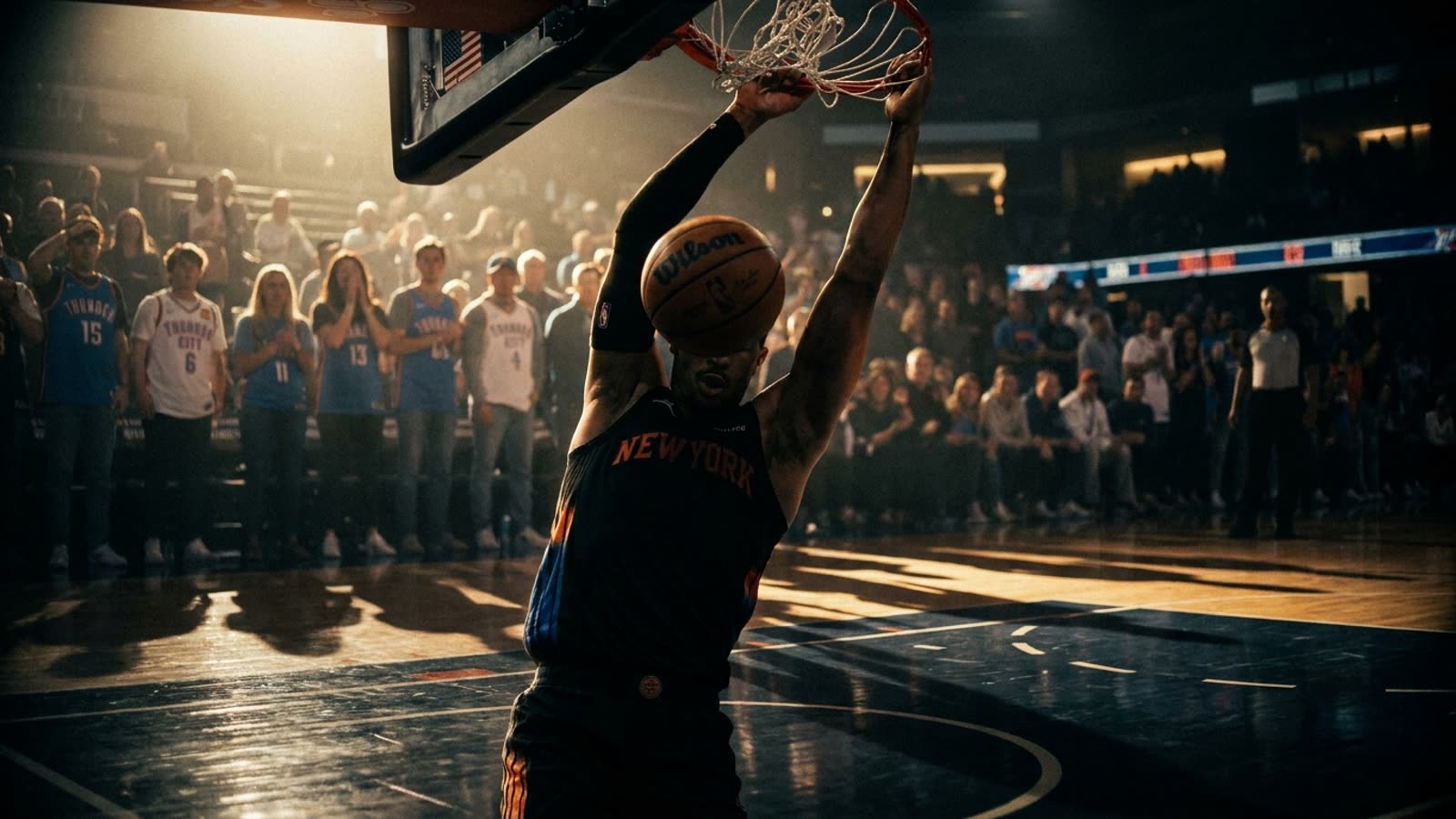
The Thunder entered these Finals as favorites for good reason: the league's best regular-season record, a historically efficient offense, and a young core that seemed to have exorcised its postseason demons. Then the Knicks came to Paycom Center and administered a 106-minute clinic in why regular-season dominance and championship pedigree are different currencies.
New York's Game 1 victory wasn't a heist so much as a statement of philosophical superiority. The Knicks defended with the switching aggression that has become Tom Thibodeau's signature, rotating seamlessly between coverages and refusing to let Oklahoma City's motion offense find its rhythm. The Thunder's halfcourt possessions grew stagnant, their usually crisp ball movement devolving into isolation purgatory.
The late-game equation
Championship series are won in the margins, and the margins belong to teams that can execute under duress. The Knicks closed the fourth quarter with the poise of a franchise that has been here before—because, in the Thibodeau era, they have. Their half-court offense, often criticized as plodding during the regular season, revealed itself as a feature rather than a bug: deliberate, patient, and designed to generate quality looks when the stakes are highest.
Oklahoma City, by contrast, looked like a team discovering in real time that playoff basketball is a different sport. Their transition game, the engine of their regular-season success, was neutralized by New York's defensive transition discipline. When forced to grind out possessions, the Thunder's youth showed.
Structural concerns for OKC
One game is a small sample, but the patterns that emerged are not easily corrected. The Thunder's perimeter defense, adequate against most opponents, struggled to contain New York's multi-positional attack. Their bench, deep and productive during the regular season, was outplayed by Knicks reserves who understood the assignment: don't lose the lead, don't freelance, trust the system.
More troubling for Oklahoma City is the question of adjustments. Mark Daigneault is a gifted coach, but the Knicks' defensive scheme doesn't offer obvious solutions. You can't simply "run more" against a team that takes away transition. You can't rely on three-point variance against a defense that contests without fouling.
Our take
The Thunder remain talented enough to win this series, but Game 1 revealed that talent alone won't be sufficient. The Knicks have something Oklahoma City is still developing: a playoff identity forged through years of Thibodeau's demanding system. New York knows exactly who they are in June. The Thunder are still figuring it out, and the Finals is an unforgiving classroom.