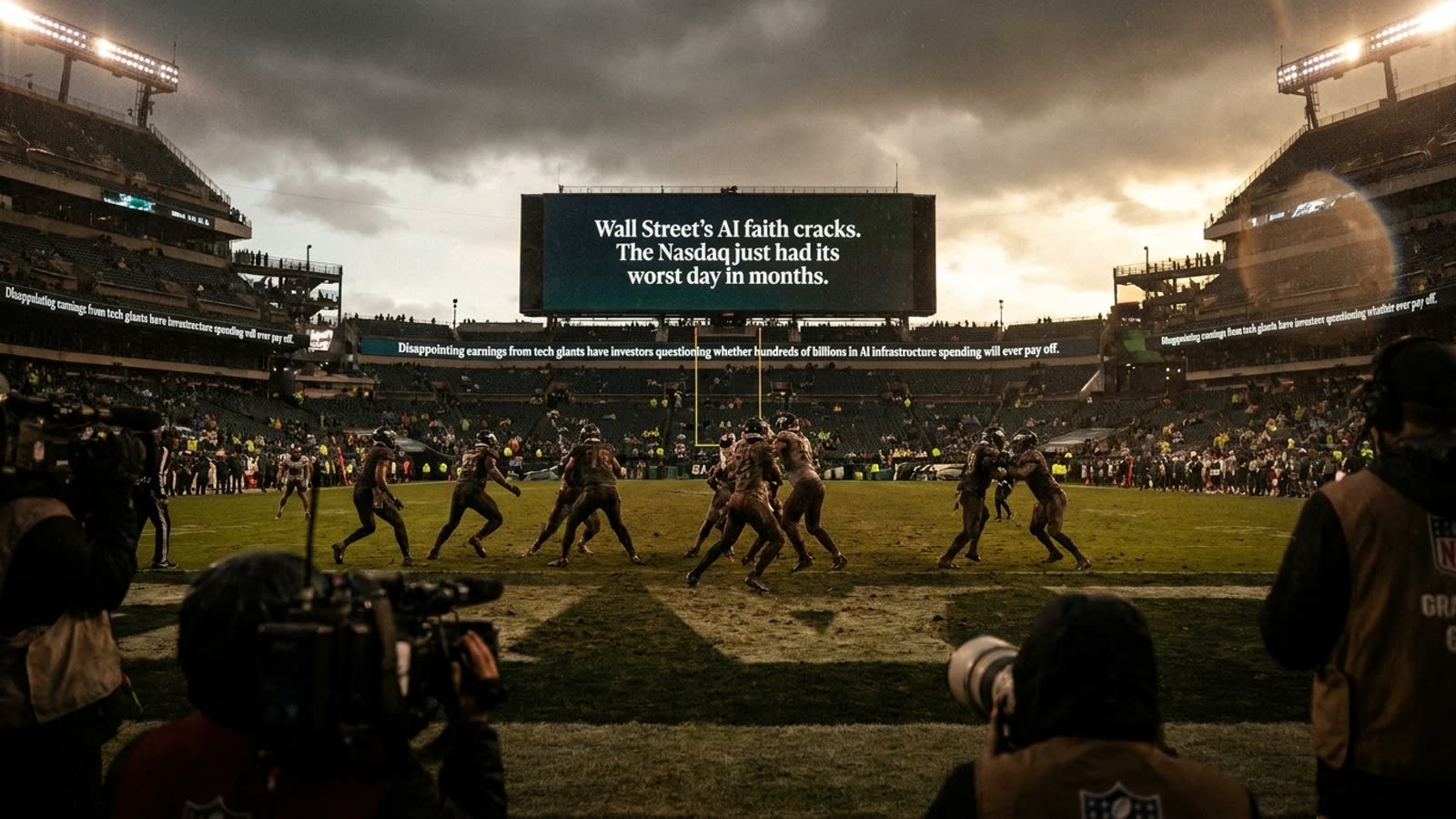
The great AI trade is finally facing its moment of doubt. The Nasdaq 100 plunged 2.6 percent on Friday as a cascade of underwhelming earnings reports forced Wall Street to confront an uncomfortable question it has spent two years avoiding: what if the returns on all that AI spending never arrive?
The immediate trigger was earnings season's crescendo of disappointment. Major technology companies reported results that, while often meeting revenue expectations, revealed capital expenditure trajectories that made even the most committed AI bulls pause. The market's verdict was swift and unforgiving.
The capex reckoning arrives
For the past three years, investors have treated AI infrastructure spending as an article of faith. Every additional billion committed to data centers, every new chip order, every expanded cloud capacity announcement was greeted as evidence of inevitable future dominance. The logic was seductive: spend now, reap exponential returns later.
That logic is now being stress-tested. Quarterly results from the largest technology companies revealed a pattern that spooked the market: capital expenditure continues to accelerate even as the revenue growth that was supposed to justify it remains stubbornly elusive. The gap between investment and return is widening, not narrowing.
Analysts who spent months upgrading price targets are now scrambling to model scenarios where the payoff timeline extends well beyond their original projections. Some are quietly questioning whether certain AI applications will ever generate returns commensurate with their infrastructure costs.
Contagion beyond the obvious names
The selloff was notable for its breadth. This was not a surgical repricing of one or two companies that missed expectations. The entire technology complex sold off in sympathy, suggesting investors are reassessing the sector's fundamental assumptions rather than punishing individual missteps.
Chip designers, cloud providers, enterprise software companies, and even tangentially AI-adjacent firms all saw significant declines. The message from the market was clear: the rising tide that lifted all AI-related boats may be receding.
Bond markets added to the anxiety. Treasury yields ticked higher as investors rotated out of growth stocks, compounding the pressure on long-duration equity valuations that depend on distant future cash flows—precisely the profile of most AI infrastructure plays.
Our take
This correction was overdue and healthy. The AI investment thesis was never wrong, but its timeline was always more uncertain than the market's relentless bid suggested. Technology companies are building genuine capabilities, but the path from capability to profitability runs through years of iteration, enterprise adoption cycles, and competitive pressure that compresses margins. Friday's rout does not mean AI is a mirage. It means Wall Street is finally pricing in the possibility that the future takes longer to arrive than the pitch decks promised.