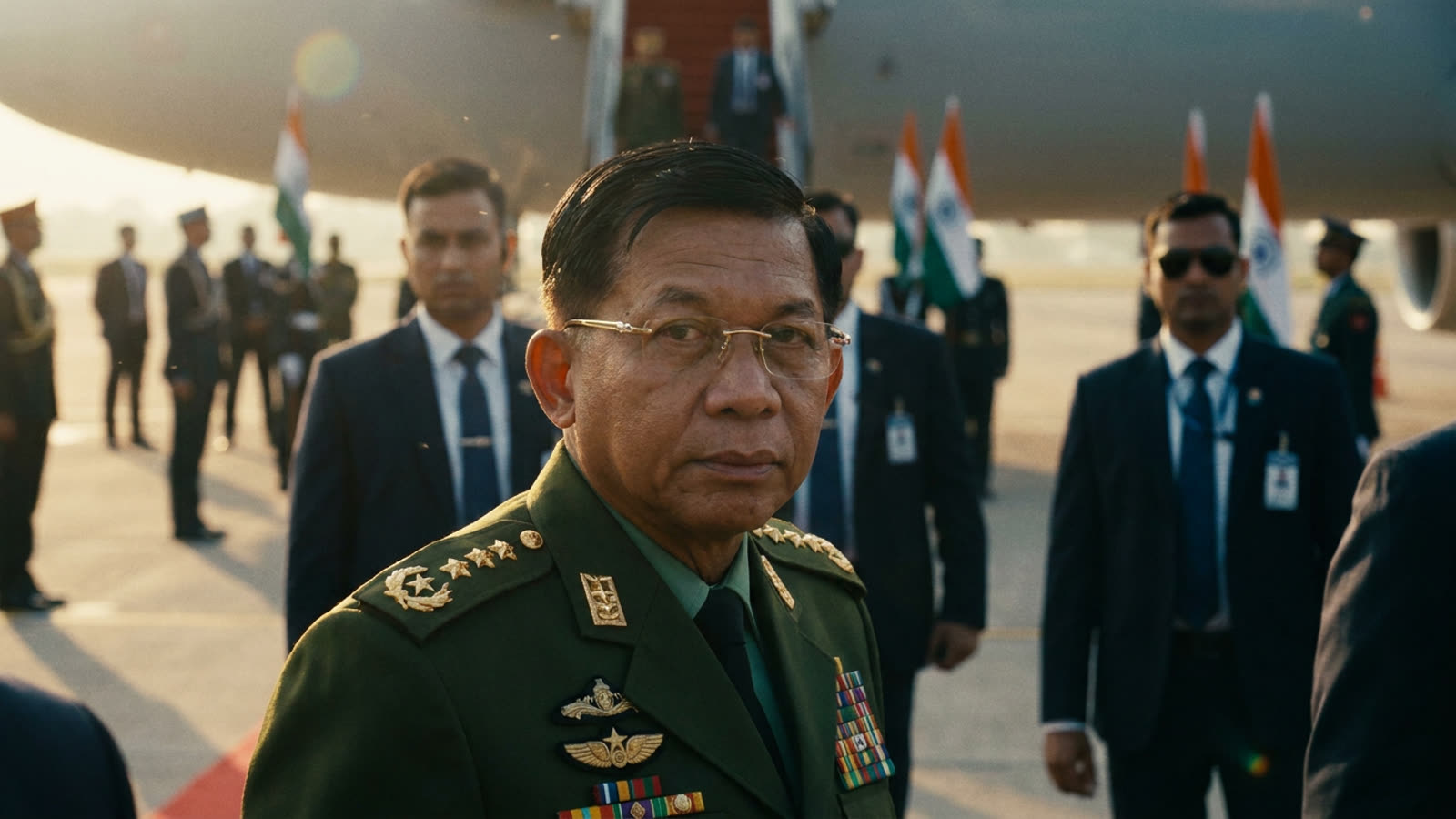
When a military dictator who seized power in a 2021 coup and has presided over a brutal civil war gets rolled out the red carpet by the world's largest democracy, the explanation is never about values. It is about geography, and the geography here spells China.
Senior General Min Aung Hlaing arrived in India this week in his freshly minted capacity as president—a title he awarded himself in a constitutional reshuffle designed to launder the junta's legitimacy. New Delhi's decision to receive him, rather than the parallel government-in-exile or the ethnic resistance coalitions that control swathes of Myanmar's borderlands, is a calculated bet that engagement with the regime still in nominal control of Naypyidaw serves India's interests better than isolation.
The China factor
Myanmar shares a 1,600-kilometer border with India's restive northeast, but it shares an even longer one with China—and Beijing has been playing all sides of Myanmar's fractured politics for years. Chinese infrastructure projects, arms sales, and quiet support for certain ethnic militias have given it leverage that New Delhi cannot match. India's fear is straightforward: if it shuns the junta entirely, Min Aung Hlaing tilts further into Beijing's orbit, and India loses whatever residual influence it retains over a neighbor that sits astride critical trade corridors and insurgent supply lines.
The visit also comes as Myanmar's military faces its most serious battlefield reversals since the coup. Resistance forces have captured border towns, severed key highways, and exposed the junta's hollowed-out command structure. A weakened Min Aung Hlaing is, paradoxically, a more pliable one—or so New Delhi's strategists appear to believe.
Democratic optics, autocratic realities
For Prime Minister Narendra Modi's government, the visit is an awkward fit with its stated commitment to democratic norms in the Indo-Pacific. India has criticized coups in other contexts and positioned itself as a counterweight to Chinese authoritarianism. Hosting a general who has overseen documented atrocities—including the Rohingya genocide that predates the coup—complicates that narrative.
Yet India has form here. It maintained ties with Myanmar's previous military rulers for decades, prioritizing border security and counterinsurgency cooperation over human-rights diplomacy. The calculation has always been that India cannot afford the luxury of principled distance from a neighbor whose instability spills directly into its own territory.
Our take
India is making a realist's wager: that a weakened junta chief desperate for international legitimacy will offer concessions on border security, refugee flows, and Chinese encroachment that a victorious resistance government might not. It is a morally uncomfortable position, and it may prove strategically mistaken if the junta's collapse accelerates. But in a region where China sets the tempo, New Delhi has decided that sitting out the game is the only move it cannot afford.