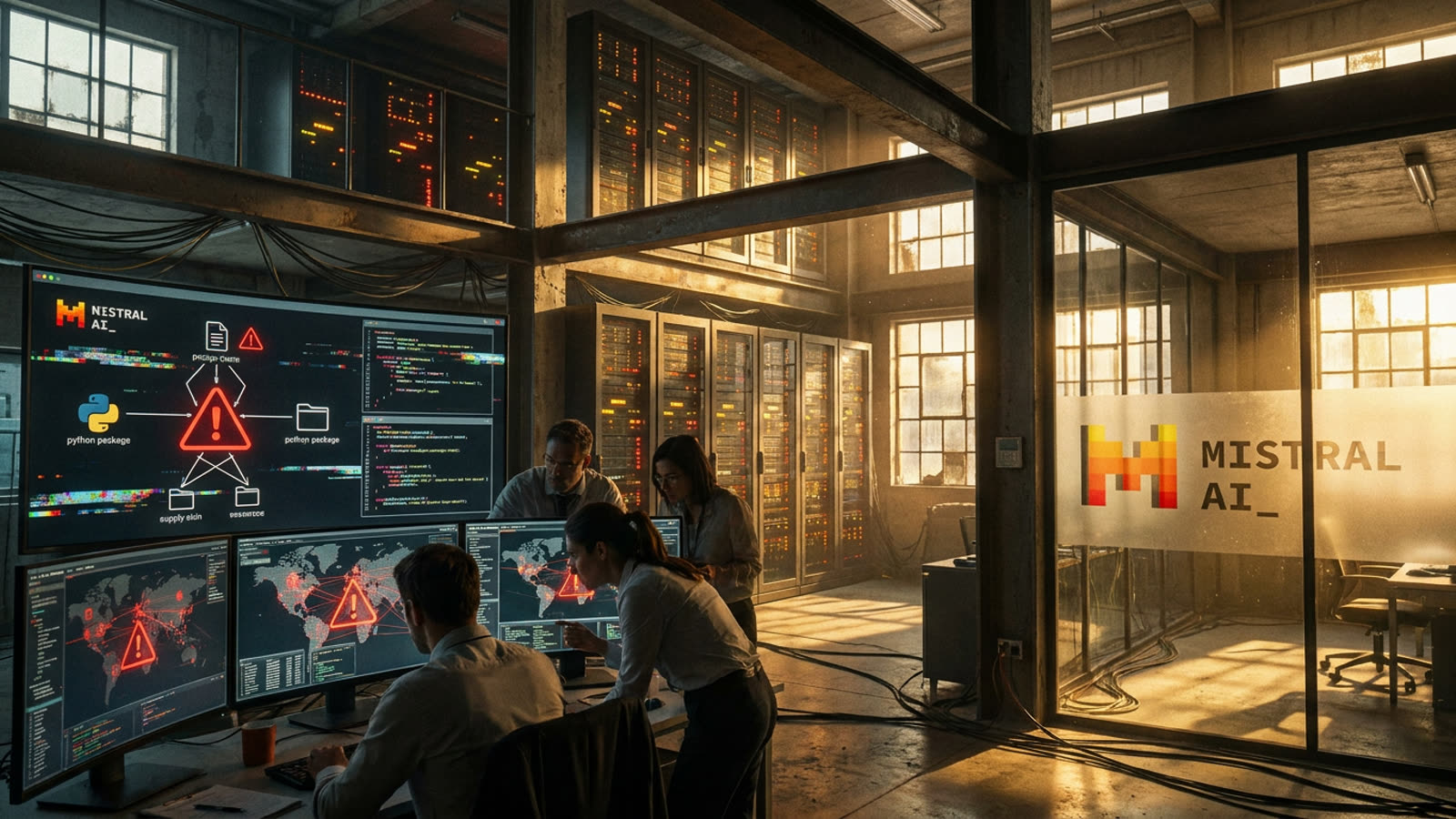
The breach was elegant in its simplicity: attackers inserted malware directly into a Mistral AI software download distributed through a Python package, according to Microsoft Threat Intelligence. For developers who pulled the compromised code—and there are likely thousands—the infection happened the moment they typed pip install.
Mistral, the Paris-based startup valued at roughly $6 billion and celebrated as Europe's answer to OpenAI, now joins a growing list of AI companies learning that their greatest vulnerability may not be their models, but their distribution pipelines.
The anatomy of a supply chain attack
Python's package ecosystem, PyPI, has long been a soft target. Researchers have documented hundreds of malicious packages over the years, many using typosquatting or dependency confusion to trick developers. But targeting a major AI company's official distribution channel represents an escalation. The attackers didn't need to break into Mistral's servers or compromise its models—they simply needed to poison the well that developers drink from.
Microsoft's threat intelligence team caught the intrusion, though the timeline of exposure remains unclear. What is clear is that any developer who downloaded the affected package during the window of compromise may have executed arbitrary code on their systems, potentially exposing API keys, proprietary code, or access to production environments.
Why AI companies are uniquely vulnerable
The AI industry's development culture practically invites this kind of attack. Developers routinely pull packages from public repositories, often without verification, because the pace of innovation demands it. Model weights, tokenizers, and inference libraries change weekly. Nobody has time to audit every dependency.
Mistral's open-weight model strategy—releasing models that anyone can download and run—amplifies the attack surface. The company's popularity among developers who want alternatives to OpenAI's closed ecosystem means its packages are installed on machines across startups, enterprises, and research institutions worldwide.
This isn't theoretical risk anymore. It's realized harm, even if the full scope won't be known for weeks.
Our take
The Mistral breach is a preview of what's coming for the entire AI industry. As these companies race to ship models and tools, security is treated as a speed bump rather than a foundation. Open-source AI was supposed to democratize access; it's also democratizing attack surfaces. The next major AI incident won't be a jailbroken chatbot saying something offensive—it will be a compromised supply chain that gives attackers access to thousands of systems simultaneously. Mistral got caught this time. The question is how many similar intrusions have gone undetected elsewhere.