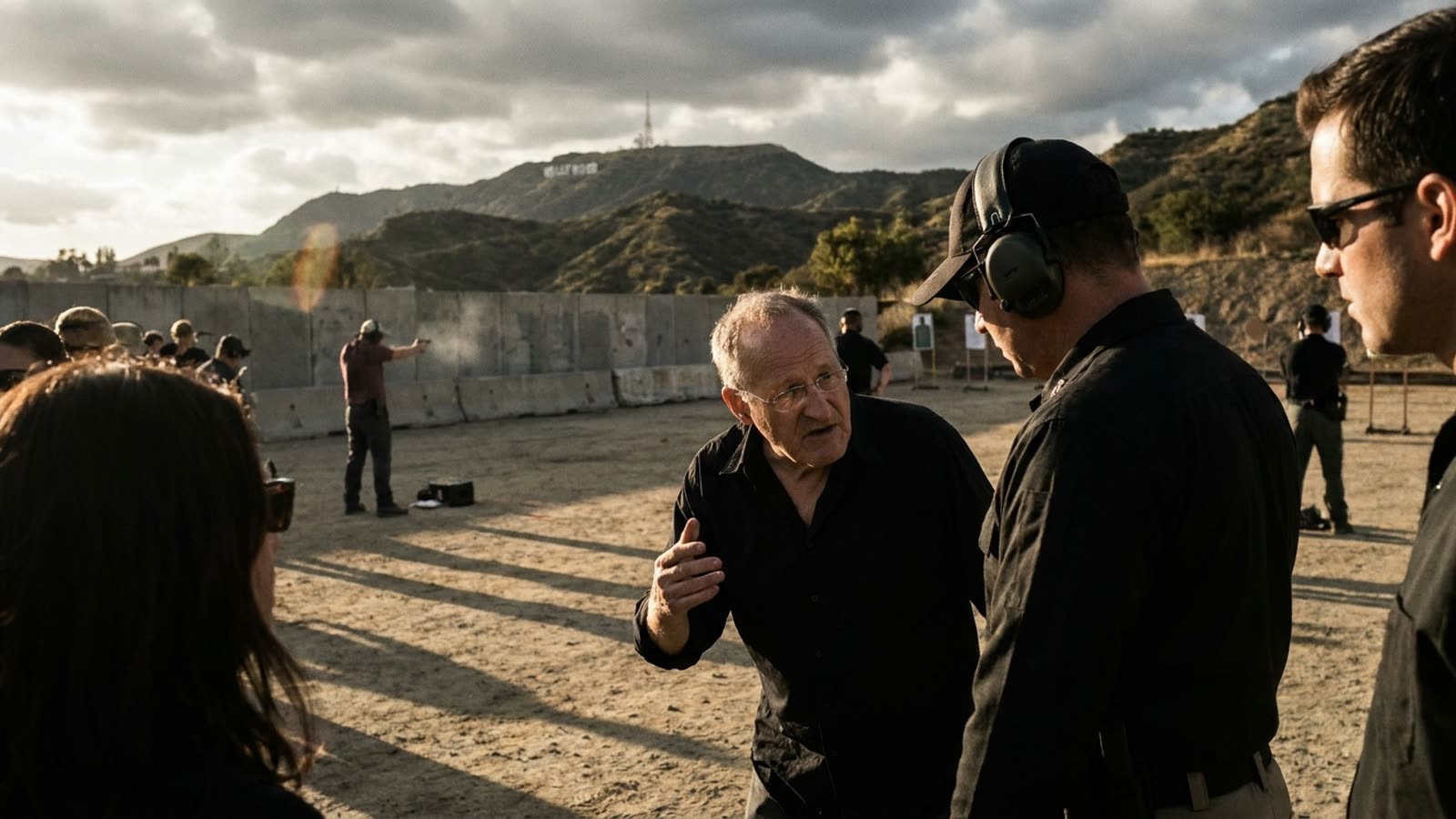
Michael Mann has spent four decades teaching Hollywood how firearms actually work. The downtown Los Angeles shootout in Heat, the Mozambique drill in Collateral, the tommy-gun staccato of Public Enemies—his films are studied by military trainers and gun enthusiasts as textbooks in ballistic realism. On Saturday, at a Los Angeles gun range, the 83-year-old director accidentally shot himself in the leg while holstering a firearm.
The LAPD confirmed the incident; Mann was transported to a local hospital with non-life-threatening injuries. Representatives have not commented on his condition or the circumstances beyond the basic facts. But the basic facts are enough to make anyone who has watched Mann's work wince at the cosmic irony.
The auteur of authenticity
Mann's obsession with procedural accuracy is legendary. For Heat, he embedded his actors with real LAPD officers and professional thieves. Val Kilmer's magazine change in the bank-robbery sequence became a training clip. For Miami Vice, Mann insisted on live-fire exercises and real drug-interdiction consultants. His forthcoming Heat 2, the prequel-sequel adaptation of his own novel, has been in meticulous pre-production for years, partly because Mann refuses to shoot a single frame until every tactical detail is locked.
This perfectionism extends to safety protocols. Mann's sets are known for rigorous weapons handling—armorers, choreographers, and multiple rehearsals before any blank is fired. The irony, then, is not that Mann was careless. It's that even the most disciplined practitioner can fall victim to the split-second lapse that real firearms, unlike movie props, do not forgive.
A genre's uncomfortable mirror
Hollywood's relationship with guns has grown more fraught since the 2021 Rust tragedy, which killed cinematographer Halyna Hutchins and led to criminal charges against the film's armorer and, eventually, Alec Baldwin. Productions have tightened protocols; some have moved to digital muzzle flashes entirely. Mann, who built his reputation on the opposite approach—real steel, real recoil, real danger—represents an older philosophy now under scrutiny.
His accident won't settle that debate, but it will inflect it. If the director who literally wrote the book on cinematic gunplay can shoot himself at a range, the argument for eliminating live weapons from sets gains another data point. Mann himself might disagree; his entire aesthetic depends on the weight and consequence that only real objects convey. But aesthetics don't stop bullets.
Our take
There is no schadenfreude here, only the grim comedy of a universe that occasionally insists on irony. Mann will almost certainly recover, and Heat 2 will almost certainly proceed. But the image of cinema's foremost gun poet felled by a holstering mishap is a parable no screenwriter would dare pitch—too on the nose, an editor would say. Life, unlike a Michael Mann film, doesn't care about subtlety.