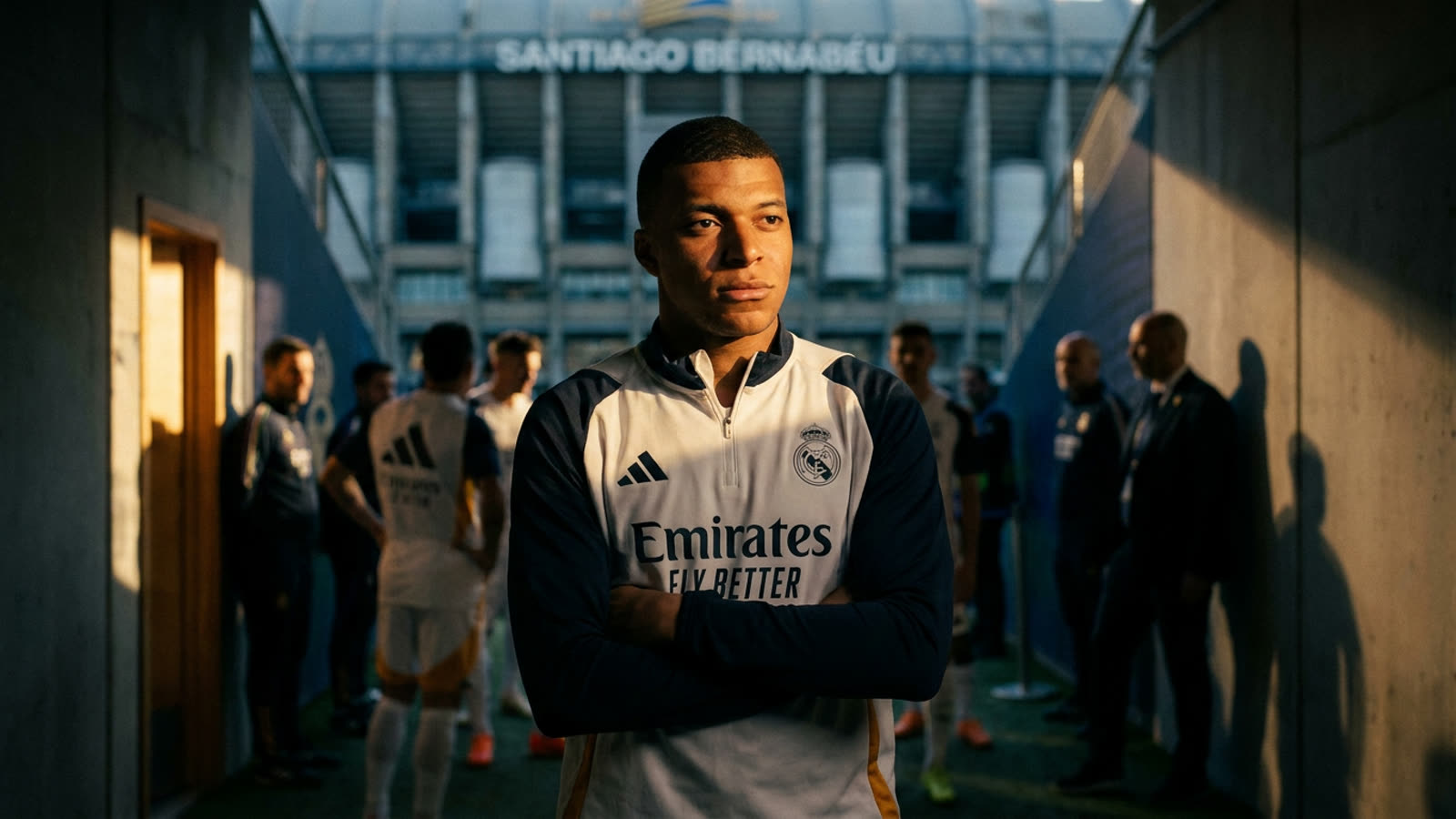
The cruelest thing about Kylian Mbappé's current predicament is that he did everything right. He waited out his PSG contract like a man with infinite patience, turned down reported fortunes from Saudi Arabia, and finally consummated the move to Real Madrid that had been telegraphed for the better part of a decade. The destination was supposed to be destiny. Instead, it has become purgatory.
On Thursday, Mbappé revealed that assistant coach Álvaro Arbeloa informed him he was Real Madrid's "fourth-choice forward" — a designation that would be humiliating for a journeyman, let alone the player who arrived as the presumptive heir to Cristiano Ronaldo's throne. The Frenchman was benched, then whistled by the Bernabéu faithful, the same supporters who had chanted his name for years while he remained tantalizingly out of reach.
The arithmetic of abundance
Real Madrid's forward line was already obscenely stocked before Mbappé's arrival. Vinícius Júnior had evolved into a Ballon d'Or contender. Rodrygo had proven himself in the biggest moments. Jude Bellingham, nominally a midfielder, had spent last season playing as a de facto second striker with devastating effect. Adding Mbappé to this equation was always going to require either tactical innovation or ego management on a scale rarely seen in elite football. Madrid appears to have achieved neither.
The club's hierarchy presumably believed that talent of this magnitude would sort itself out — that the cream would rise, that minutes would materialise, that Mbappé's quality would simply overwhelm any structural concerns. What they failed to anticipate was that four world-class attackers cannot simultaneously occupy three positions, and that the player who arrived with the greatest expectations might be the one most expendable to a system already functioning at its peak.
The free transfer fallacy
Mbappé's move was celebrated as a masterstroke of financial engineering: no transfer fee, just wages. But the absence of a fee created its own distortions. Without a sunk cost to justify, Madrid had no financial imperative to force integration. The club could afford to let him languish in ways they never could with a €200 million investment. The signing was treated as a luxury acquisition rather than a foundational piece — a trophy for the cabinet rather than a tool for the pitch.
There is also the matter of timing. Mbappé arrived at 25, theoretically entering his prime but practically arriving at a club that had already solved the problems he was meant to address. Madrid won the Champions League without him. They had constructed an identity without him. His presence, rather than completing a puzzle, introduced pieces that no longer fit.
Our take
This is what happens when narrative overtakes strategy. For years, Mbappé-to-Madrid was treated as an inevitability so powerful that no one bothered to ask whether it still made sense by the time it actually happened. The player wanted the move. The club wanted the prestige. Neither party paused to consider that the perfect moment had already passed. Mbappé may yet salvage his Madrid career — talent of his calibre tends to find a way — but the dream transfer has become a cautionary tale about the difference between acquiring greatness and knowing what to do with it.