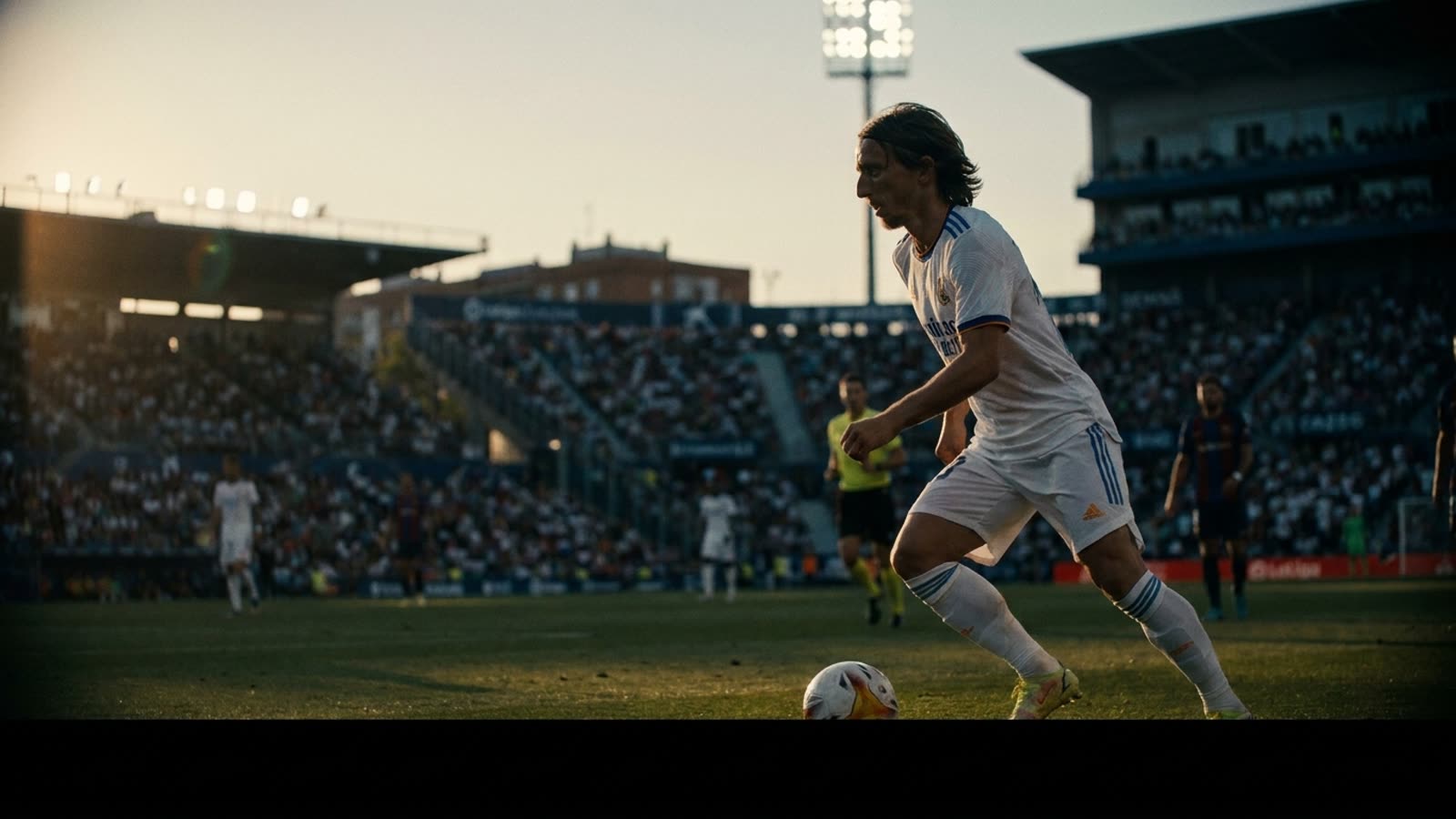
The great midfielders of the twenty-first century tend to announce themselves with force. Steven Gerrard's thunderbolts, Yaya Touré's bulldozing runs, Kevin De Bruyne's laser-guided through balls — these are players who bend matches to their will through sheer physical imposition. Luka Modrić, standing five-foot-eight with the physique of a distance runner, chose a different path entirely. He made the ball do the work.
What Modrić mastered, and what remains stubbornly difficult to replicate, is the art of manipulating space without occupying it. Where other midfielders demand the ball and hold it, Modrić receives, assesses, and releases in a single fluid motion, often having already identified his third or fourth passing option before his first touch. The effect is disorienting for opponents: they press toward the ball only to find it has already moved elsewhere, and the Croatian is drifting into the pocket they just vacated.
The Croatian paradox
Modrić's career trajectory defied every reasonable projection. Rejected by Hajduk Split's academy for being too small, he spent his formative years on loan at lower-division clubs, developing the peripheral awareness that would become his signature. By the time he reached Tottenham in 2008, and then Real Madrid in 2012, he had cultivated something that cannot be coached: an internal metronome that synchronized perfectly with the rhythm of elite football.
His 2018 Ballon d'Or — the first in over a decade not awarded to Lionel Messi or Cristiano Ronaldo — was both vindication and anomaly. The award recognized his orchestration of Croatia's improbable World Cup run, but it also acknowledged a style of play that had been undervalued for years. Modrić didn't score spectacular goals or rack up gaudy assist numbers. He simply made everyone around him better, a contribution that statistics struggle to capture.
The inheritance problem
Clubs have spent fortunes trying to find the next Modrić, largely without success. The issue is categorical: most scouting frameworks optimize for measurable attributes — sprint speed, passing accuracy, defensive duels won — while Modrić's genius resides in qualities that resist quantification. His body feints, the way he shifts his hips to open passing lanes, his ability to receive the ball on his back foot and spin away from pressure — these are learned behaviors, certainly, but they require a spatial intelligence that appears to be rare.
Real Madrid's own succession planning illustrates the difficulty. They've signed technically gifted midfielders, physical specimens, and pressing machines, yet none have replicated Modrić's ability to control tempo. The closest analogue might be Pedri at Barcelona, who shares Modrić's economy of movement, but even he operates with a different metabolic rate, preferring to dwell on the ball rather than circulate it instantly.
Our take
Modrić's legacy will be debated in terms of trophies and individual honors, but his real contribution is philosophical. He demonstrated that football's arms race toward athleticism has a ceiling, and that the game's deepest pleasures — the perfectly weighted pass, the subtle dummy, the turn that creates chaos from order — remain available to players who prioritize intelligence over intensity. In an industry increasingly obsessed with data, Modrić is a reminder that some forms of excellence can only be recognized by watching.