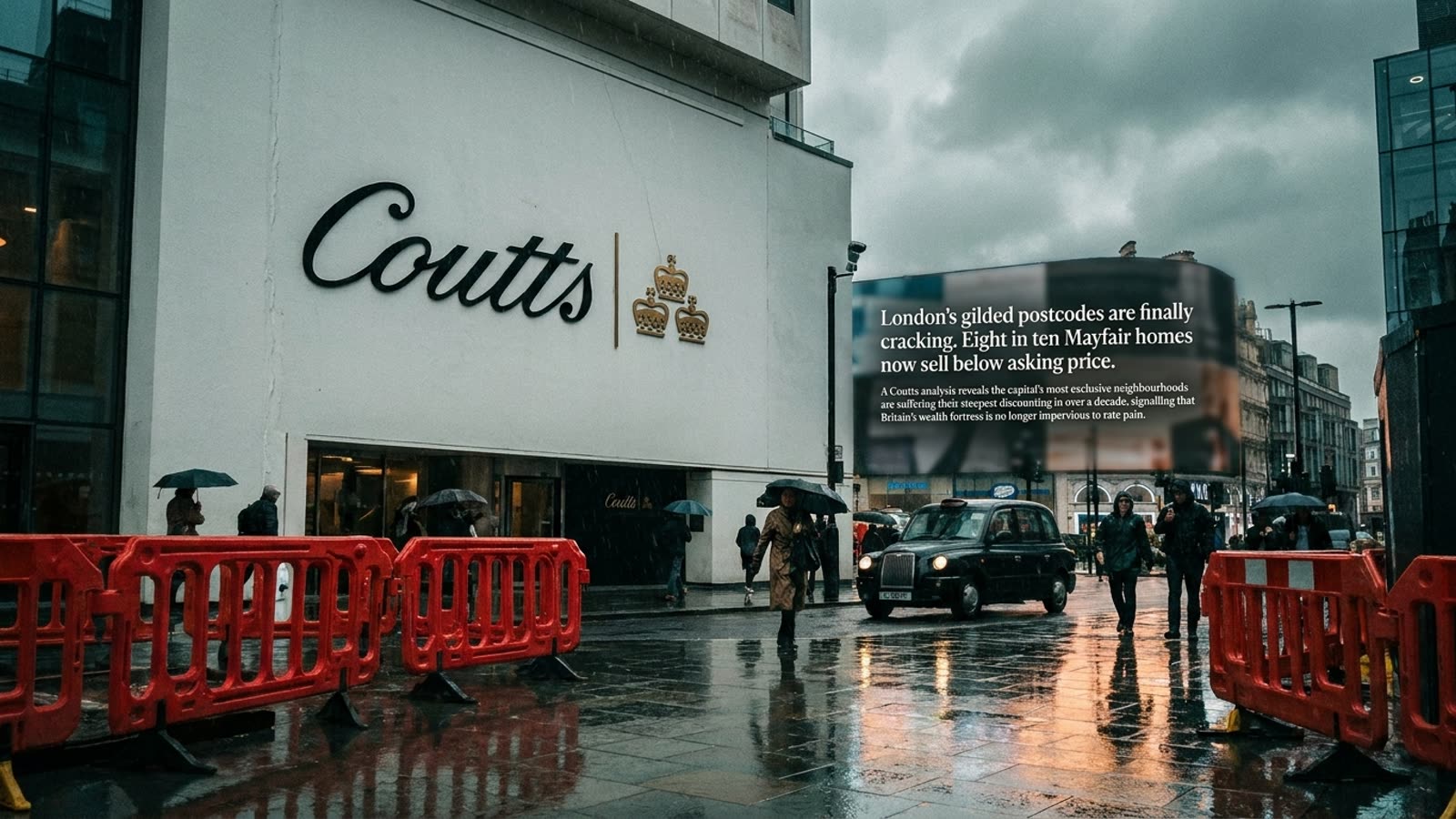
The mythology of prime central London real estate has always rested on a simple premise: Mayfair, Belgravia, and Knightsbridge exist outside normal economic gravity. Oligarchs, Gulf royals, and hedge-fund refugees would always pay the asking price, or near enough. That premise is now demonstrably false.
New data from Coutts, the private bank that services exactly the sort of clientele who shop in these postcodes, shows that 80 percent of properties in London's most exclusive neighbourhoods are now selling below asking price. Sellers are absorbing discounts running into the hundreds of thousands of pounds—sometimes more—as the market adjusts to a reality that higher interest rates, geopolitical uncertainty, and shifting capital flows have made inescapable.
The mechanics of a correction
Prime central London has always operated as a parallel market, less correlated with UK mortgage rates than with global wealth movements. But the Bank of England's sustained rate elevation—now into its third year above four percent—has finally bitten. Domestic buyers who once stretched into PCL are priced out entirely. International buyers, meanwhile, face a sterling that has weakened but not enough to offset the opportunity cost of capital parked in low-yielding bricks when money-market funds offer five percent risk-free.
The Coutts findings suggest vendors are slow to accept the shift. Asking prices remain aspirational, rooted in 2021 valuations that assumed permanent negative real rates. The gap between expectation and execution is now widening into a chasm.
Who is selling, and why now
The composition of sellers matters. Post-2022 sanctions froze Russian money in place; those assets are not transacting. What remains is a mix of elderly downsizers, divorcing couples, and funds rotating out of residential into higher-yielding commercial or alternative assets. None of these cohorts can afford to wait indefinitely. The result is a buyer's market in streets where buyers have historically queued.
There is also a generational dynamic. Inheritors of Belgravia townhouses often lack the liquidity—or the desire—to maintain them. Stamp duty at the top end remains punitive, and the non-dom tax changes implemented in 2025 have made London less attractive as a wealth domicile. The exit pressure is structural, not cyclical.
Broader implications for UK housing
Prime central London is a small slice of the national market, but it functions as a leading indicator of sentiment among the wealthy. When Mayfair discounts, it signals that even the most insulated buyers see risk. That perception filters down. Estate agents in the home counties report similar softening; the ripple effect is already visible in commuter-belt pricing.
For the Treasury, falling PCL values are a mixed blessing. Stamp duty receipts decline, but so does the political toxicity of a housing market perceived as a playground for foreign capital. The government's quiet hope is that a correction at the top loosens supply without triggering a broader crash.
Our take
London's prime property market spent two decades defying gravity, and gravity has now sent the invoice. The 80-percent-below-asking figure is not a blip; it is the market confessing that the old rules no longer apply. For sellers clinging to 2021 valuations, the choice is simple: cut the price or wait for a world that is not coming back. For buyers with patience and liquidity, the next twelve months may offer opportunities unseen since the financial crisis. The rest of us can simply enjoy the spectacle of Mayfair learning what a discount feels like.