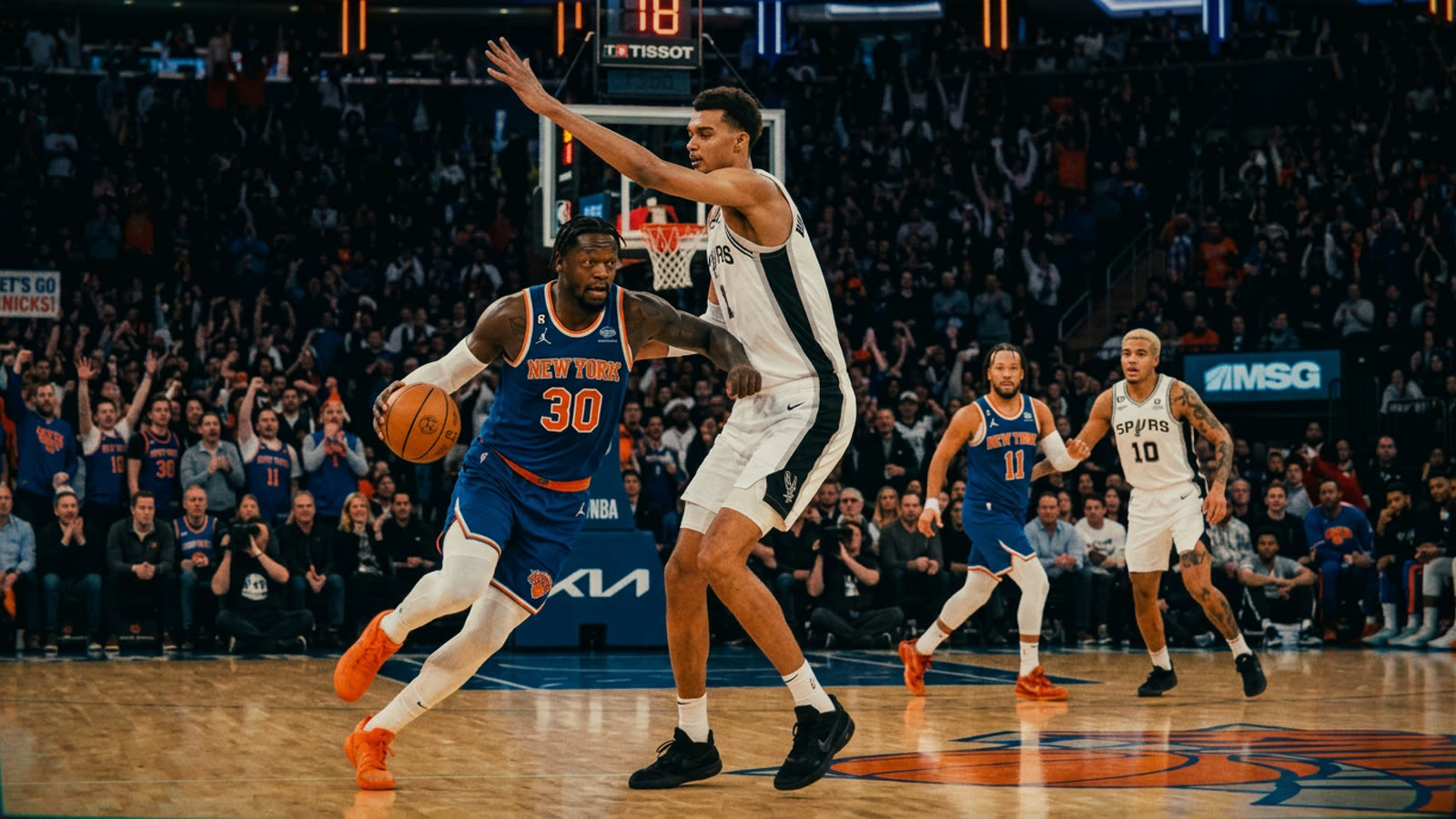
The New York Knicks are two wins from their first championship since 1973, and they are making it look inevitable.
That sentence alone would have seemed hallucinatory eighteen months ago, when the franchise was still synonymous with dysfunction, when Madison Square Garden's most reliable drama came from James Dolan's feuds rather than playoff basketball. Now the Knicks lead the San Antonio Spurs 2-0 in the Finals, and the margin has been less about close games than about controlled demolition. New York has discovered something the rest of the league spent the season fearing: when their defense locks in and Karl-Anthony Towns plays like a franchise cornerstone rather than a talented enigma, they are extraordinarily difficult to beat.
The Wembanyama Problem
Victor Wembanyama remains the most gifted physical specimen the sport has produced—a 7-foot-4 guard with a 8-foot wingspan who can handle, shoot, and protect the rim. None of that has mattered through two games. The Knicks have thrown waves of bodies at him, switching seamlessly, forcing him into contested mid-range jumpers rather than the lobs and three-pointers that define his brilliance. His numbers look respectable in isolation; his impact has been muted in reality.
San Antonio's problem is structural. They built around Wembanyama's singular talent without acquiring the secondary playmaking and perimeter shooting that championship teams require. The Spurs' supporting cast—serviceable in the Western Conference—has looked overwhelmed against New York's length and physicality. Gregg Popovich's system demands execution; execution demands options; the Spurs have too few.
Towns' Redemption Arc
For years, Karl-Anthony Towns was the poster child for empty statistics—a big man who dominated in losses, who wilted in playoff moments, who seemed constitutionally incapable of imposing his will when stakes rose. The Knicks bet that environment, not character, was the issue. That bet is paying off spectacularly.
Towns has been the series' best player through two games, bullying smaller defenders in the post, stretching the floor with his shooting, and—crucially—anchoring a defensive scheme that has turned Wembanyama into a mortal. The redemption narrative writes itself, but the reality is simpler: Towns is finally surrounded by defenders and playmakers who compensate for his weaknesses while amplifying his strengths.
What San Antonio Needs
No team has ever come back from 3-0 in the NBA Finals. History says the Spurs need to win Game 3 at home to have any realistic path forward. That means Popovich must solve New York's switching defense, must find ways to get Wembanyama easier looks, must coax better performances from a supporting cast that has shrunk under the lights. The blueprint exists—isolate Towns defensively, attack in transition before the Knicks set their half-court trap—but execution against this New York team has proven elusive.
The Spurs are not finished. Wembanyama is too talented, Popovich too experienced, home court too valuable. But the burden of proof has shifted entirely. San Antonio must now prove they belong in this series.
Our take
The Knicks' dominance feels earned rather than lucky, which is what makes it so striking. This is a franchise that spent decades confusing activity for progress, that cycled through stars and coaches without ever building the connective tissue that championships require. Now they have it—defense, depth, a closer in Jalen Brunson, a star in Towns who finally looks comfortable in his own skin. Two more wins and New York ends a drought older than most of its fans. The Spurs' rebuild remains promising; it just collided with a team whose timeline arrived first.