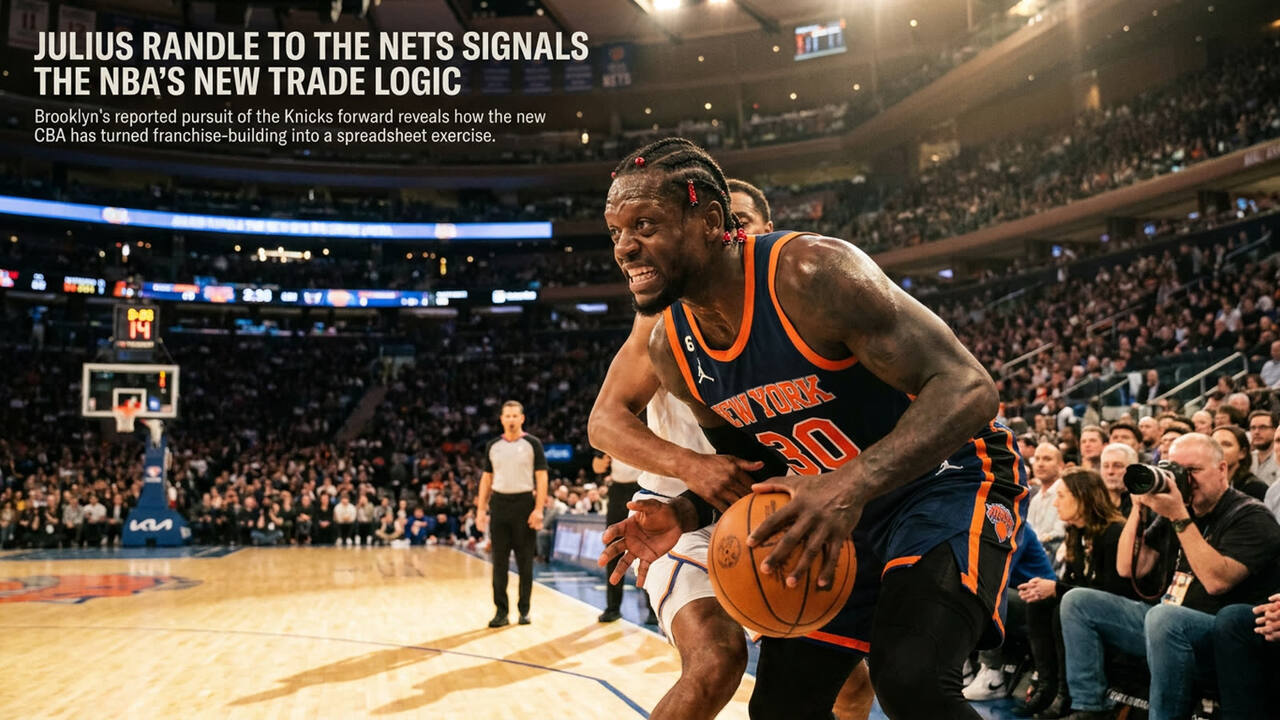
The NBA offseason used to be about dreams — assembling superteams, chasing rings, building dynasties. Now it's about arithmetic. Reports that the Brooklyn Nets are pursuing Julius Randle from their crosstown rivals encapsulate everything strange about the league's current trade market: a team with no championship aspirations acquiring a star-caliber player not because he fits a vision, but because the numbers work.
Randle, a three-time All-Star who has spent the past five seasons as the Knicks' offensive fulcrum, represents exactly the kind of talent that would have sparked bidding wars in previous eras. Instead, he's being discussed as a salary-matching piece in a league where the second apron has become the new hard cap.
The CBA's quiet revolution
The 2023 collective bargaining agreement was sold as a competitive-balance measure, designed to prevent superteams and give small markets a fighting chance. In practice, it has created a two-tier system: teams willing to pay the luxury tax and its punitive second-apron penalties, and teams desperately trying to stay beneath arbitrary thresholds. The Nets, having traded away their future for a Kevin Durant-Kyrie Irving experiment that collapsed spectacularly, now exist in a purgatory where acquiring Randle makes sense primarily because his $28 million salary slots neatly into their cap structure.
For the Knicks, moving Randle would complete a philosophical pivot that began when they acquired Jalen Brunson and accelerated with the OG Anunoby and Mikal Bridges trades. New York has decided it prefers two-way wings and floor-spacers around Brunson's pick-and-roll wizardry. Randle's ball-dominant style, while productive, creates redundancies. The marriage has grown stale.
What Brooklyn actually gets
The Nets are not contenders. They won't be contenders next season, or likely the season after. So why pursue a 31-year-old power forward with a history of playoff inconsistency? The cynical answer: because tanking is harder than it used to be, and Randle puts fans in seats at Barclays Center while the franchise waits for its draft picks to convey. The practical answer: because the alternative is paying similar money for worse players.
Randle averaged 24 points and 9.2 rebounds last season. He remains one of the league's most skilled big men, capable of creating his own shot from anywhere on the floor. His defensive limitations and occasional tunnel vision are real, but so is his ability to carry an offense for stretches. For a team in Brooklyn's position, that's not nothing.
Our take
This is what the NBA has become: trades driven by cap gymnastics rather than basketball logic, stars shuffled between franchises like assets on a balance sheet. Randle to the Nets isn't exciting or depressing — it's simply efficient, a transaction that makes sense to accountants if not to romantics. The league wanted parity; it got spreadsheets. Whether that's progress depends entirely on how you define the word.