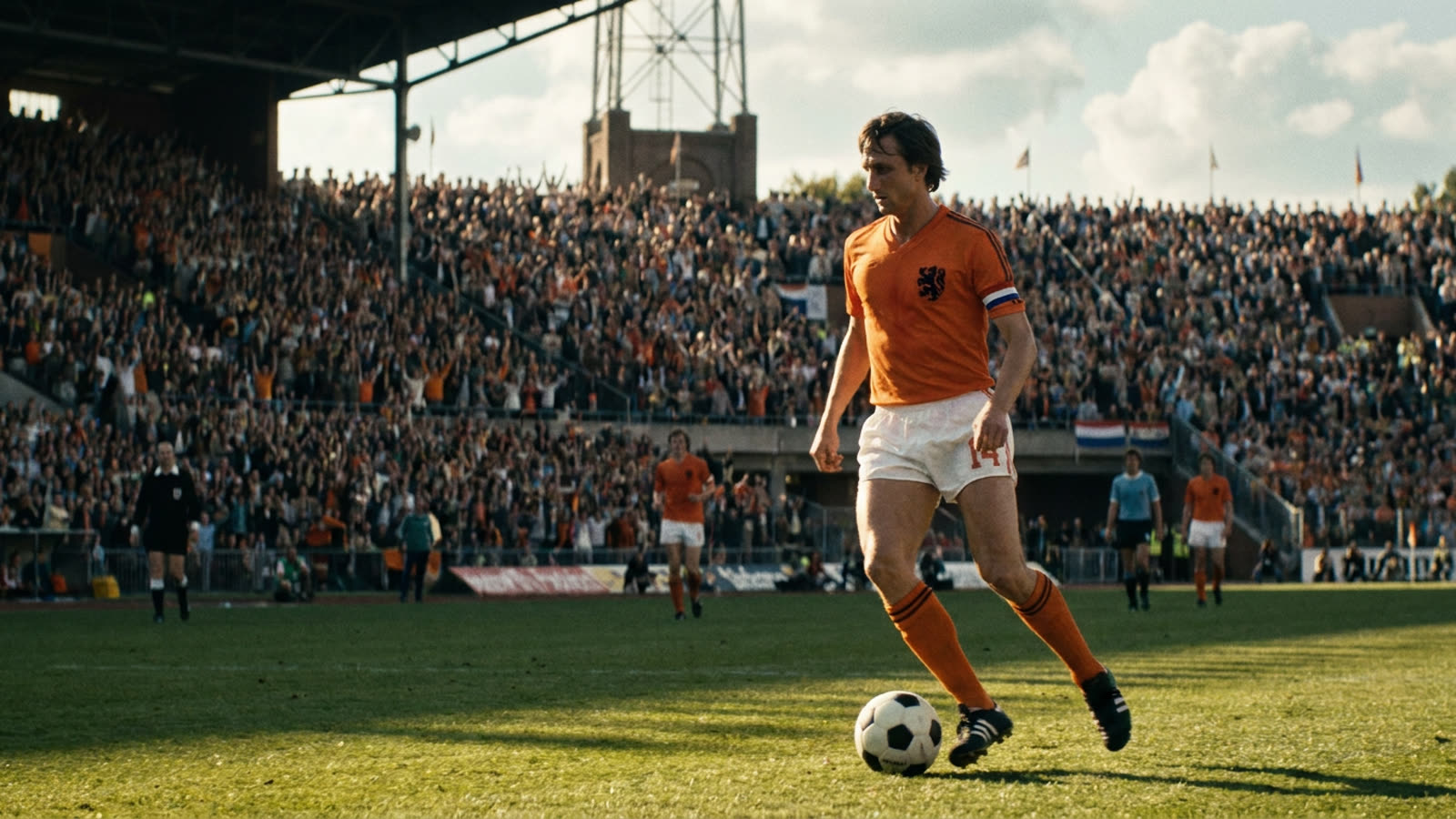
The most influential figure in football history never won a World Cup. Johan Cruyff's Netherlands fell in the 1974 final to West Germany, and his playing career ended without the sport's ultimate prize. Yet no player, manager, or theorist has shaped how football is thought about, taught, and played more profoundly than the chain-smoking Amsterdammer who believed the beautiful game should be, above all, intelligent.
Total football — totaalvoetbal — is often reduced to a tactical gimmick: players swap positions fluidly, everyone attacks, everyone defends. This description is accurate and entirely insufficient. What Cruyff articulated, first as Ajax's transcendent number fourteen and later as Barcelona's transformative coach, was something closer to an epistemology of sport. Football, in his conception, was a problem-solving exercise conducted at speed, where spatial awareness mattered more than physical dominance and where the team that controlled space controlled the match.
The geometry of genius
Cruyff's famous turn — the drag-back that left Sweden's Jan Olsson grasping at air during the 1974 World Cup — has been replayed countless times. But the turn itself was merely the visible expression of something more important: Cruyff had already seen the space behind Olsson, calculated the angle, and understood where his teammates would be when he emerged on the other side. The technique served the vision, never the reverse.
This hierarchy of intellect over athleticism was radical in an era when football still celebrated the hard man, the target striker, the winger who ran at defenders until one of them broke. Cruyff's Ajax and Rinus Michels' Netherlands proposed that football could be played like chess at thirty kilometers per hour — that the team which thought fastest would beat the team that ran hardest.
Barcelona's permanent revolution
When Cruyff arrived at Barcelona as manager in 1988, he inherited a club with one league title in the previous fourteen years. He departed in 1996 having won four consecutive La Liga championships and the club's first European Cup. More consequentially, he established La Masia's youth philosophy, insisting that every Barcelona team from the youngest academy side upward play the same way: short passes, positional discipline, relentless pressing, the goalkeeper as the first attacker.
The results of this institutional commitment became visible decades later. Pep Guardiola, Xavi Hernández, Andrés Iniesta, and Lionel Messi all emerged from a system Cruyff designed. The tiki-taka that dominated world football from roughly 2008 to 2012 was not an invention but an inheritance — Cruyff's ideas refined by disciples who had absorbed them as children.
The misreadings persist
Yet total football remains more invoked than understood. Coaches who claim Cruyffian influence often mistake possession for purpose, treating ball retention as an end rather than a means of creating the numerical advantages and spatial imbalances that Cruyff actually sought. The philosophy was never about keeping the ball for its own sake; it was about using the ball to make opponents run more than you did, to exhaust them mentally before their legs gave out.
Cruyff himself was characteristically blunt about imitators who missed the point. Football, he insisted, was simple — but playing simply was the hardest thing of all.
Our take
Cruyff's legacy is unusual because it operates on two levels simultaneously. On one, he was a player of outrageous gifts, capable of moments that still seem impossible when viewed in grainy footage. On another, he was football's most successful public intellectual, a man who could explain why the sport worked the way it did and how it might work differently. That combination — genius and articulation — is vanishingly rare. Football remains in his debt not because he won trophies, though he won plenty, but because he gave the sport a language for thinking about itself.