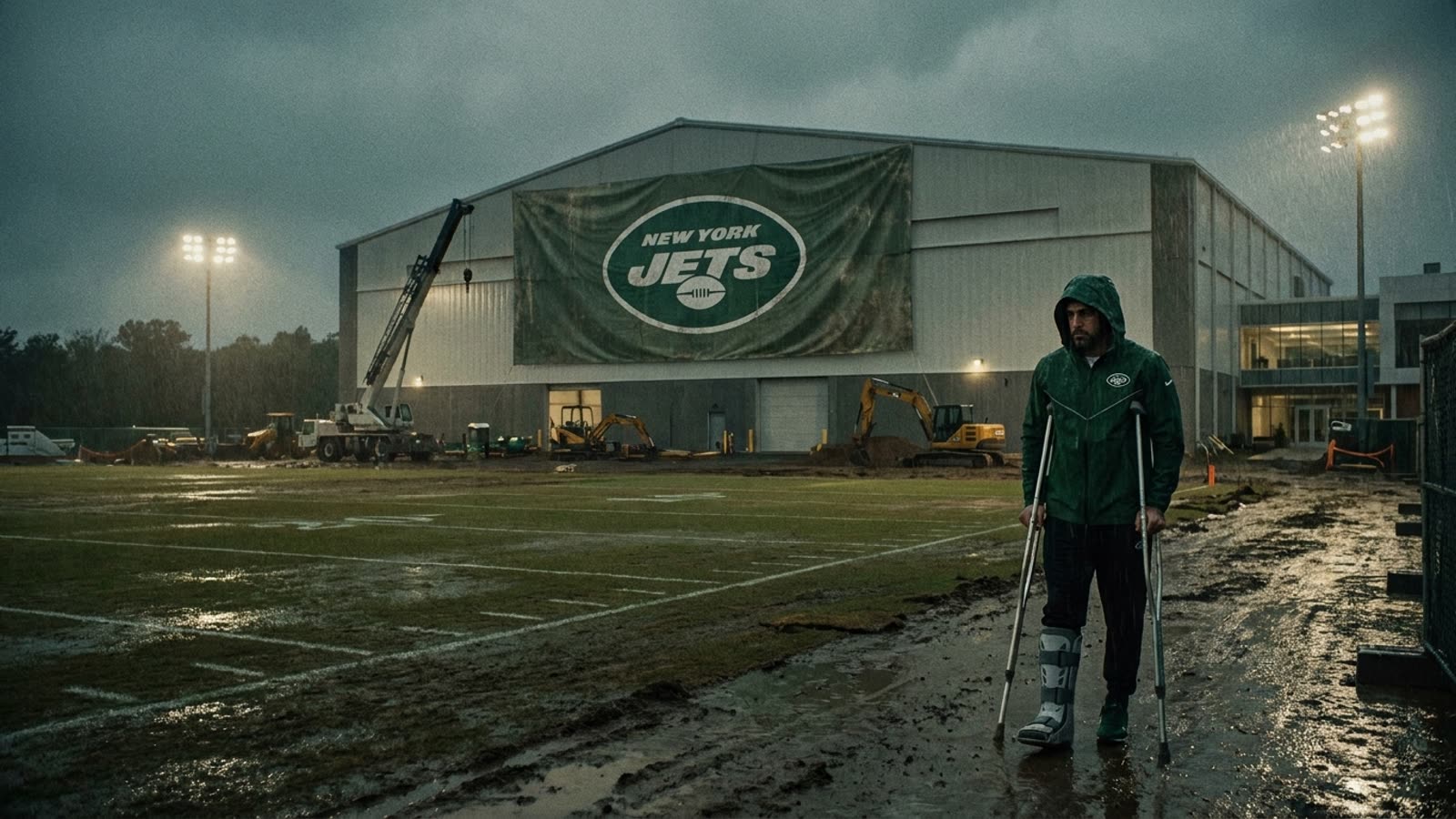
The New York Jets have a gift for turning optimism into anxiety before a single regular-season snap is played, and their 2026 first-round selection is now recovering from hernia surgery—a procedure that, while routine in the abstract, carries the unmistakable whiff of organizational déjà vu.
Sadiq, the explosive edge rusher the Jets selected with visions of defensive reinvention dancing in their heads, went under the knife this week to repair the issue. The team announced he is expected to be ready for training camp, which begins in late July. That timeline, while theoretically reassuring, does little to quiet the murmurs that follow this franchise like a persistent low-pressure system.
The procedure and the prognosis
Hernia repairs have become almost mundane in professional football. The surgery is minimally invasive, recovery is measured in weeks rather than months, and players routinely return to full activity without lingering complications. By most medical standards, this is a non-event dressed in press-release language.
But context matters. Sadiq was drafted to provide immediate pass-rush relief for a defense that ranked in the bottom third of the league in sacks last season. Every missed practice rep, every day spent in rehabilitation rather than learning the playbook, represents a marginal erosion of the advantage a first-round pick is supposed to provide. Rookies who miss offseason programs tend to look like rookies longer into the fall.
The Jets' pattern recognition problem
New York's recent draft history reads like a medical chart. Offensive linemen with knee concerns. Quarterbacks with shoulder questions that metastasized into career-altering problems. The organization has become synonymous with the phrase "expected to be ready," a formulation that manages to be both technically accurate and spiritually hollow.
This is not to suggest the Jets are uniquely cursed or that Sadiq's surgery portends disaster. Every team deals with injuries; every roster absorbs setbacks. But the Jets have developed a reputation for absorbing more than their share, and for doing so at precisely the moments when stability would be most valuable. The franchise has not reached the playoffs since 2010—a drought that spans multiple coaching staffs, front-office regimes, and quarterback experiments. At some point, bad luck becomes indistinguishable from bad process.
What the surgery means for the defensive scheme
Defensive coordinator's plans for Sadiq involved an immediate role in the edge rotation, with the possibility of starting by midseason if his development warranted it. That timeline now carries an asterisk. Even if Sadiq returns for training camp as projected, he will be learning on the fly rather than building on a foundation laid during OTAs and minicamp.
The Jets have depth at the position—they would not have drafted Sadiq so high otherwise—but depth is not the same as transformation. The pick was supposed to signal a new era of defensive aggression. Instead, it signals the same old Jets: talented on paper, fragile in practice, perpetually explaining why this year will be different.
Our take
A hernia surgery in late May is not a catastrophe. Players recover from this procedure constantly, and Sadiq has every reason to expect a full and productive career. But the Jets do not get the benefit of the doubt, and they have not earned it. This franchise has spent the better part of two decades turning minor setbacks into major narratives, and until they prove otherwise on the field, every piece of bad news—however small—will be read as confirmation of a deeper dysfunction. Sadiq will be fine. Whether the Jets will be is another question entirely.