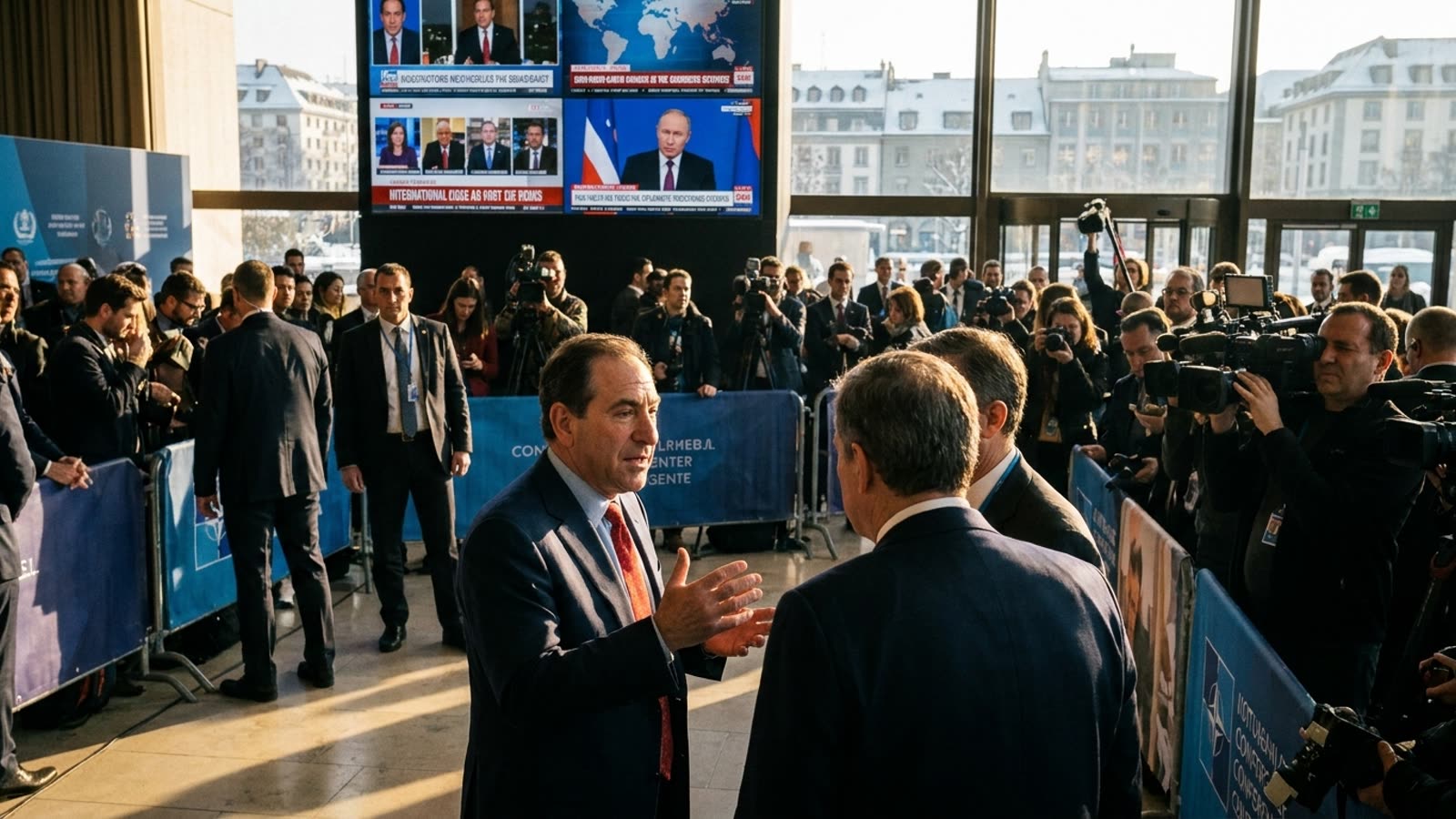
The announcement came with suspiciously convenient timing: hours before Trump envoy Steve Witkoff boards a plane for Switzerland to continue nuclear negotiations with Tehran, Israel and Hezbollah have agreed to halt hostilities along the Lebanese border. The ceasefire, brokered with quiet American involvement, removes the most immediate obstacle to progress in the broader US-Iran diplomatic track — namely, the awkwardness of negotiating with a regime whose proxy was actively exchanging fire with America's closest Middle Eastern ally.
This is diplomacy as choreography. The Biden-era approach to the region treated each conflict as a discrete crisis requiring separate management. The Trump administration, for all its improvisational chaos, has grasped something its predecessor missed: in the Middle East, everything is connected, and leverage in one theater can be converted to progress in another.
The ceasefire's fragile architecture
The Israel-Hezbollah agreement reportedly includes provisions for Hezbollah to pull back from positions it occupied during the recent escalation, while Israel commits to halting airstrikes on Lebanese infrastructure. Neither side is celebrating. Israeli officials have described the arrangement as a "tactical pause" rather than a durable peace, while Hezbollah's leadership has framed it as a strategic repositioning that preserves their military capacity.
What matters for the Iran talks is simpler: the guns have stopped, at least temporarily. Tehran can now engage with Witkoff without the daily embarrassment of its Lebanese client provoking Israeli retaliation. And Washington can negotiate without Republican hawks pointing to active Hezbollah rocket fire as evidence that diplomacy with Iran is futile.
What Witkoff carries to Switzerland
The framework agreement that emerged from earlier rounds has already drawn criticism from former Trump administration officials, who argue it offers Tehran too much sanctions relief in exchange for too little verification. But the ceasefire strengthens Witkoff's hand in one crucial respect: he can now argue that diplomatic progress is producing tangible security benefits, not just pieces of paper.
The administration's theory of the case is that a comprehensive deal — one that addresses not just Iran's nuclear program but also its regional proxies — is achievable precisely because the conflicts are linked. Pressure Hezbollah through Israel, and Tehran becomes more pliable on enrichment. Offer sanctions relief, and Iran reins in its proxies. Whether this elegant theory survives contact with the region's realities is another matter.
The spoiler problem
Ceasefires in Lebanon have a poor survival rate. The 2006 agreement lasted until it didn't. The 2024 truce collapsed within weeks. This one faces similar structural vulnerabilities: Hezbollah's leadership answers to multiple constituencies, not all of whom take orders from Tehran, and Israeli domestic politics creates constant pressure for military action.
More concerning for the Iran talks is the possibility that hardliners on both sides view the ceasefire as an obstacle to be overcome rather than a foundation to build upon. Iranian Revolutionary Guard commanders have historically operated with considerable autonomy from the foreign ministry. Israeli security officials have made clear they consider any deal that leaves Hezbollah's arsenal intact to be unacceptable.
Our take
The simultaneous ceasefire and resumption of talks represents the Trump administration's most sophisticated diplomatic play in the region — a recognition that Middle Eastern conflicts must be addressed as a system rather than a series of isolated crises. But sophistication is not the same as durability. The ceasefire buys time; it does not resolve the underlying tensions. Witkoff will arrive in Switzerland with a cleaner negotiating environment than seemed possible a week ago. What he does with that advantage will determine whether this moment becomes a turning point or merely a pause before the next escalation.