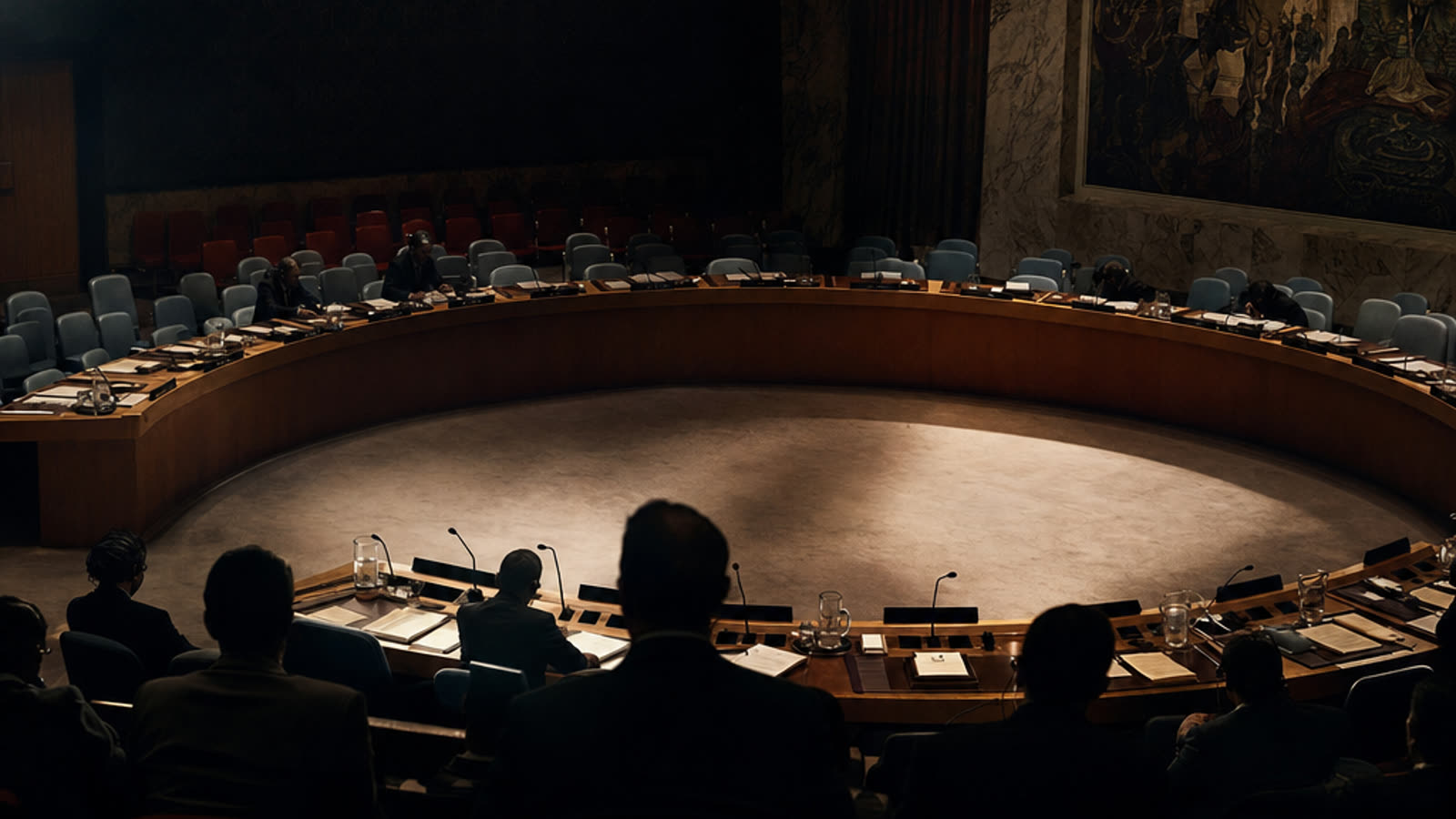
The most consequential word in international diplomacy is often "nyet." Or "non." Or simply a raised hand at the horseshoe table in New York, where five nations possess the extraordinary power to nullify any substantive resolution the rest of the world supports. The UN Security Council veto is not a bug in the postwar order — it is the feature that made the order possible, and the same feature that now renders it increasingly impotent.
The arithmetic is stark: China, France, Russia, the United Kingdom, and the United States each hold permanent seats and absolute veto authority. A resolution can secure fourteen affirmative votes from the Council's fifteen members and still die if one permanent member objects. No appeal. No override. The matter simply fails.
The Yalta bargain and its logic
The veto emerged from the wreckage of the League of Nations, which had required unanimity among all members and consequently achieved very little. At Yalta and San Francisco in 1945, the architects of the United Nations faced a practical problem: the great powers would never submit to an organization that could compel them against their will. The veto was the price of their participation. Without it, there would have been no Security Council, and likely no United Nations at all.
The framers understood the trade-off. They were not designing a world government but a forum where the most powerful states might coordinate — or at least communicate — rather than stumble into catastrophic war. The veto ensured that the UN could never be used as a weapon by one great power against another. It also ensured paralysis whenever great-power interests collided.
Patterns of obstruction
The Soviet Union cast the first veto in 1946 and proceeded to use the power liberally throughout the Cold War, blocking resolutions on everything from membership applications to peacekeeping mandates. The United States, initially restrained, became the most frequent vetoer from the 1970s onward, particularly on resolutions concerning Israel. Russia has wielded the veto repeatedly to shield Syria's government from condemnation. China, historically more sparing, has grown more assertive in recent years.
The pattern reveals the veto's true function: not to adjudicate right and wrong, but to protect vital interests as each permanent member defines them. When those interests align, the Council can act decisively — authorizing the Gulf War in 1990, sanctioning North Korea, establishing tribunals for Yugoslavia and Rwanda. When they diverge, the Council watches.
The reform that never arrives
Proposals to reform the veto have circulated for decades. Some advocate expanding permanent membership to include Germany, Japan, India, Brazil, or African representation. Others suggest limiting veto use in cases of mass atrocity. A few dreamers propose abolition altogether. None has gained traction, for an obvious reason: any change to the UN Charter requires ratification by all five permanent members, each of whom would be surrendering power.
The permanent five have occasionally shown rhetorical flexibility. France and the United Kingdom have endorsed voluntary restraint on vetoes involving genocide or crimes against humanity. But voluntary restraint is not structural change, and the states most likely to face such resolutions — or to protect allies who might — have shown no interest in binding themselves.
Our take
The veto is maddening precisely because it works as designed. It was never meant to deliver justice or enforce international law uniformly; it was meant to keep the great powers inside the tent, however imperfectly. Abolishing it would not create a more effective United Nations — it would create no United Nations at all, as the major powers withdrew rather than submit to majority rule. The honest conversation is not about eliminating the veto but about acknowledging what the Security Council can and cannot do: a useful forum when interests converge, an expensive debating society when they do not. Expecting more is to misunderstand the institution entirely.