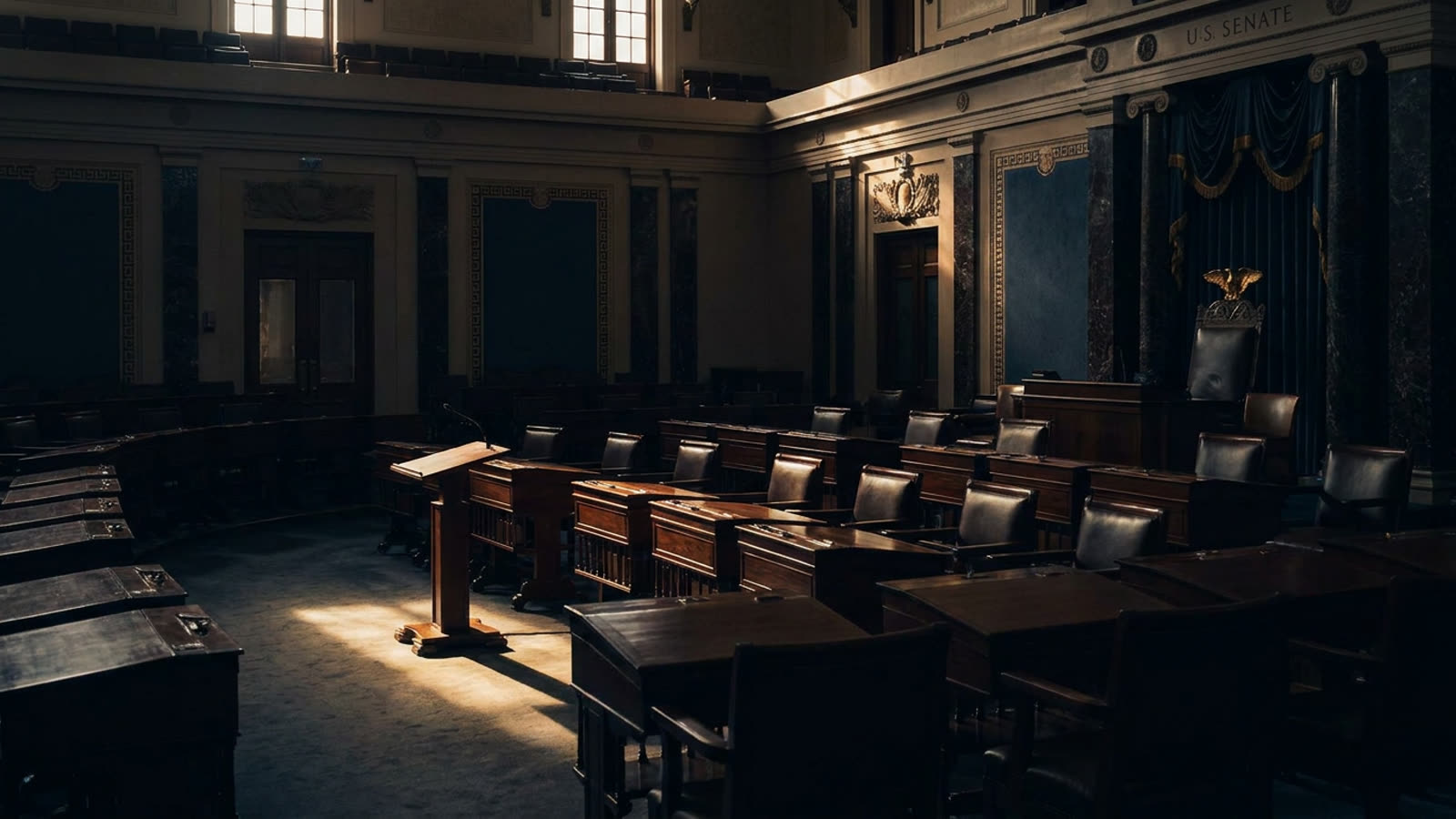
The romantic image persists: a lone senator, hoarse and defiant, reading the phone book through the night to block an unjust law. It makes for good cinema. It bears almost no resemblance to how the filibuster operates in practice.
The modern filibuster is silent, invisible, and devastatingly effective. A senator need not speak a single word. They simply inform their party leadership that they object to proceeding, and the bill in question now requires sixty votes instead of fifty-one to advance. No stamina required. No public spectacle. The obstruction happens off-camera, often without the objecting senator's name appearing in any headline.
The accidental birth of minority rule
The filibuster was never designed. The Constitution says nothing about supermajority requirements for ordinary legislation. In 1806, Vice President Aaron Burr suggested the Senate clean up its rulebook by eliminating the "previous question" motion—a procedural tool that allowed a simple majority to end debate. Burr thought it redundant. He was catastrophically wrong.
Without that tool, any senator could theoretically talk forever, and there was no mechanism to stop them. For decades, this mattered little; the Senate operated on gentlemanly norms. But as the chamber grew more polarized, the loophole became a weapon. In 1917, the Senate created "cloture"—a procedure requiring two-thirds of senators to vote to end debate. That threshold dropped to sixty in 1975. The filibuster had been formalized, and with formalization came normalization.
The silent revolution of the two-track system
The crucial transformation came in the 1970s under Majority Leader Mike Mansfield. Frustrated by filibusters freezing all Senate business, Mansfield invented the "two-track" system: the Senate could set aside a filibustered bill and proceed to other matters. This seemed like a practical reform. It was, in effect, a catastrophe for majority rule.
Under the old system, filibustering was costly. A senator had to physically hold the floor, and their obstruction paralyzed everything else. Colleagues grew furious. Public attention focused. The filibusterer paid a reputational price. Under the two-track system, obstruction became free. A senator could block a bill indefinitely while the Senate conducted other business, and nobody outside Washington would notice. The filibuster went from a dramatic last resort to a routine first move.
The sixty-vote Senate
The numbers tell the story. In the entire nineteenth century, there were fewer than two dozen filibusters. In the 2010s alone, there were hundreds of cloture motions filed—each one an attempt to overcome an actual or threatened filibuster. The Senate has become, in practice, a sixty-vote body for nearly all contested legislation. This is not what the framers intended, not what the rules explicitly require, and not what most Americans understand when they hear that a bill "failed to pass."
The consequences ripple outward. Presidents of both parties have turned increasingly to executive orders, knowing legislation cannot survive the Senate. Judicial confirmations became so contentious that both parties eventually carved out exceptions—first for lower courts, then for the Supreme Court—eliminating the filibuster for nominees while preserving it for laws. The asymmetry is telling: senators will protect their own prerogatives even as they strip them from each other.
Our take
The filibuster survives because it serves every senator's individual interest while undermining the institution's collective purpose. Each senator imagines themselves as the heroic minority, not the frustrated majority. Reform proposals abound—requiring actual floor speeches, lowering the threshold, exempting certain categories of legislation—but they all founder on the same rock: changing Senate rules itself requires sixty votes, or a controversial majority-rules maneuver that senators fear will be used against them someday. The filibuster is a trap of the Senate's own making, and the key was thrown away long ago.