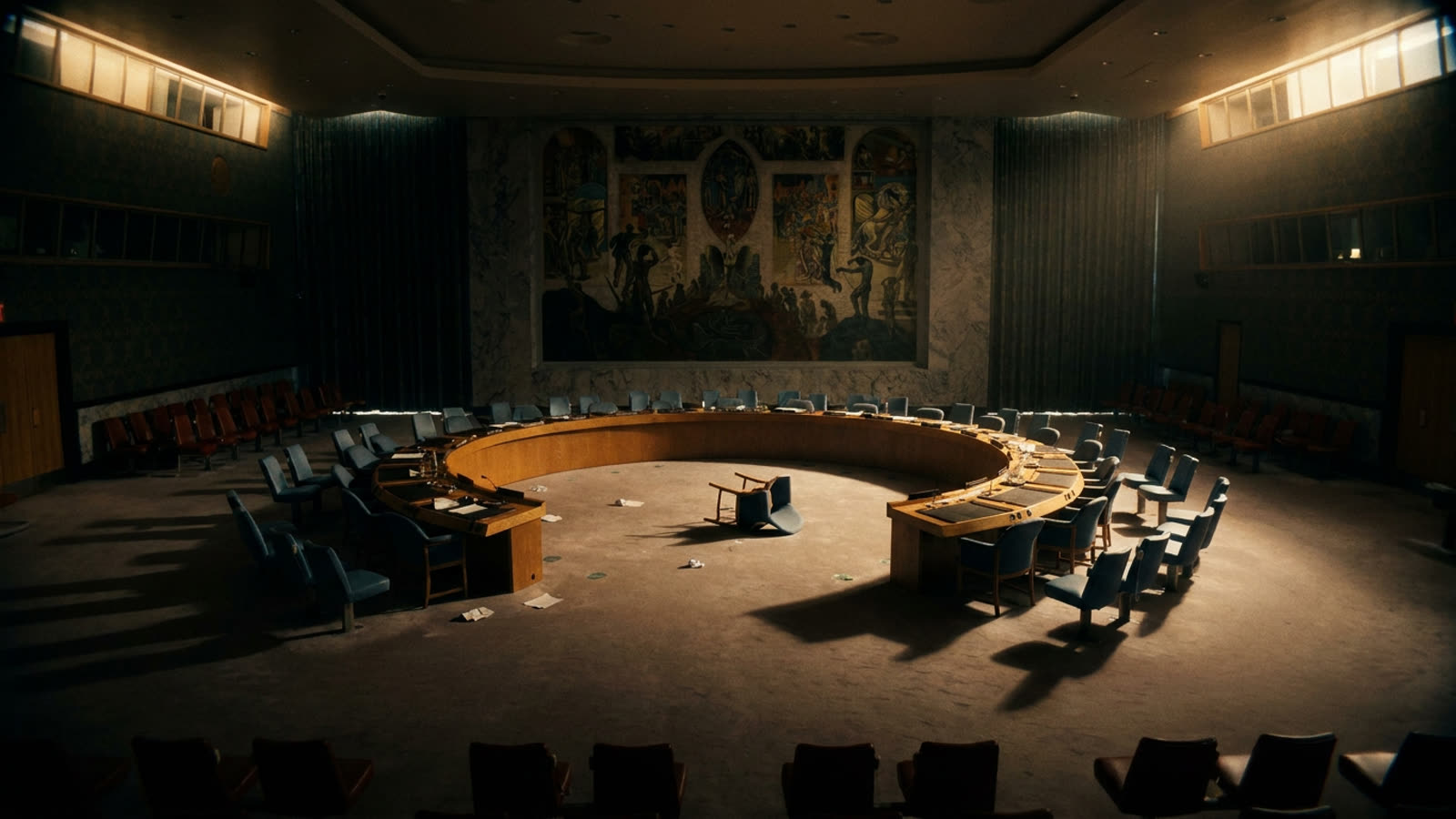
The United Nations Security Council is routinely described as paralyzed, dysfunctional, or obsolete. These criticisms miss the essential truth: the Council was engineered for gridlock. Its architects in 1945 understood that a body capable of authorizing military force against sovereign nations would only function if the most powerful states could never be coerced by it. The veto is not a bug. It is the load-bearing wall.
The five permanent members—the United States, Russia, China, France, and the United Kingdom—emerged from World War II with the capacity to ignore any international institution they disliked. The League of Nations had already demonstrated what happens when great powers walk away. The UN's founders, led by Franklin Roosevelt and Winston Churchill, made a calculated trade: universal legitimacy in exchange for great-power impunity. The P5 would stay in the room precisely because they could never be outvoted on matters touching their vital interests.
The arithmetic of paralysis
The Council has fifteen members, but only the permanent five possess the veto. The ten rotating seats, allocated by regional blocs for two-year terms, provide geographic diversity and the appearance of democratic participation. In practice, any resolution opposed by a single permanent member dies. Russia has used its veto more than fifty times since the Soviet Union's dissolution, frequently to shield Syria and block condemnations of its own military actions. The United States has deployed the veto most often to protect Israel from censure. China, historically more sparing, has grown assertive in recent years.
This structure means the Council can only act decisively when P5 interests align or when none of them cares enough to object. The Korean War authorization in 1950 passed only because the Soviet delegation was boycotting sessions. The Gulf War coalition in 1991 succeeded because Moscow, weakened and seeking Western aid, abstained. These are exceptions that prove the rule.
Why reform never happens
Proposals to expand or restructure the Council surface every decade. Germany, Japan, India, and Brazil have long sought permanent seats. African nations demand representation. Yet any amendment to the UN Charter requires ratification by two-thirds of member states, including all five permanent members. The P5 have no incentive to dilute their privilege. More fundamentally, adding new vetoes would multiply the gridlock, while creating permanent members without vetoes would establish a humiliating second tier.
The Council's critics often propose abolishing the veto entirely, imagining a body that could authorize intervention by majority vote. This fantasy ignores why the institution exists. A Security Council that could mandate action against American, Chinese, or Russian objections would simply be ignored by those states—or worse, would trigger the kind of great-power confrontation the UN was designed to prevent.
Our take
The Security Council is not broken; it is functioning exactly as intended. It provides a forum where nuclear-armed rivals can posture, negotiate, and occasionally cooperate without anyone pretending they are equals to be outvoted. The veto is the price of keeping the dangerous players at the table. Those who demand a more muscular UN should ask themselves whether they truly want an institution empowered to order American soldiers into combat over Washington's objection, or to sanction Beijing without Beijing's consent. The honest answer clarifies why the Council will remain what it has always been: a mirror of power, not a substitute for it.