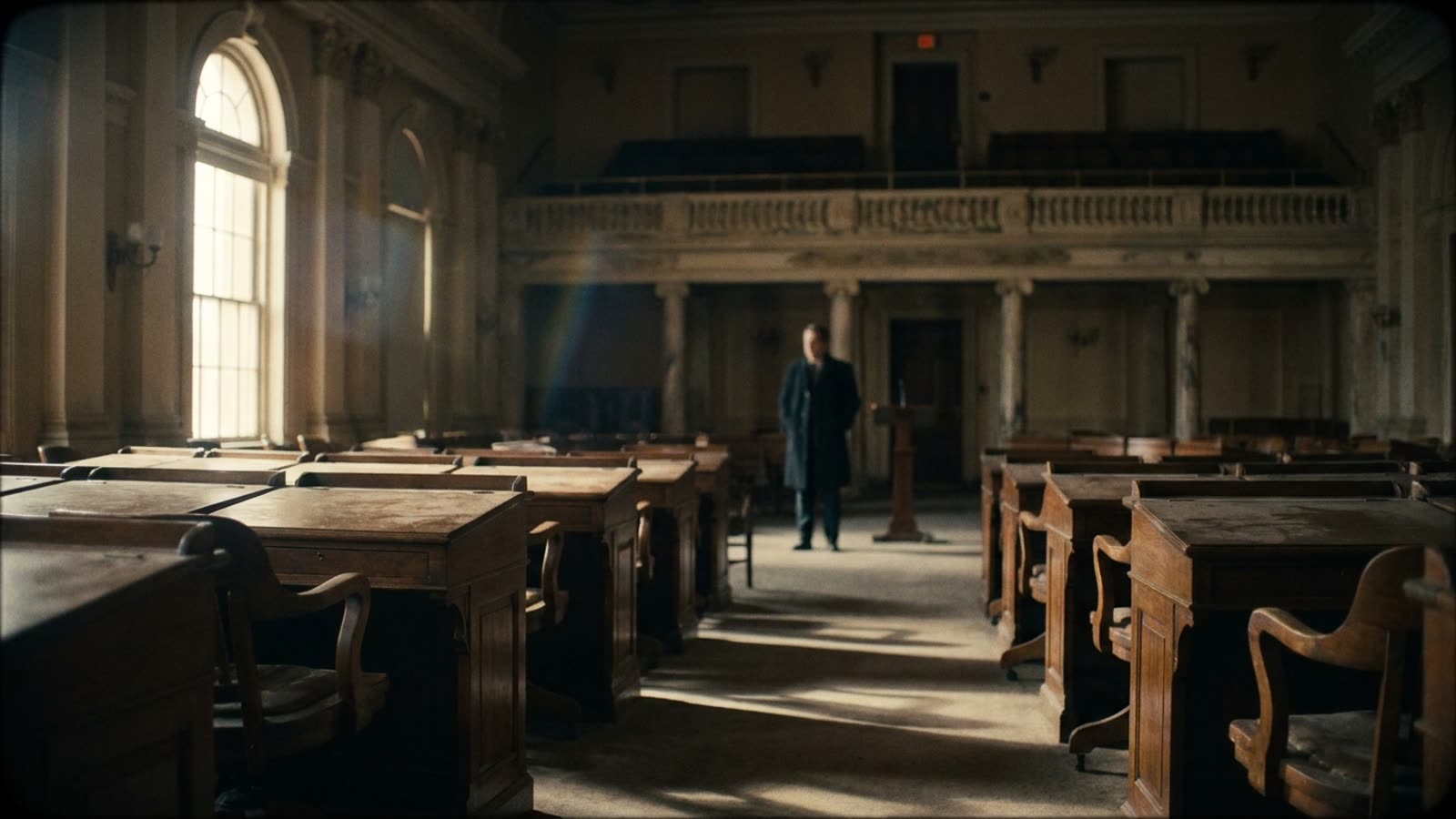
The United States Senate operates under a peculiar fiction: that it is the world's greatest deliberative body, where extended debate refines legislation and protects minority rights. In practice, the modern filibuster has almost nothing to do with debate. It is a silent veto, exercised by email, requiring sixty votes to do almost anything of consequence—and it exists because of an accident.
The Founders never intended it. The original Senate rules included a mechanism called the "previous question motion," which allowed a simple majority to end debate and force a vote. In 1806, Vice President Aaron Burr—fresh from killing Alexander Hamilton and facing treason charges—advised the Senate to clean up its rulebook by eliminating redundant procedures. The previous question motion was struck. No one realized they had just created a loophole that would paralyze American governance two centuries later.
The drift from accident to weapon
For decades, the oversight went unnoticed. Senators occasionally talked at length, but the chamber functioned. The first recognizable filibuster came in 1837, and the tactic remained rare until the twentieth century, when Southern Democrats discovered its utility for blocking civil rights legislation. Between 1917 and 1964, the filibuster was deployed almost exclusively against anti-lynching bills, voting rights, and fair employment laws. The tool of "minority protection" protected one minority interest above all: white supremacy.
The cloture rule, adopted in 1917, allowed two-thirds of senators to end debate. It was weakened to three-fifths—sixty votes—in 1975. But the more consequential change came quietly in the 1970s, when the Senate began allowing "tracking," permitting multiple bills to proceed simultaneously. This meant a senator no longer needed to physically hold the floor to block legislation. The talking filibuster became the silent filibuster: a senator could simply indicate objection, and the majority leader, lacking sixty votes for cloture, would move on. The filibuster transformed from a dramatic last stand into a routine scheduling notation.
The sixty-vote Senate
Today, the practical effect is that nearly all significant legislation requires a supermajority. This is not how parliamentary democracies function, nor how the Founders designed the system. The Constitution specifies supermajority requirements for specific actions—treaty ratification, constitutional amendments, impeachment conviction, veto overrides—implying that ordinary legislation requires only a simple majority. The filibuster inverts this logic, making the exception the rule.
The consequences compound. Presidents of both parties have increasingly governed through executive orders, knowing legislation will die in the Senate. Judicial confirmations became so contentious that both parties eventually carved out exceptions: Democrats eliminated the filibuster for lower-court judges in 2013, Republicans for Supreme Court justices in 2017. The legislative filibuster remains, but its survival owes more to mutual deterrence than principle. Each party fears being in the minority when the other finally abolishes it.
Our take
The filibuster's defenders invoke tradition and deliberation, but the tradition is accidental and the deliberation is fictional. No senator delivers marathon speeches anymore; they send a staffer to register an objection. What remains is a mechanism that rewards obstruction, punishes ambition, and ensures that American governance perpetually disappoints American voters. Whether it survives another decade depends less on constitutional theory than on which party calculates it has more to gain from majority rule. The irony is that a procedure designed by no one, for no purpose, may ultimately be abolished not on principle but on convenience.