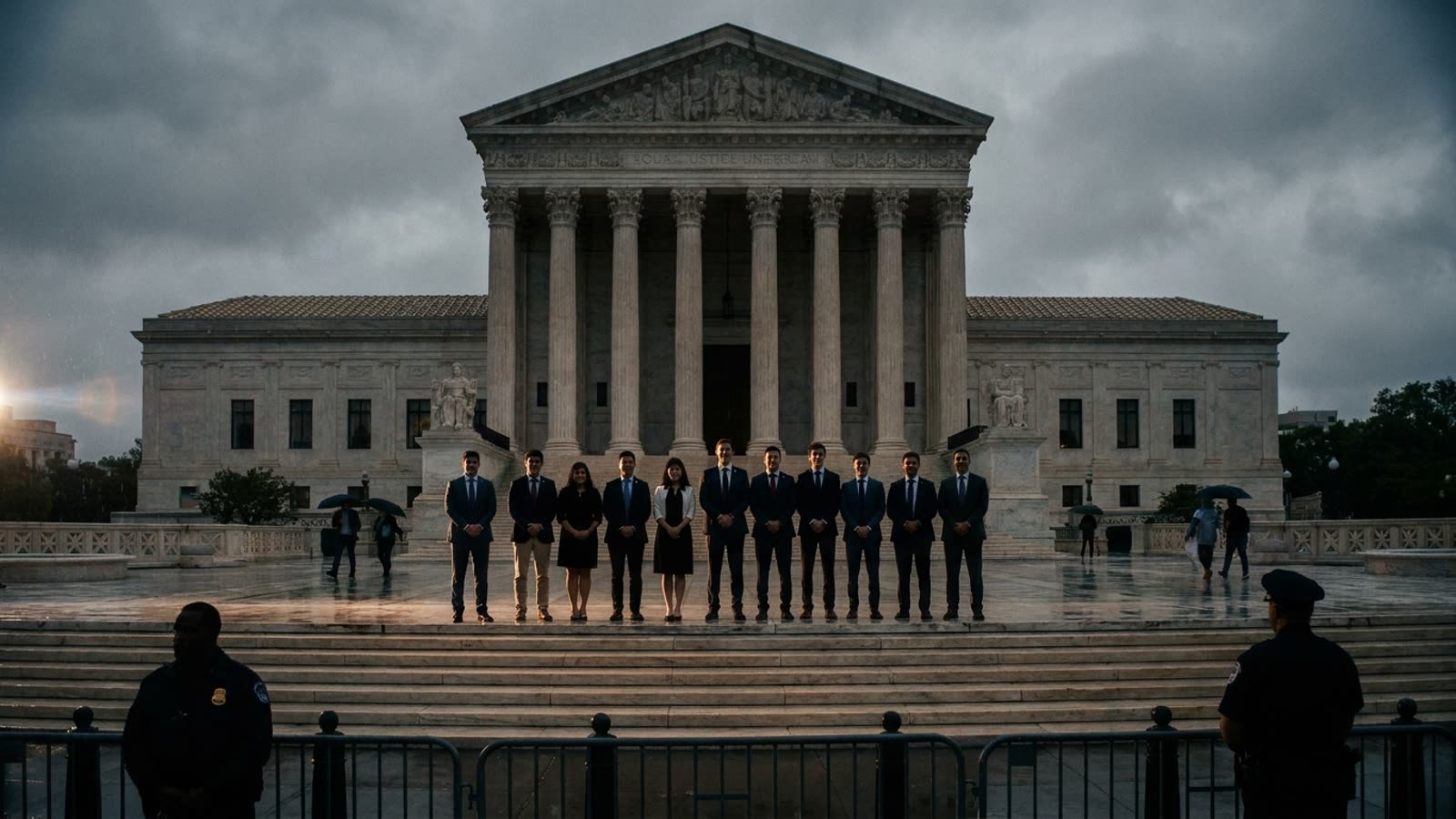
The justices of the United States Supreme Court are nominated by presidents, confirmed by senators, and scrutinized by the press for decades. Their law clerks—the young attorneys who research, draft, and often shape the very opinions that become the law of the land—arrive through a process that resembles nothing so much as a secret society's initiation.
Each justice typically employs four clerks per term, drawn almost exclusively from a handful of elite law schools and a narrow pipeline of feeder judges on the federal appellate courts. These thirty-six or so individuals, most in their late twenties, spend a year wielding influence that career government officials accumulate over lifetimes. They draft bench memos that frame how justices understand cases. They prepare the first drafts of opinions that will be cited for generations. And they do so behind a veil of confidentiality that makes the Pentagon look transparent.
The feeder system and its discontents
The path to a Supreme Court clerkship runs through specific chambers on the D.C. Circuit and a few other appellate courts whose judges have established themselves as reliable talent scouts for particular justices. A clerkship with the right appellate judge is often more determinative than law school grades, law review membership, or any other credential. This creates a system in which a small number of gatekeepers—perhaps a dozen federal judges—effectively control access to the Court's inner workings.
Critics argue this pipeline reproduces ideological and demographic homogeneity. Studies of clerk demographics over the decades show persistent underrepresentation of graduates from non-elite schools, of racial minorities, and until relatively recently, of women. The justices have made intermittent efforts to diversify their chambers, but the feeder system's gravitational pull remains strong.
What clerks actually do
The precise division of labor between justice and clerk varies by chambers and remains one of the Court's most closely guarded customs. Some justices are known to draft their own opinions from scratch; others rely heavily on clerk drafts that undergo revision. What is consistent is the clerk's role in the certiorari process—the selection of which cases the Court will hear from the thousands of petitions filed each year. Most justices participate in a "cert pool" in which clerks divide up petitions and write memoranda recommending whether to grant review. A single clerk's assessment can determine whether a case ever reaches the justices' conference.
Former clerks describe the experience as intellectually intoxicating and professionally transformative. It is also, by design, temporary. After one year, clerks disperse to law firm partnerships, academic positions, and government roles, carrying with them relationships and knowledge that shape careers for decades.
The confidentiality compact
Unlike other branches of government, the Court operates under no freedom of information regime. Clerks sign no formal confidentiality agreements—the obligation is understood as a matter of honor and professional survival. Those who have broken the code, most notably through leaks to journalists or in tell-all accounts, have faced professional ostracism. The leaked draft opinion in the Dobbs case several years ago represented a breach so unusual that it prompted an internal investigation, though no leaker was ever publicly identified.
This secrecy serves institutional purposes: it allows justices to deliberate candidly and change positions without political consequence. But it also insulates the clerk system from the accountability that governs virtually every other exercise of federal power.
Our take
The Supreme Court clerkship is American meritocracy's most refined contradiction—a position of immense influence allocated through networks of patronage and prestige that would make a Gilded Age railroad baron nod approvingly. The clerks themselves are almost certainly brilliant and hardworking. The system that selects them is almost certainly narrower than it needs to be. In a democracy that demands transparency from every other powerful institution, the Court's inner chambers remain a monastery. The robes may be black, but the pipeline is invisible.