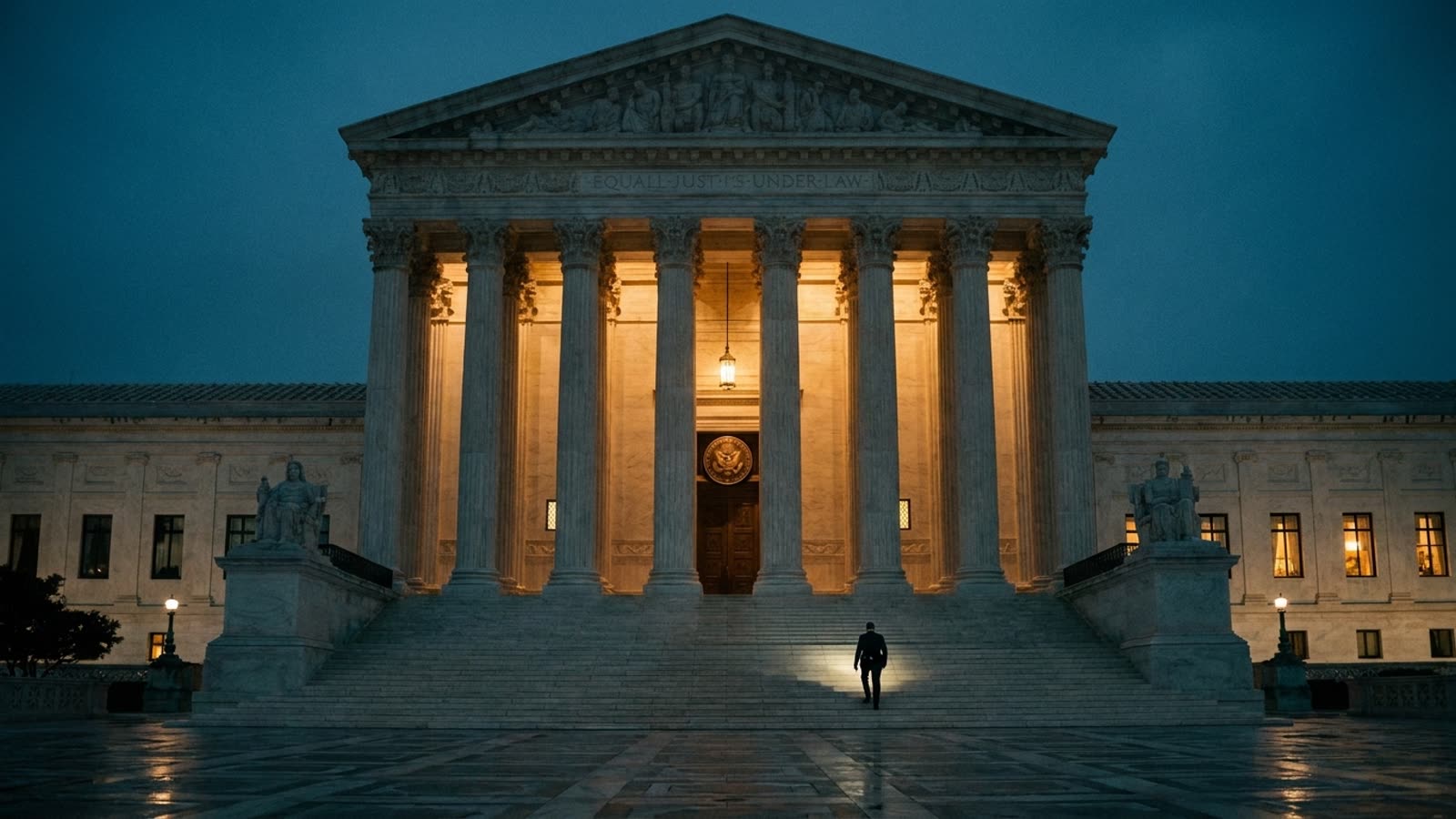
The most powerful court in the world operates like a nineteenth-century gentleman's club, and that anachronism explains more about American jurisprudence than any legal doctrine.
When the nine justices of the United States Supreme Court gather in their private conference room to decide cases, no clerks attend. No recordings exist. No minutes are taken. The junior justice—currently the most recently confirmed member—sits nearest the door and is responsible for answering any knock, passing notes to staff, and ordering lunch. This tradition persists regardless of the junior justice's age, prestige, or prior judicial experience. It is a small humiliation designed to reinforce institutional hierarchy over individual ego.
The conference ritual
The Chief Justice speaks first on every case, framing the issues and stating a tentative position. Then discussion proceeds in strict order of seniority, with each justice speaking once before anyone speaks twice. This protocol prevents senior justices from dominating through sheer verbal persistence and gives newer members guaranteed floor time. The vote follows the same seniority order. By the time the junior justice casts a ballot, the outcome is usually determined—yet their vote still matters for the margin, which affects how broadly the opinion can be written.
If the Chief Justice is in the majority, the Chief assigns who writes the opinion. If not, assignment falls to the senior associate justice in the majority. This power is enormous. A Chief Justice can assign a controversial case to a moderate colleague to produce a narrower ruling, or keep it personally to make a statement. Strategic assignment has shaped landmark decisions for generations.
The draft wars
Once assigned, the opinion author circulates a draft. Other justices in the majority may request changes as the price of their continued support. A justice threatening to write a concurrence—agreeing with the result but not the reasoning—can fracture the majority's legal authority. Dissenters, meanwhile, write to history: their arguments become ammunition for future litigants seeking to overturn precedent. Some dissents, like those that eventually undermined Plessy v. Ferguson, wait decades for vindication.
The process is slow by design. Cases argued in October may not produce opinions until June. Justices trade drafts, negotiate language, and occasionally switch sides entirely. The public sees only the final product; the internal deliberation remains sealed, revealed only when justices' papers are donated to archives years after their deaths.
Why the secrecy endures
The Court's opacity serves a function. Unlike legislators who must answer to voters, justices derive legitimacy from the perception that they reason from law rather than politics. Exposing the sausage-making—the horse-trading, the personal tensions, the strategic calculations—would undermine that mythology. Whether the mythology is healthy for democracy is another question. Critics argue that lifetime appointments and sealed deliberations create an accountability vacuum; defenders counter that insulation from public pressure is precisely what allows unpopular but constitutionally correct rulings.
Our take
The Supreme Court's rituals are not quaint relics—they are power structures disguised as etiquette. The seniority system, the assignment prerogative, the enforced silence: each shapes outcomes as surely as any legal argument. Understanding the Court requires looking past the robes to the room where the junior justice answers the door.