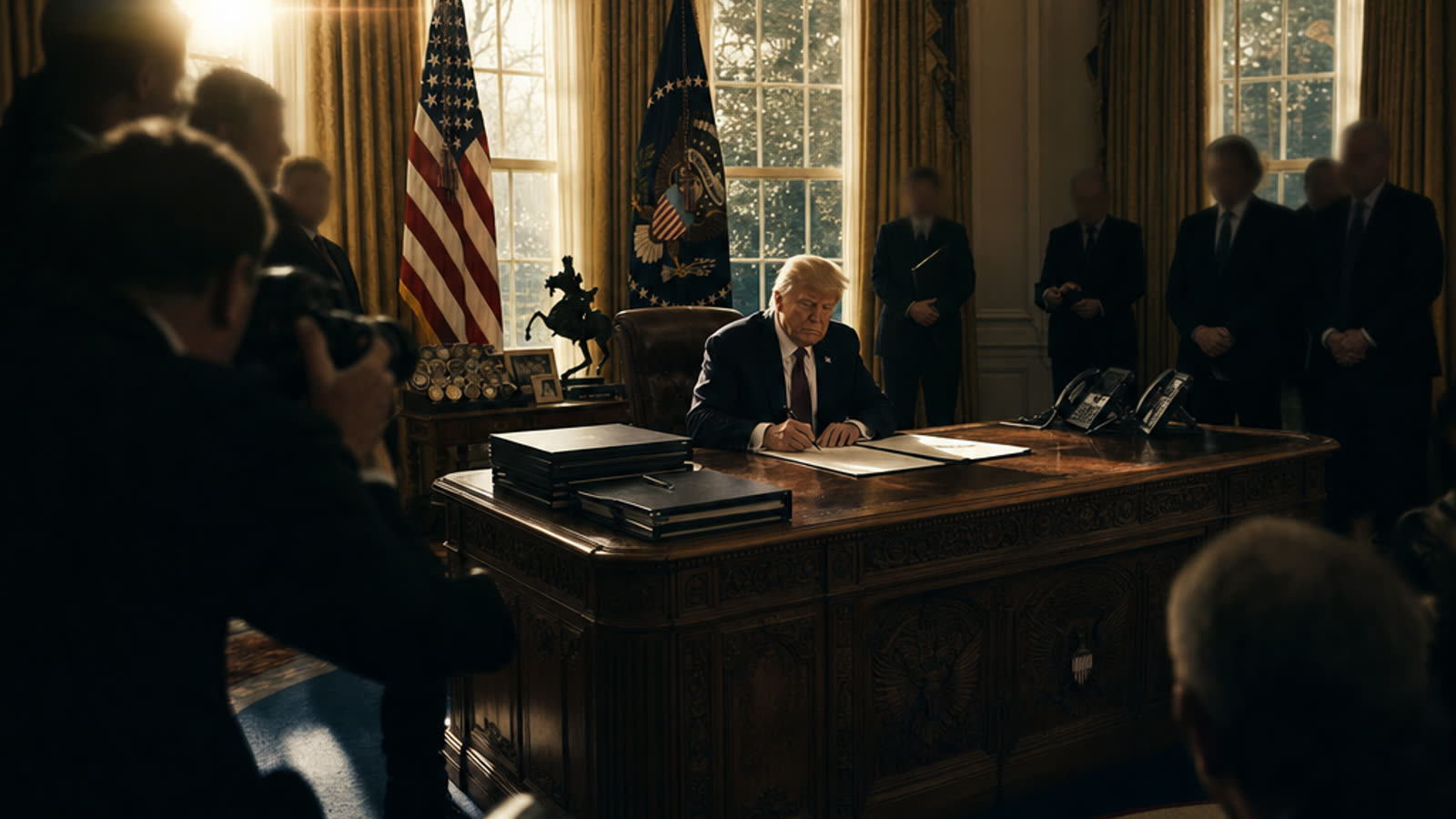
Every incoming American president stages the same ritual: seated at the Resolute Desk, pen in hand, signing a stack of executive orders while cameras click. The imagery suggests monarchical authority—a sovereign's signature transforming policy with a flourish. The reality is considerably messier, and considerably more interesting.
Executive orders occupy a peculiar space in American governance. They are not mentioned in the Constitution. They cannot create new law. Yet they have been used to desegregate the military, intern Japanese Americans, and reshape immigration enforcement. Understanding what executive orders actually are—and what they cannot do—reveals something essential about how American power really operates.
The constitutional ghost
The Constitution grants the president "executive power" and instructs that they "take care that the laws be faithfully executed." From these spare phrases, an entire architecture of presidential directives has emerged. Executive orders are, in theory, simply instructions from the president to the executive branch about how to implement existing law. They are managerial memos with constitutional pretensions.
The key limitation is that executive orders must be tethered to some source of authority—either a power granted by the Constitution or one delegated by Congress through statute. A president cannot order the Treasury to mint trillion-dollar coins or direct the military to invade Canada simply by signing a document. The order must connect, however tenuously, to pre-existing legal ground.
This tethering requirement explains why executive orders are so vulnerable to reversal. What one president orders, the next can un-order. The back-and-forth on regulations governing everything from offshore drilling to federal contractor wages reflects not presidential whim but structural reality: orders built on delegated authority can be rebuilt by the next occupant of the office.
The theater of day one
Modern presidents have transformed the executive order into performance art. The first-day signing ceremony has become obligatory, a visual assertion of mandate. Yet many of these orders are either symbolic (directing agencies to "review" policies) or simply reverse the previous administration's orders (which themselves reversed the orders before them).
The performative quality obscures a genuine tension. Presidents increasingly reach for executive orders precisely because legislative action has become so difficult. When Congress cannot or will not act, the executive order offers a workaround—temporary, fragile, but immediate. This dynamic has accelerated across administrations of both parties, creating a ratchet effect where each president expands the boundaries of unilateral action.
The courts as referee
Executive orders are not self-executing magic. They can be challenged in court, blocked by injunction, and ultimately struck down. Federal judges have invalidated orders on immigration, environmental regulation, and federal employment policy. The judiciary serves as a check, though an imperfect one—litigation takes years, and by the time a definitive ruling arrives, the political moment may have passed.
Congress, too, retains theoretical authority to override executive orders through legislation. In practice, this requires veto-proof majorities, making congressional reversal rare. The result is a system where executive orders exist in a state of constitutional uncertainty, valid until challenged, permanent until reversed.
Our take
The executive order is neither the tyrannical instrument its critics fear nor the transformative tool its champions celebrate. It is a workaround—a pressure-release valve for a system where legislative gridlock has become the default. The real story is not presidential overreach but congressional dysfunction. When the branch designed to make law cannot function, the branch designed to execute law inevitably expands to fill the vacuum. Executive orders are a symptom, not the disease.