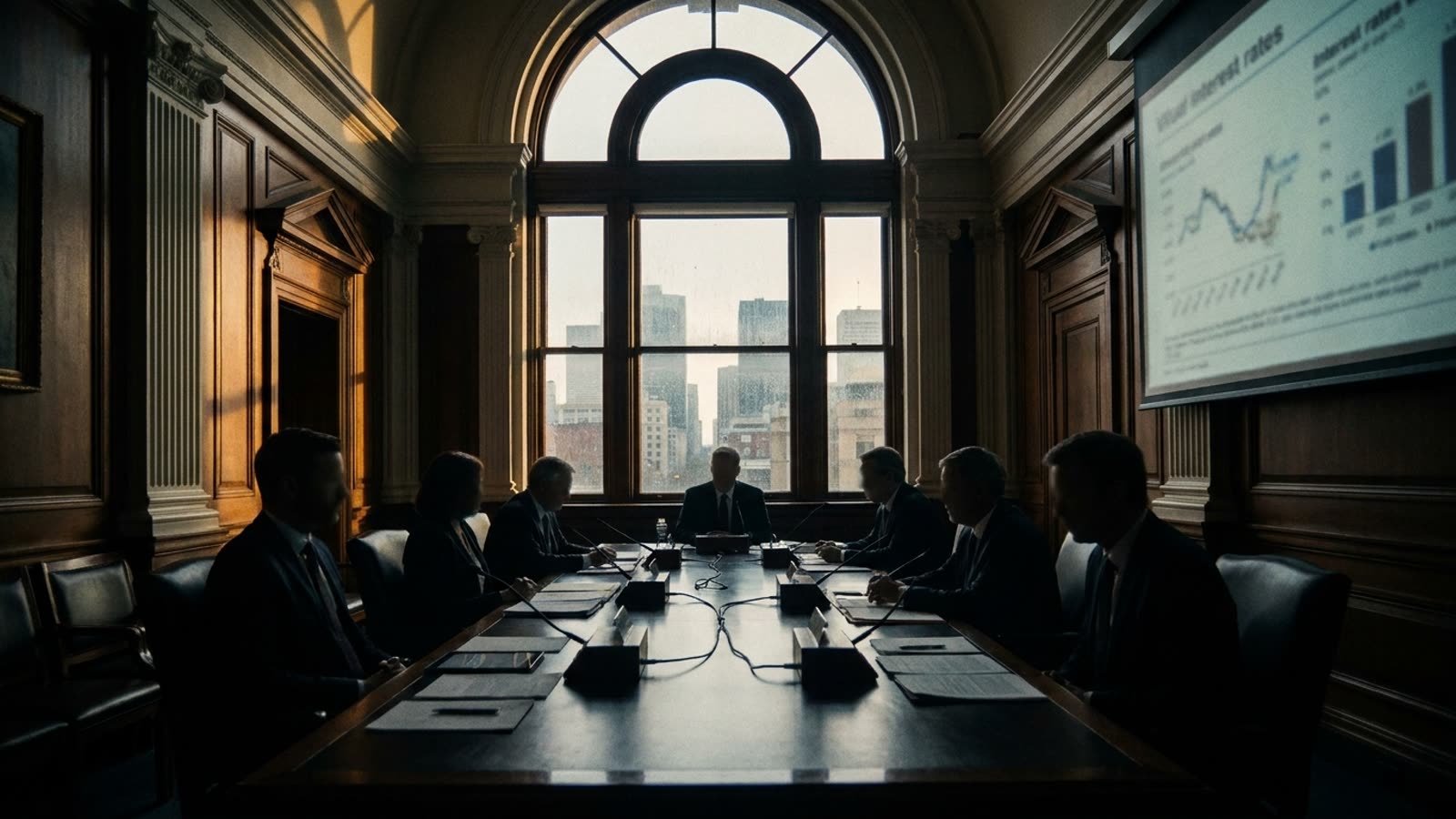
The most consequential economic decisions in the world are made by small groups of people sitting around conference tables, armed with binders of data and competing theories about how money works. Central bank monetary policy committees — the Federal Reserve's FOMC, the European Central Bank's Governing Council, the Bank of England's MPC — wield extraordinary power with remarkably little democratic accountability. Understanding how they actually function reveals much about the strange architecture of modern capitalism.
The process is neither as scientific as central bankers suggest nor as arbitrary as their critics claim. It is, instead, a carefully managed exercise in collective judgment under uncertainty.
The information funnel
Weeks before each rate decision, staff economists at major central banks begin assembling what amounts to a probabilistic portrait of the economy. At the Federal Reserve, this takes the form of the Tealbook, a confidential document running to hundreds of pages that synthesizes employment data, inflation readings, financial conditions, and global developments into baseline forecasts and alternative scenarios.
Committee members receive this material alongside their own regional intelligence. Fed governors hear from business contacts across their districts; ECB members bring perspectives from economies as different as Germany and Greece. The asymmetry of information is deliberate — it forces genuine deliberation rather than rubber-stamping staff recommendations.
What outsiders often miss is how much the discussion concerns not current conditions but the transmission mechanism: how long rate changes take to affect hiring, spending, and prices. These lags, estimated anywhere from six to eighteen months, mean committees are essentially steering by looking in the rearview mirror while guessing at the road ahead.
The choreography of dissent
Voting records suggest central bank committees reach consensus with remarkable frequency. This appearance of unanimity is largely manufactured. Chairs and presidents engage in extensive pre-meeting consultations, sounding out colleagues and adjusting proposals to secure comfortable majorities. Genuine surprises in the vote count are rare because they represent failures of internal management.
Dissent, when it occurs, serves strategic purposes. A hawkish dissent signals to markets that the committee considered tighter policy; a dovish one suggests the opposite. Chairs sometimes welcome dissents that bracket their preferred position, making it appear moderate by comparison. The Bank of England's MPC, with its tradition of more frequent split votes, offers a messier but arguably more honest picture of genuine disagreement.
Forward guidance as performance
The rate decision itself is often less important than the accompanying statement and press conference. Central bankers have learned that expectations about future policy matter as much as current settings — a thirty-year mortgage rate depends not on today's overnight rate but on where markets believe rates will be over the loan's life.
This has transformed monetary policy into a form of strategic communication. Every word in the statement is negotiated. The shift from "patient" to "data-dependent" becomes front-page news. Press conferences feature carefully rehearsed answers designed to move markets in intended directions without committing to specific actions.
The result is a peculiar institution: unelected technocrats making binding decisions about the cost of money for entire economies, accountable primarily through the credibility of their inflation-fighting reputation. It works, when it works, because markets believe central banks will do what they say.
Our take
The mystique surrounding central banking serves a purpose — it insulates difficult decisions from short-term political pressure. But it also obscures how much monetary policy involves educated guessing rather than precise calibration. The committees that set rates are staffed by intelligent people working with imperfect models and incomplete data, making consequential choices under genuine uncertainty. The confidence projected in press conferences is itself a policy tool. Citizens would benefit from understanding that the people controlling their economic destiny are, in the end, just people — thoughtful ones, but navigating the same fog as everyone else.