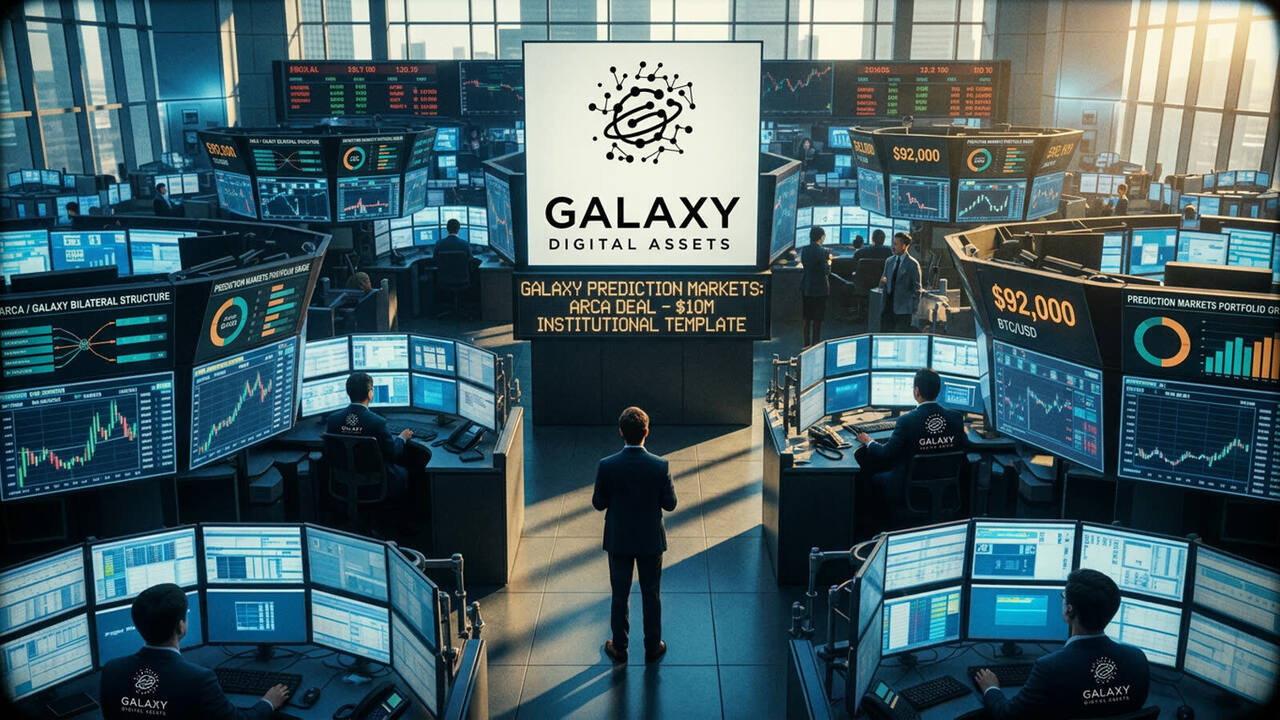
For years, prediction markets have occupied an awkward middle ground in finance: too interesting to ignore, too legally fraught to touch. Galaxy Digital's $10 million trade with Arca may have just ended that ambiguity.
The transaction, executed as a bilateral structured product rather than a direct platform bet, represents the first major institutional deployment into prediction market exposure. Galaxy and Arca—both established crypto asset managers—structured the deal to provide Arca with synthetic exposure to prediction market outcomes while Galaxy takes the other side, earning a spread for its market-making role. The mechanics matter less than the signal: two regulated entities have found a compliant pathway into a market that traditional finance has studiously avoided.
Why now, and why this way
The timing is not accidental. Kalshi's recent regulatory victories—including approval for Bitcoin perpetuals and expansion into altcoin products—have normalized prediction markets in ways that seemed impossible two years ago. Polymarket's explosive growth during the 2024 election cycle demonstrated genuine price discovery capabilities. And the CFTC's evolving posture has shifted from hostility to cautious engagement.
But direct institutional participation remains constrained. Most prediction platforms lack the custody infrastructure, counterparty agreements, and regulatory clarity that institutional mandates require. Galaxy's solution—wrapping prediction market exposure in a bilateral derivative structure—sidesteps these obstacles entirely. The trade never touches a prediction market platform directly; it simply references the outcomes.
The template emerges
This is how new asset classes typically enter institutional portfolios: not through direct participation, but through structured products that translate exotic exposures into familiar formats. Credit default swaps did this for corporate credit risk. Variance swaps did it for volatility. Galaxy is now doing it for information markets.
The implications extend beyond crypto. Prediction markets have demonstrated superior forecasting accuracy for everything from election outcomes to economic data releases to geopolitical events. If institutions can access this information through compliant structures, the demand could be substantial. Galaxy is positioning itself as the prime broker for a market that barely existed at institutional scale six months ago.
Our take
The $10 million figure is modest by institutional standards—a proof of concept, not a market-moving allocation. But the architecture matters more than the size. Galaxy has demonstrated that prediction market exposure can be packaged, priced, and delivered through conventional bilateral channels. That template will be copied. Within eighteen months, expect to see prediction market structured products from traditional prime brokers, not just crypto-native firms. The information market is becoming a market.