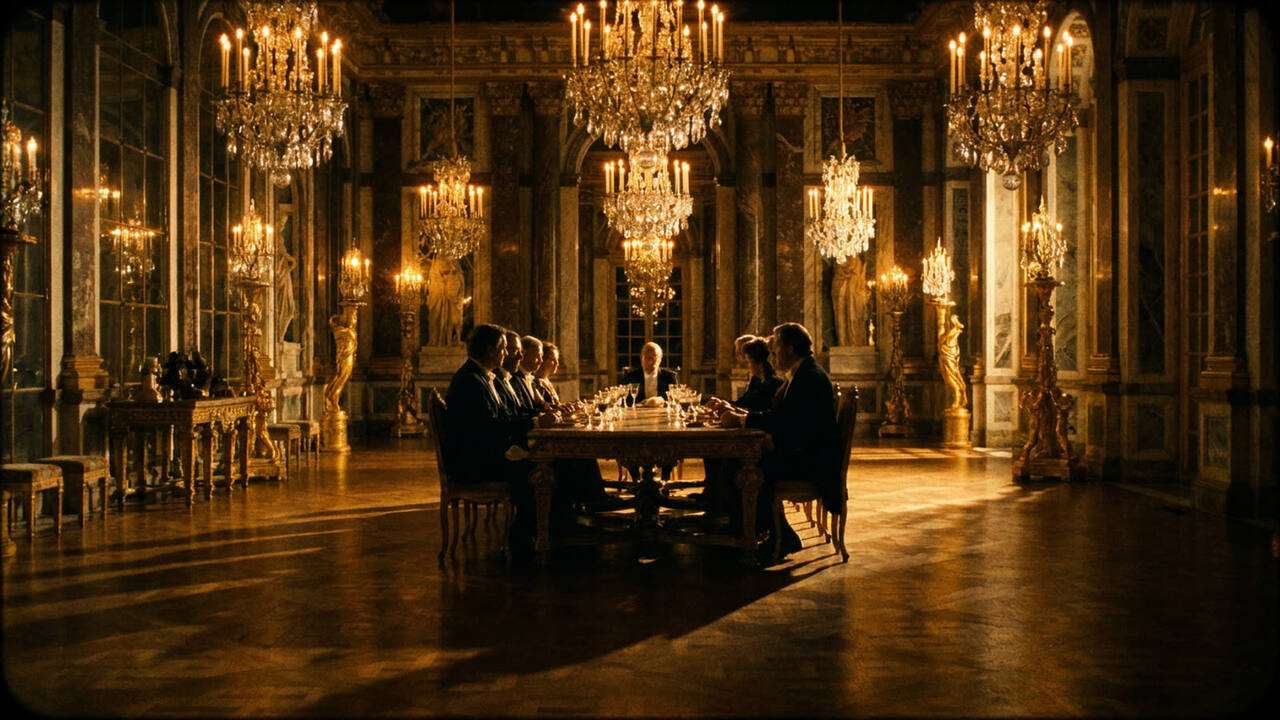
The setting told you everything you needed to know about the priorities at play. On Tuesday evening, President Trump sat down at the Palace of Versailles—the Hall of Mirrors, naturally—to sign a ceasefire agreement with Iran. The chandeliers glittered. The cameras rolled. And somewhere in the fine print, a war that depleted American weapons stockpiles and rattled global oil markets was declared, at least temporarily, over.
The substance of the agreement remains murky. Iran retains its enrichment capabilities. The United States gets a pause in hostilities and a photo opportunity that will dominate campaign materials for years. Whether this constitutes victory depends entirely on what you thought the war was about in the first place.
The imagery economy
Trump has always understood that in modern politics, the picture is the policy. Versailles—synonymous with French grandeur, the humiliation of Germany after World War I, and the kind of baroque excess that photographs beautifully—was not chosen by accident. The G7 summit in the French Alps provided the backdrop; the palace provided the iconography.
The president's critics have already surfaced his 2020 quote that Iran "never lost" a negotiation with the United States. His defenders note that actually stopping a shooting war, even on imperfect terms, is more than his predecessors managed. Both observations can be true simultaneously. The deal may indeed be, as CNN's analysis suggests, "a dud" in terms of lasting strategic gain. But lasting strategic gain was never really the metric.
What the agreement actually does
The ceasefire halts active hostilities but leaves the fundamental architecture of the conflict intact. Iran's nuclear program continues under international monitoring that Tehran has historically treated as a suggestion. American forces in the region remain on elevated alert. The weapons production that Trump invoked the Defense Production Act to accelerate will continue—the stockpiles need replenishing regardless of whether peace holds.
The deal's most consequential provision may be its ambiguity. Trump explicitly reserved the right to "resume attacks" if conditions warrant, which could mean anything from a genuine Iranian provocation to a slow news week in an election year. This is diplomacy as option value: the president gets credit for ending a war while retaining the ability to restart it.
The domestic calculus
Back home, the agreement lands in a political environment primed to receive it favorably. War fatigue is real. Gas prices, while stabilizing, remain a sore point. A president who can claim he both started and ended a conflict—on his terms, at Versailles, in time for the evening news—has a compelling narrative regardless of the policy merits.
The G7 leaders, for their part, offered the diplomatic equivalent of polite applause. They need American engagement on Ukraine, on China, on critical minerals. If praising Trump's Iran deal is the price of that engagement, it's one they'll pay with minimal internal complaint.
Our take
The Versailles signing will be remembered long after the agreement's specific provisions are forgotten—which is precisely the point. Trump has always been a creature of spectacle, and this was spectacle executed at the highest possible level. Whether it constitutes good foreign policy is a question for historians. Whether it constitutes effective politics is not really a question at all.