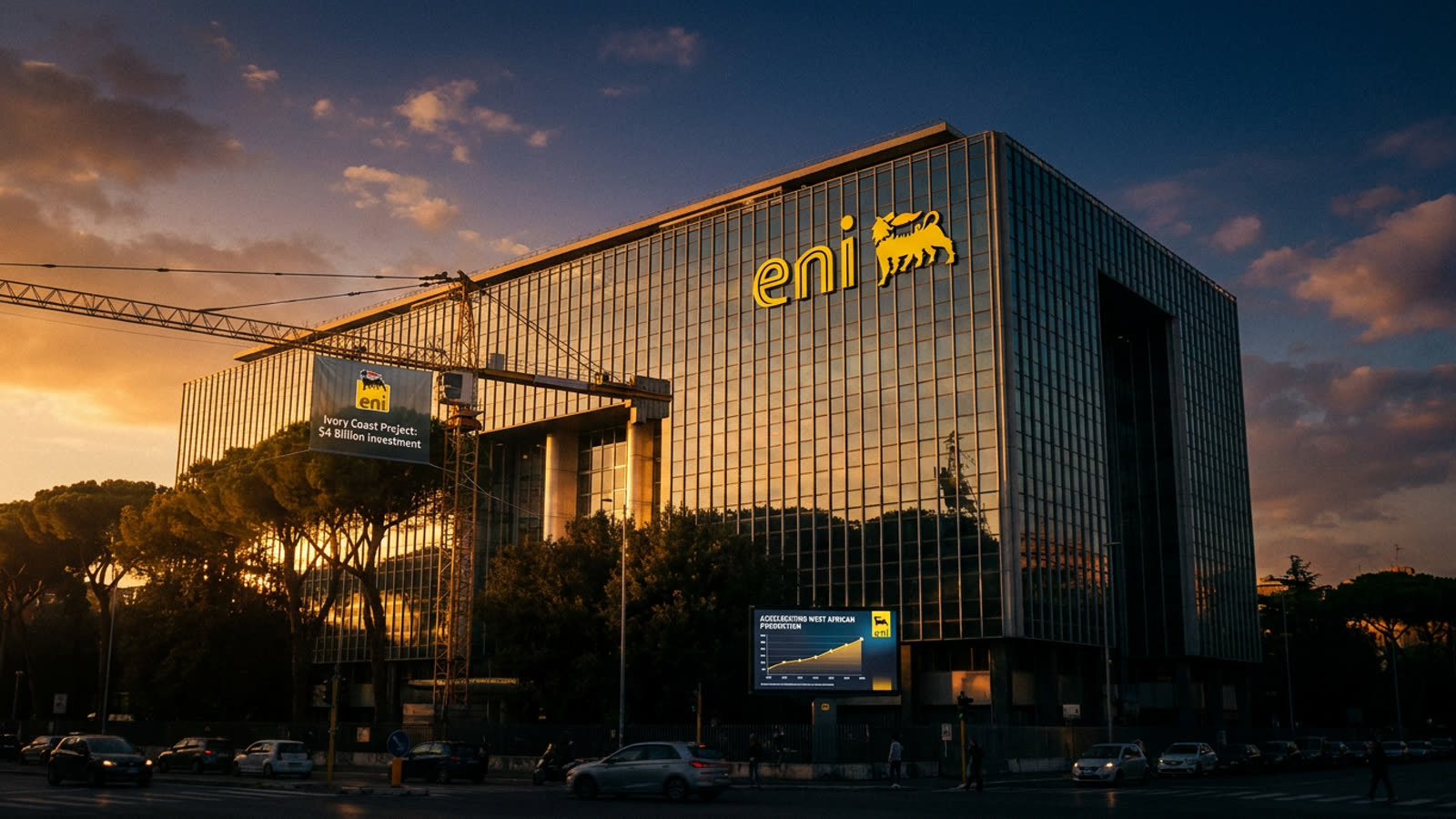
The gap between what European energy policy says and what European energy companies do has never been wider. Eni, Italy's state-influenced oil giant, is now pushing to accelerate a $4 billion expansion in Ivory Coast—a bet that African crude will remain indispensable for decades, regardless of what climate communiqués might suggest.
The project, centered on the Baleine offshore field discovered in 2021, represents one of the largest hydrocarbon investments in West Africa this decade. Eni wants to speed up development timelines, a decision that speaks louder than any sustainability report.
The African pivot nobody discusses
While Shell and BP have trimmed exploration budgets and issued net-zero pledges, Eni has quietly become the most active European major in sub-Saharan Africa. Ivory Coast is the latest chapter in a strategy that spans Mozambique, Angola, Nigeria, and Libya. The logic is straightforward: African fields offer lower development costs, lighter regulatory burdens, and governments eager for revenue.
For Ivory Coast specifically, the Baleine discovery was the country's first major deepwater find. Eni moved from discovery to first oil in under three years—a pace that would be impossible in the North Sea or Gulf of Mexico. The company is now targeting production capacity that could transform Ivory Coast into a meaningful regional producer.
Europe's energy hypocrisy, quantified
The timing is instructive. European Union policy nominally discourages new upstream investment. The European Investment Bank no longer funds fossil fuel projects. Yet Eni—whose largest shareholder remains the Italian state—faces no meaningful domestic pressure to abandon African expansion.
This reflects a broader reality: European energy security still depends on hydrocarbons, and the continent would rather those hydrocarbons come from friendly African states than from Russia or the volatile Gulf. The Iran war has only reinforced this calculus. When Hormuz shipping looked vulnerable, African crude suddenly seemed like portfolio insurance.
What Eni knows that activists don't
Eni's management is betting that global oil demand won't peak until well into the 2030s, and that even in decline scenarios, the last barrels standing will be the cheapest ones. African offshore fields—with their relatively low lifting costs and minimal decommissioning liabilities—fit that profile.
The company has also learned from peers' mistakes. BP's aggressive pivot toward renewables produced neither the returns nor the stock-price premium that management promised. Shell's strategic ambiguity pleased nobody. Eni, by contrast, has been unapologetically hydrocarbon-focused while maintaining just enough green window-dressing to avoid ESG exclusion lists.
Our take
Eni's Ivory Coast acceleration is the energy transition's most honest corporate signal. While competitors issue press releases about hydrogen and carbon capture, the Italians are writing $4 billion checks for oil fields that will produce for thirty years. They may be wrong about demand trajectories, but they're at least being consistent. The real question is whether European policymakers will ever reconcile their stated goals with the investments their own national champions keep making. So far, the answer is a comfortable shrug.